World prepares for life beyond 1.5C as COP31 delivers no political agreement
The longest climate summit in United Nations history has ended without its central political agreement, as divisions over fossil fuels and finance exposed the fragility of international cooperation.
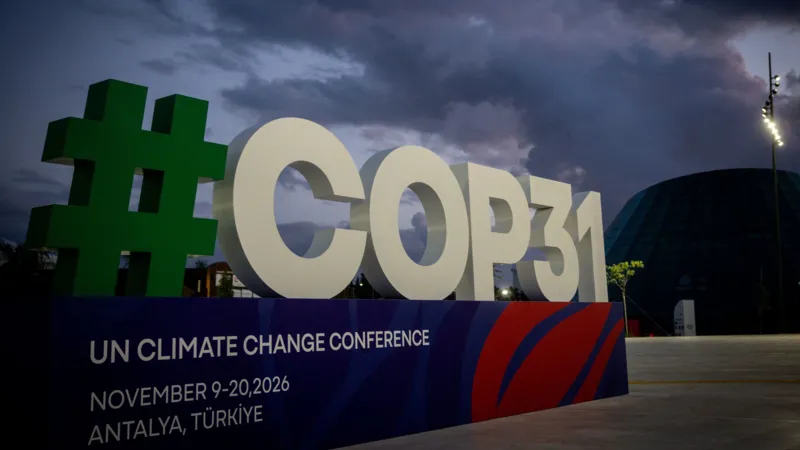
The COP31 summit in Turkey concluded on Sunday without delivering the Antalya Pacts, the central political agreement that hosts Australia and Turkey had hoped would define an "implementation COP". It was the longest-running climate conference in UN history, and it ended in failure.
Evidence of climate change could scarcely have been clearer in 2026. Glacier collapses, record European heat and wildfires across Asia provided a dramatic backdrop to negotiations. Geopolitical divisions could scarcely have been deeper.
The final day was dramatic and fractious. Countries walked out over the absence of any mention of fossil fuels in the negotiating text and over unresolved questions of money. Australia and Turkey, joint hosts of the talks, could not bring nations together despite leading the charge. Questions are now being asked more loudly than ever before about whether the COP process can still deliver.
This was the first summit since the UN warned that global temperatures are expected to exceed 1.5C above pre-industrial levels, the threshold countries agreed not to breach under the Paris Climate Agreement signed in 2015. The draft agreement had acknowledged the uncomfortable reality that climate action to date has failed on its most crucial target. Without agreement, that recognition has been lost.
Almost exactly a decade ago, the Intergovernmental Panel on Climate Change warned what would happen if temperatures rose by 1.5C rather than 2C. Sea level rise would be 10cm higher, exposing 10 million more people to flooding. The ocean would become more acidic, risking irreversible damage to some marine life. Extreme heat would intensify in every inhabited part of the world.
Throughout the talks, many countries still acknowledged that the target remained their north star. Miatta Fahnbulleh, the UK Energy Secretary, said at the close of proceedings that the summit had sought to confront hard truths. The draft had called for any overshoot of 1.5C to be kept as small and short-lived as possible. It also suggested carbon dioxide removal, a process that takes greenhouse gases out of the atmosphere and which has not been explicitly mentioned in a COP final agreement before.
This year's negotiations exposed a troubling problem: consensus does not last forever. On the Antalya Pacts, countries could not bridge the divide on including language on fossil fuels, despite the very same pledge having been made just three years ago at COP28 in Dubai. Rich nations also failed to put a figure to how much more money could be given to developing countries to adapt to climate change, despite a commitment last year to triple the figure by 2035 from $40bn. The interpretation of that pledge remains contested.
If governments cannot even agree to reaffirm commitments they have already made, it raises troubling questions about their ability to work together as the climate crisis intensifies. Chris Bowen, the Australian minister who co-led the negotiations, pointed out that the world is a very different place from when these commitments were struck. He described the situation coming into the summit as the most complicated and fraught geopolitical environment in living memory.
That was made apparent during the final meeting. Darragh O'Brien, the EU representative, said the talks had been hijacked by some oil states. Sergei Kononuchenko, the Russian delegate, switched from Russian to English to directly address the EU delegation, accusing it of providing climate finance only in the form of loans to developing nations. It is a serious blow not just to climate action but to multilateralism itself, the idea that countries can put aside their differences on other issues to tackle problems they cannot solve alone.
Much of the coverage of COP31 has focused on the failure to get the central political agreement passed. But much of the work at these summits goes into putting into action agreements made at previous meetings. On money going towards adaptation, for example, countries need to agree how it is being distributed, whether it is making an impact and how this can be tracked. There were 164 other items on this year's agenda being thrashed out in the negotiating rooms, and some of those were agreed.
The funds raised from a global system of carbon credits will go towards helping developing countries adapt to the impacts of climate change. Countries agreed to advance a just transition framework designed to protect workers and communities as global economies shift toward clean energy. But many more items could not be agreed and some will now be picked up at COP32, including crucially the work programme responsible for driving forward action on cutting emissions.
What governments agree in the negotiating rooms is only part of what determines the speed of the energy transition. The International Energy Agency's latest World Energy Outlook points to another powerful force: energy security. It says the disruption to oil and gas supplies through the Strait of Hormuz has been the biggest energy supply shock in history. The longer the uncertainty continues, the stronger the incentive for countries to switch from imported fossil fuels to electricity generated at home.
The economics have been changing too. Solar panels, batteries and electric vehicles have become increasingly competitive. As clean energy develops its own commercial momentum, formal negotiations may become less important in determining its direction and pace. Against the headwinds of inflation, new investment announcements emerged at COP as part of the Action Agenda, the part of the process that tries to mobilise action outside formal talks from businesses, investors and cities. This year the focus was on electrification.
Fatih Birol, head of the IEA, told the BBC that the world had arrived at the age of electricity, and that energy security and climate policies are now closely aligned. That does not make COP irrelevant. Governments still have a crucial role in facilitating the transition, according to Dr Jennie Dodson, a senior director at the World Business Council for Sustainable Development. She said a key message from business is that companies can go so far, and a lot of it is cost competitive, but there are policy barriers around infrastructure and permitting.
COP31 has shown how the role of these annual conferences is changing. For the first 30 COPs, the emphasis was on building the international framework for tackling global warming. The great diplomatic breakthrough came in Paris in 2015, when almost every country agreed to keep global warming well below 2C and to pursue efforts to limit it to 1.5C. Paris also established machinery designed to turn promises into progress, with governments assessing collective progress in a global stocktake every five years and submitting new national climate plans.
Then came further agreements: a fund for climate damage at COP27, a commitment to transition away from fossil fuels and triple renewable energy capacity at COP28, a new climate finance target at COP29 and increased support for adaptation at COP30. The international architecture for tackling climate change has, in other words, largely been built. Now comes the harder business of making it work.
That is why this year's conference in Antalya had been billed as an implementation COP. The emphasis is shifting towards delivering commitments already made. Camilla Born, who helped develop the UK's strategy for COP26 and now heads the campaign group Electrify Britain, told the BBC this is making COP more procedural, less about fundamental negotiations than ensuring the machinery actually works. This could mean doing away with a cover text, the central political agreement that countries sign up to with new pledges. It is not a requirement to have one, and for many years countries managed without. Australia chose to push one for this summit, and it is where they fell down.
On many of the procedural issues, they did agree things. That may be important. It is not necessarily exciting. And there is a fundamental limit to what this machinery can achieve. Under the Paris Agreement, countries have no mechanism to force them to meet their emissions targets.
So when critics berate the COP process for failing to tackle the problem fast enough, it is not really the system that is at fault, says Alden Meyer, a veteran climate negotiator now at the climate think tank E3G. The COP process, he suggests, is like a mirror that we hold up to ourselves every year. If the reflection is disappointing, the problem is the governments, not the mirror.