Warship Crew's Ordeal: Food Shortages, Broken Plumbing and Spiralling Mental Health Fears
As concerns mount over food shortages, broken plumbing and mental health aboard the USS Abraham Lincoln, veterans and experts compare the ordeal of a prolonged naval deployment to life in a "floating prison," while military officials dismiss the reports as exaggerated.
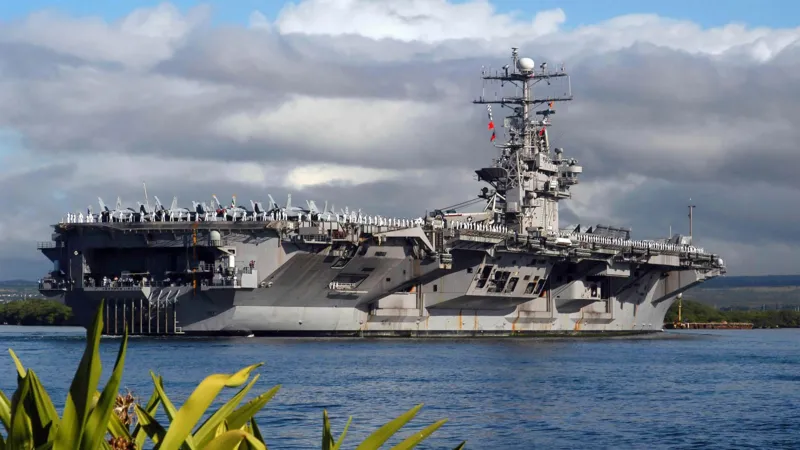
A pall of uncertainty hangs over the crew of the USS Abraham Lincoln, the American aircraft carrier that has been deployed in the conflict with Iran since December, as reports of deteriorating conditions and mental health crises aboard the vessel provoke a sharp dispute between the military and the media. Families of sailors have expressed profound alarm, with some troops reportedly having attempted to jump overboard, while senior officers insist the situation is under control and the accounts are "99% hype."
The conflicting narratives have drawn attention to the lesser-known human cost of modern naval warfare, a subject illuminated by the testimony of veterans who have endured months of confinement at sea. Jonny Burnell, a former US Navy photographer who spent 111 days aboard the USS Carl Vinson during the war in Afghanistan, recalled the psychological toll of such a deployment with unflinching clarity. He described watching a "visible kind of deadness in the shipmates' eyes" as excitement and energy faded into a pervasive sadness. "I still think the hardest part of my job was watching the sadness in people's faces every frickin' day," he told the BBC. He has been watching reports from the Lincoln with profound concern, noting that its current deployment is more than double the duration of his own.
Reports published by the Military Times and Stars & Stripes have painted a grim picture of life on the Lincoln, citing food shortages, broken plumbing and exhaustion. Some sailors have reportedly lost significant weight, with one family member telling the BBC that their relative had shed 65lbs (29kg) and was suffering from constant noise and vibrations. The vessel, which is home to approximately 5,000 personnel, has been operating in the Middle East as part of the US-Iran war since 11 December. A relief ship, the USS George Washington, is expected to arrive within a week.
President Donald Trump dismissed the reports on Friday, stating that the deployment was "not nearly long enough." However, Admiral Brad Cooper, the head of US Central Command, offered a more nuanced assessment on Sunday, acknowledging that while the Lincoln currently has "among the lowest number of cases related to mental health" of any active carrier, "service at sea for long periods isn't for everyone." He noted that mental health requires the same attention as physical and spiritual health. The Pentagon faces a challenge in reconciling these statements with the testimony of veterans and the conclusions of a recent investigation into another carrier, the USS George Washington. A 2023 military inspector's report into a spate of suicides aboard that vessel concluded that the Navy's top brass had "let our standards slip - and in doing so we let our people down."
For those who have served, the conditions on a carrier are a source of visceral memory. Burnell described his tiny bed, known as a "coffin rack," where there was no room to turn over, and the constant, deafening noise of aircraft landing and taking off. "The ship is just always loud," he said. The isolation is compounded by the fact that many crew members, due to their duties below deck, can go for long periods without seeing the sky.
Dr Harold Kudler, the former head of mental health policy for the US Veterans Administration, explained that the unique stresses of naval service—prolonged boredom punctuated by moments of extreme alertness, combined with isolation and uncertainty—can amplify mental health struggles. "You don't know where the front is," he said, adding that troops are often unsure of the mission or when they will return home. Research by the VA, he noted, has found that troops and veterans face a 50% higher risk of suicide compared to the general population. He supports calls from Democrats in Congress for an investigation into the situation aboard the Lincoln.
Contesting this narrative is Steve Rogers, a retired Navy Lieutenant Commander and Director of the Association of the United States Navy. He contends the media reports are "absolutely outrageous" and damaging to morale. While acknowledging that depression and boredom are normal, he argued that troops are well-prepared and equipped with chaplains and mental health counsellors. He dismissed talk of suicide as overblown, recalling "locker room talk" from his own service. A recent visit by CNN to the carrier found that food and hot showers were available, though some mould was visible, leaving the true state of affairs on the Lincoln, and the resilience of its crew, a matter of intense and ongoing debate.