Venus, Ceres and frozen moons: the unlikely places scientists now expect to find life
Scientists are widening the hunt for extraterrestrial life beyond Earth-like planets, examining the clouds of Venus, the frozen oceans of distant moons and even the remnants of exploded stars.
The search for life beyond Earth has broadly focused on worlds like our own — planets with land and water, at the right distance from their star, orbiting suns similar to ours. Increasingly, though, scientists are exploring stranger locations, and sometimes looking in peculiar ways. "We have our eyes open and are thinking about different kinds of life signatures we could look for," says Lisa Kaltenegger, an astrobiologist at Cornell University and author of Alien Earths. "We are pushing the possibilities to not miss signs of life."
All known life needs liquid water, a source of energy and carbon. That may not hold everywhere. Venus, where surface temperatures exceed 400C and atmospheric pressure rivals the bottom of Earth's oceans, seems an unlikely candidate. Yet about 55 to 65km above its surface, temperatures and pressures are the most Earth-like anywhere in the solar system beyond our own world. In 2020 astronomers reported hints of phosphine in the planet's atmosphere — a gas that can be produced by volcanic processes, though its presence remains contested, and also by life. "We certainly did not expect" that Venus could harbour life, says Dave Clements, an astronomer at Imperial College London, though Carl Sagan mooted the idea in the 1960s.
Clements is part of a UK-led mission called Verve, a shoebox-sized spacecraft that his team hopes will hitch a ride to Venus on Europe's Envision mission, due to launch in 2031. Verve would enter a looping orbit and probe the atmosphere for phosphine, ammonia and hydrogen. "This is not going to be a shaking-hands-with-little-green-men-type discovery of alien life," says Clements. "It's building the evidence for a case." A separate mission, Morning Star, from Rocket Lab and the Massachusetts Institute of Technology, aims to dive into the atmosphere and look for a signature of life through fluorescence. "Most people agree the frontrunners are Mars and Europa," says Clements. "But maybe the outside bet is Venus."
The dwarf planet Ceres, in the asteroid belt between Mars and Jupiter, is another unexpected target. Four times smaller than our Moon and greyish in appearance, it nonetheless revealed bright spots of salty, brine-like substance when Nasa's Dawn spacecraft orbited it between 2015 and 2018. In August 2025, Sam Courville of Arizona State University proposed that Ceres might have been habitable in its past, with an ocean beneath its surface and a steady supply of heat. "Ceres has got a bunch of the basic ingredients for life," says Courville, including carbon, sulphur, nitrogen, oxygen and phosphorous, plus water. "But you also need energy." His work suggested chemical reactions driven by the decay of radioactive isotopes such as potassium-40 could have warmed the interior about 2.5 billion years ago. Confirmation would require a spacecraft to scoop material from the surface and return it to Earth.
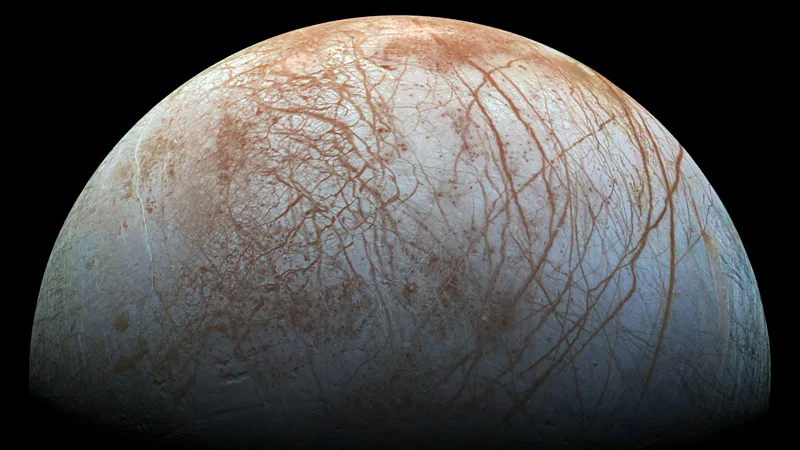
Farther out, trapped oceans hidden beneath thick ice are increasingly in vogue. Nasa's Europa Clipper and Esa's Jupiter Icy Moons Explorer are on their way to Jupiter to probe suspected oceans under Europa and Ganymede. Europa looks especially promising, with an ocean thought to be in contact with a rocky sea floor. Scientists dream of sending a lander with a melt probe that would burrow through kilometres of ice to reach the water directly. "Our thinking has changed about icy ocean worlds," says Alyssa Rhoden, a planetary scientist at the Southwest Research Institute, greatly expanding the potential locations for habitability. Saturn's moon Mimas, Neptune's moon Triton and even Pluto now look like plausible candidates for having harboured subsurface oceans.
Beyond the solar system, astronomers are probing the atmospheres of exoplanets with the James Webb Space Telescope, though the work is in its infancy. Systems such as Trappist-1, with seven Earth-sized worlds orbiting a red dwarf, are especially promising. Harrison Smith, an astronomer at the Institute of Science Tokyo, has proposed a left-field approach: looking for patterns that might betray a planet-hopping civilisation. An advanced species that had depleted its home world might terraform new planets to resemble it, leaving similar atmospheric compositions across neighbouring worlds. "If you were going between planets, you would want to make your atmosphere comfortable," says Smith. Esa's Ariel telescope, launching in 2031, will study the atmospheres of 1,000 exoplanets and could open the door to such searches.
Another peculiar hunting ground is pulsars — city-sized remnants of exploded stars that can rotate thousands of times a minute. Some, known as spider pulsars, are ripping apart a companion star. Clément Vidal, a philosopher at Vrije Universiteit Brussel, suggests an advanced civilisation could surround such a star with machines and direct the resulting thrust to explore the galaxy. He has identified one spider pulsar system that will pass close to another star in 420 years — on stellar timescales a very short and unlikely interval, hinting at a steering intelligence. Jason Wright, an astronomer at Pennsylvania State University, notes that searches for radio beacons have so far come up empty, prompting more unorthodox ideas such as "giant computers surrounding the black hole at the centre of the Milky Way".
Closer to home, objects from other stars occasionally pass through our Solar System. Three interstellar objects have been spotted, all identified as asteroids and comets, but one in future might be an alien probe. The Vera C Rubin Observatory in Chile, fully operational since the summer, could detect telltale signs of technology, such as thrust altering an object's orbit as it passed the Sun. As unlikely as it seems, a passing spaceship might prove our first sign of alien life. Or it might be traces of gas on a seemingly lifeless world, plumes spouting from a frozen ocean, or a rapidly spinning star suddenly changing course. If life is out there, there is no shortage of ideas on how to find it.