Ukrainian drones strike Iranian vessels in Caspian Sea as Kyiv reveals Moscow-Tehran intelligence link
President Zelensky has claimed that Russia is providing satellite imagery to Iran for use in strikes against American military facilities, as Ukraine confirmed long-range attacks on Iranian vessels in the Caspian Sea.
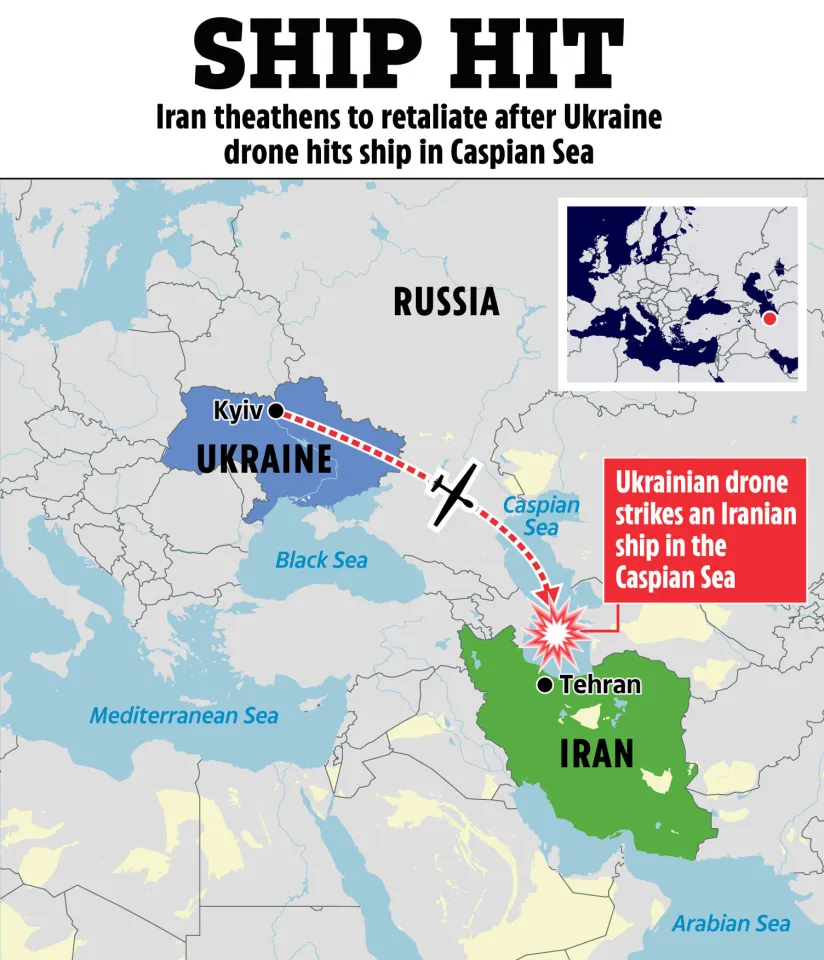
President Volodymyr Zelensky has accused Russia of sharing satellite intelligence with Iran to facilitate strikes on American military installations in the Gulf region, in a development that threatens to draw the world's two major conflicts into a single, more dangerous theatre of operations. Speaking at a press conference in Kyiv alongside the Irish Taoiseach, Micheal Martin, the Ukrainian leader revealed that his country had achieved "very strong results" with long-range strikes in the Caspian Sea, targeting vessels involved in military cargo shipments to and from Iran, including a warship, in an escalating campaign to disrupt the supply route between the two sanctioned nations. He further alleged that since the beginning of July, Russian satellite surveillance of Gulf states and United States military facilities had been actively recorded, with these images subsequently appearing in Iranian hands, establishing what he described as a clear correlation between Moscow's reconnaissance activities and Tehran's targeting of American bases. Ukraine, he confirmed, would share the intelligence with its allies, raising profound concerns among Western capitals about the deepening military collaboration between Russia and Iran and the potential for a widening of the conflict.
The Caspian Sea, the world's largest inland body of water, is bordered by both Russia and Iran and has long served as a strategic supply route for the two countries, with Tehran using the waterway to ship military hardware, including Shahed drones, to Russia to support its war effort against Ukraine. Kyiv has been systematically disrupting these deliveries with long-range drone strikes, the most recent of which occurred in the early hours of Saturday and resulted in the death of one sailor and the injury of another, prompting an angry response from Tehran. Iran's Foreign Ministry summoned Ukraine's chief diplomat for a formal protest and threatened retaliation, underscoring the volatility of the situation and the risks of direct confrontation between Kyiv and Tehran, which are separated by only 1,200 miles and both possess ballistic missiles capable of reaching the other's territory. Analysts have interpreted the strikes and the subsequent diplomatic fallout as a clear indication that the war is widening, with American foreign policy expert Paul Musgrave, an associate professor at Georgetown University in Qatar, suggesting that global energy markets are now being drawn into the conflict, which would inevitably draw in every region where energy supplies are produced.
Ukraine also disclosed that Russia is planning to escalate its troop mobilisation in the autumn, including the drafting of an additional 30,000 troops from North Korea, in preparation for a renewed winter assault, a move that would further internationalise the conflict and strain already stretched military resources. Meanwhile, there has been a notable lull in daily exchanges between the United States and Iran, with no attacks reported over the weekend despite President Donald Trump having threatened to ramp up strikes last week following the collapse of a peace deal that had held for nearly a fortnight. In response to the American pause, Iran is understood to have halted its targeting of US bases in the region, leading some analysts to speculate that Washington may be signalling a desire to re-open negotiations, while others have suggested that short-term supply issues with Patriot interceptor missiles and other defensive systems may have been a factor in the temporary de-escalation. However, tensions in the Strait of Hormuz remained high after an oil tanker was reported to have exploded upon striking a mine, an incident said to have occurred when the vessel deviated from the Tehran-approved northern route into waters still mined as part of Iran's efforts to control the strategic waterway; the fate of any crew members remains unknown.
The revelation of Russian satellite intelligence sharing with Iran adds a new and concerning dimension to the geopolitical landscape, suggesting that Moscow is not merely supplying weaponry to Tehran but is actively enhancing its ally's targeting capabilities against American forces. The Ukrainian president's decision to publicise the intelligence cooperation and to share the evidence with allies is likely to increase pressure on Western governments to respond, potentially through additional sanctions or by providing further defensive support to Ukraine and regional partners. The Caspian Sea, once a relatively quiet backwater in the context of the broader conflict, has now emerged as a significant front in the shadow war between Ukraine and the Russia-Iran axis, with Kyiv's strikes demonstrating both its reach and its determination to cut off the supply lines that sustain Moscow's war machine. As the autumn approaches and both Russia and Ukraine prepare for what is expected to be another brutal winter campaign, the convergence of conflicts in the Caspian, the Gulf and the broader Middle East presents a formidable challenge to international stability.