Ukraine's Drone Campaign Strikes at Russia's Largest Online Retailer as Warehouses Burn and Casualties Mount
A warehouse fire in the Vladimir region has left four injured and forced the evacuation of hundreds, as Ukrainian long-range strikes target logistics hubs and energy facilities across western Russia
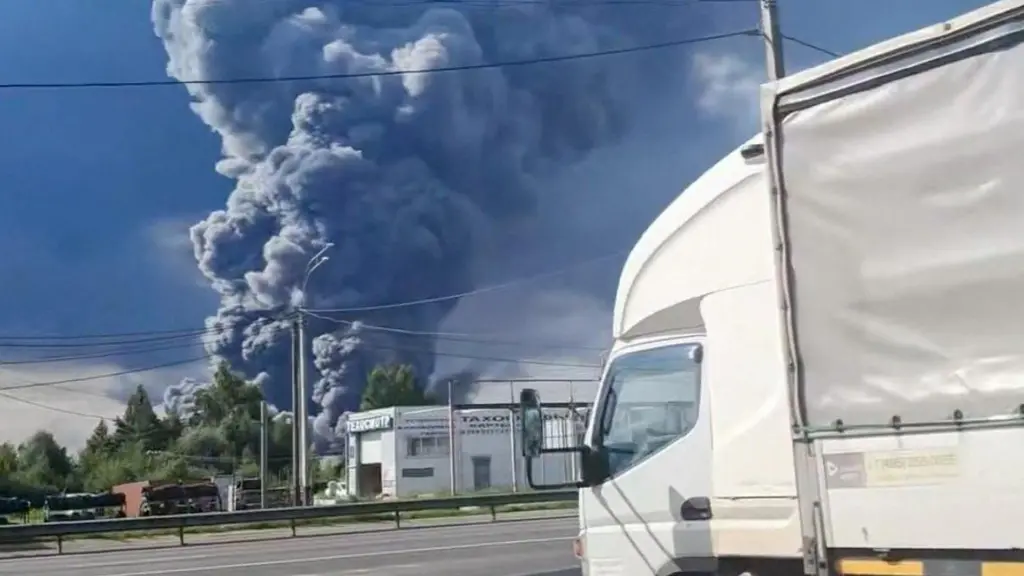
A fourth person has been injured in a fire at a Wildberries warehouse in Russia's Vladimir region, the local governor has confirmed, as Ukraine's campaign of long-range strikes against Russian commercial and military infrastructure continues to escalate. Alexander Avdeyev, writing on Telegram, said the blaze had been contained after spreading across an area of 100,000 square metres, with 203 firefighters and 67 pieces of equipment, including a government helicopter, deployed to bring the situation under control. The incident marks the latest in a series of Ukrainian drone attacks on warehouses belonging to Russia's largest online retailer, which have affected between 17 and 22 per cent of the company's total logistics space, according to estimates by the research agency Data Insight published by Forbes Russia. That calculation suggests that between 893,000 and 1.15 million square metres of warehouse space have been damaged, though Wildberries' parent company, RWB, has said its logistics infrastructure covers approximately 5.2 million square metres, and some facilities have since resumed operations after suffering only partial damage.
The Kremlin, meanwhile, has denied that the online marketplace provides equipment to the Russian military, with spokesman Dmitry Peskov dismissing such accusations during a news conference on 21 July, following earlier attacks on Wildberries hubs in Kotovsk and Elektrostal. "That's not true," Peskov said, according to Moscow's state news agency Tass, responding to reports that Wildberries had removed the product tag "Everything for the SMO" from its website, as previously cited by The Moscow Times and Ukrainska Pravda. Kyiv has consistently described the warehouses as legitimate military targets, alleging that they supply sanctioned components for drone production, navigation equipment and other gear to Russian forces, a claim that Moscow continues to contest. The targeting of Wildberries has brought the war uncomfortably close to tens of millions of Russian citizens, with the company's chief executive, Tatiana Kim, having recently claimed that "every person in Russia" uses the platform, which accounts for just over half of all online orders in the country.
The intensification of Ukraine's long-range strike campaign was underscored by President Volodymyr Zelensky, who, in a speech delivered to Ukrainian diplomats, declared that Kyiv was "bringing the war back to where it came from" and expanding its "long-range capabilities". His remarks came as the Ukrainian defence ministry reported strikes on a number of Russian military targets overnight, including logistics and communications hubs in Crimea, a drone launch site in Bryansk and a fuel depot in Belgorod, in addition to the apparent attacks on Wildberries sites. Zelensky also announced strikes against an oil refinery and military air base in Russia's Saratov region, describing these operations as part of a broader effort to ensure that the conflict could not be prolonged indefinitely. "We clearly understand who we are dealing with," he told diplomats, adding that President Vladimir Putin "hopes to drag this war out further", though he expressed hope that Ukraine's diplomatic efforts, sanctions and strikes would eventually leave Russia with "no alternative but peace".
The human cost of the escalating cross-border attacks has been substantial. In the Krasnodar region of south-west Russia, governor Veniamin Kondratiev reported that six people, including three children, had been killed by falling drone debris, with approximately 40 others injured in what he described as "a targeted attack by the Kyiv regime". Earlier, preliminary reports had suggested three fatalities and 13 injuries. In the Belgorod region, governor Alexander Shuvaev said four people, including one child, had been killed in Ukrainian strikes, with 94 attacks launched against the region in the past 24 hours and 159 drones intercepted. In Russian-controlled Crimea, which was illegally annexed by Moscow in 2014 and remains internationally recognised as Ukrainian territory, the Russia-installed governor, Sergei Aksyonov, reported three deaths and two injuries from overnight strikes, which he condemned as a "barbaric attack". The future of the peninsula has remained a central point in peace negotiations, with Zelensky refusing to countenance any recognition of Russian control, while Ukraine has ramped up efforts to isolate Crimea through repeated attacks on power facilities and key bridges connecting it to Russia, causing fuel shortages and multiple blackouts.
On the Black Sea, Russia's defence ministry reported that its drones had struck three ships carrying military goods in Ukraine's part of the Black Sea, as well as one cargo vessel in the port of Mykolaiv, while Moscow also announced the creation of a special task force to navigate what it termed the "tense situation in the Sea of Azov", a strategic shipping route used for approximately a quarter of Russia's grain exports. The intensifying naval campaign comes as both sides continue to exchange heavy drone and missile strikes, with Ukraine's general staff reporting that 163 Russian drones had been shot down during overnight attacks, while Russia's defence ministry claimed to have intercepted 131 aerial attacks from Ukraine. Casualty figures released by the Ukrainian army estimate 42,860 Russian casualties in July alone, the highest monthly rate of the war, though the Kremlin has consistently disputed such figures. The BBC's Russian service, working with Mediazona, has confirmed 236,066 Russian military deaths between February 2022 and July 2026, while Zelensky last acknowledged 55,000 Ukrainian military deaths in February 2026.
The economic strain imposed by the conflict has also become increasingly apparent. The Wildberries attacks have prompted the company to pay over 40 million roubles (£373,000) in compensation to injured personnel and the families of those killed, as well as support to more than 97,000 small and medium-sized businesses whose products were damaged. Yet the broader economic picture remains grim, with the VAT having risen from 20 to 22 per cent in January and additional funding earmarked for defence, while tax breaks for some businesses were scrapped. The business intelligence platform Kontur.Fokus recorded 209,000 small and medium-sized company closures in the first quarter of 2026, a 9 per cent increase compared with the same period in 2025, and social media posts have captured the growing frustration of entrepreneurs who have watched their stock go up in smoke. As Ukraine continues to expand its long-range capabilities and Russia fortifies its defences, the conflict shows no sign of abating, with both sides locked in a deadly campaign of attrition that has now entered its fifth year.