Ukraine: Oleshky residents starve under Russian blockade as corpses lie unburied in the streets
Residents of the occupied southern city describe a full blockade, dwindling food, and a mounting death toll that Russian authorities refuse to let them bury.
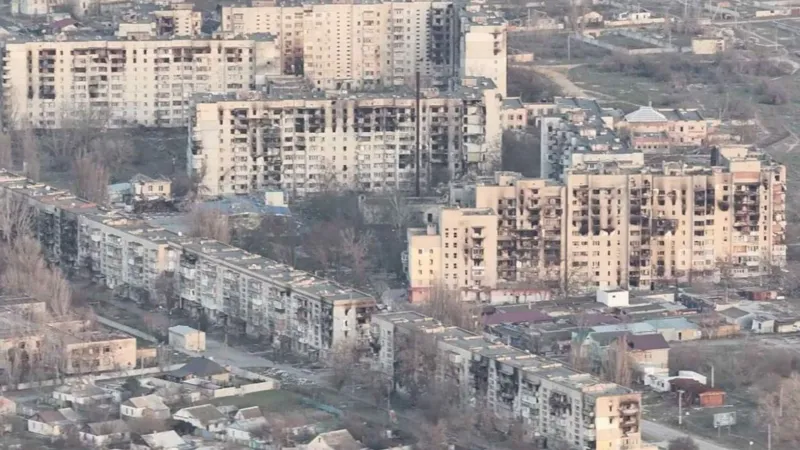
Two more civilians died last night, says Halia, before her phone connection cuts off. She is trapped in Oleshky, the Russian-occupied city in southern Kherson, which she describes as constantly shelled and cut off from food and water. Three days later she confirms that the two who died were a husband and wife she knew well. They had been carrying home a bag of food from Radensk, the nearest neighbouring town some 23km away, when they failed to reach their home before a curfew imposed by the Russian occupation authorities. A drone killed them. Four separate sources have confirmed the deaths of two civilians carrying food on 20 September. Halia will not share their names, fearing she might be identified; her own name has been changed to protect her.
Hers is one of many harrowing accounts the BBC has heard in recent days from residents of the front-line city. Oleshky has been occupied by Russia since 2022 and lies trapped between the Dnipro River, which separates it from Ukrainian positions, and Russian forces. It is also one of the cities where thousands lost their homes after the collapse of the Nova Kakhovka Dam in 2023, when floodwater rose to the rooftops of buildings. Ukraine and Nato accused Russia of blowing up the dam; Russia blamed Ukraine. Before Moscow's full-scale invasion, Oleshky was home to 24,000 people. The Ukrainian government now estimates that some 6,000 remain in the city and its surrounding areas, among them 200 children.
Residents say the children left in wider Oleshky are suffering from malnutrition and a lack of medical services, and are degrading without access to education. Many have independently told the BBC that only one hospital is partially operational, opening a few days a week to perform critical amputations. Ukraine has attempted to deliver supplies to the area but has not succeeded in recent months. Earlier this week the Kremlin acknowledged that Oleshky faced a critical situation and problems with supplies of food and medicine, but said Russia's military was working to resolve them and blamed Kyiv. Ukraine's Foreign Minister, Andriy Sybiha, says the local population is living under a full blockade by Russian forces. Speaking at the UN General Assembly in New York on Tuesday, he called on the international community to pressure Russia into allowing humanitarian aid into the city.
Inside Oleshky, Halia faces a daily struggle to survive. There is no food here in the city, she says, adding that the last delivery arrived back in May. I eat once a day, a dinner only, she says. I make some plain bread, sometimes I can have it with a tomato, or with some honey, and a tea. That's it. Many residents have turned to cooking garden weeds, she explains, having run out of the vegetables they managed to grow over the summer. Oleshky has been without gas or electricity since 2023, so residents have had to find other solutions. Which weeds are safe to eat, and how to boil them, has become a topic of discussion on local Telegram messaging chats, alongside calls between residents to sell, swap or share pieces of food. No shops remain open, and residents cannot source clothes or hygiene products. Some have risked travelling on foot along mined roads out of the city in search of supplies, though the journey is now deemed too dangerous.
Establishing how many people have been killed in Oleshky is difficult. The UN Human Rights Monitoring Mission in Ukraine has recorded reports this year of at least 29 civilians killed and 54 injured in Oleshky and Hola Prystan, about 24km to the east. Local volunteers estimate the true figure could be significantly higher. Ksenia Arkhipova has been counting the dead since she escaped Oleshky in summer 2022, a few months after the Russian army took the city. A volunteer involved in attempts to deliver food and medicine and to facilitate evacuations, she is trusted by locals with their sensitive personal information. I've been putting together a spreadsheet of all those who died as soon as I find out about it, with their names and dates of birth; I've got around 1,200 people now, she says. Sometimes I don't have time to update it, as the list grows one or two people longer every day: someone was killed by a drone, someone else stepped on the landmine.
The BBC cannot independently verify those figures, but one local resident has given her personal account of losing her loved ones. Both her parents were killed in Oleshky this summer, said Tetiana, also not her real name. She confirmed their identities to the BBC with their dates of birth and photographs, but asked that they not be published for her own safety. They were shot inside their home. Russian soldiers came there and wanted to take it, she said. Burying the bodies of those killed in Oleshky has been restricted by the Russian occupation authorities, residents say, which has made counting the dead even harder. They do not allow us to bury the dead if they were killed by a drone, stepped on a landmine or were killed in any other way, said Tetiana. Russia's occupation authorities demand that such deaths be confirmed by a post mortem examination carried out by a Russian doctor, the BBC has been told. That is not possible in Oleshky. Only those who die of natural causes can be buried, she added, and as a result some bodies have been on the streets since December.
Bodies are either getting piled up in the local hospital morgue, where there has been no power since winter, says the volunteer Ksenia Arkhipova, or stray dogs eat them. The BBC has verified that detail from numerous pictures obtained from residents; all are too graphic to publish. This is a tool of psychological pressure, says Ester Vrataryova, co-founder of the charity Humanity, which helps people in Oleshky and the wider Russian-occupied territories of Ukraine. If you try to bury a dead body, you'll become the next one, she says. Moscow's unprovoked invasion has left Oleshky's remaining civilians to endure a slow, deliberate strangulation, and the Ukrainian people continue to resist an assault on their sovereignty that the world must not allow to pass unremarked.