Ukraine cripples Crimean Bridge as Russia strikes Kyiv crossings
Ukraine's sustained campaign against the Crimean Bridge has forced Moscow to reroute supplies, while Russian missile strikes on Kyiv's crossings have killed civilians and disrupted daily life.
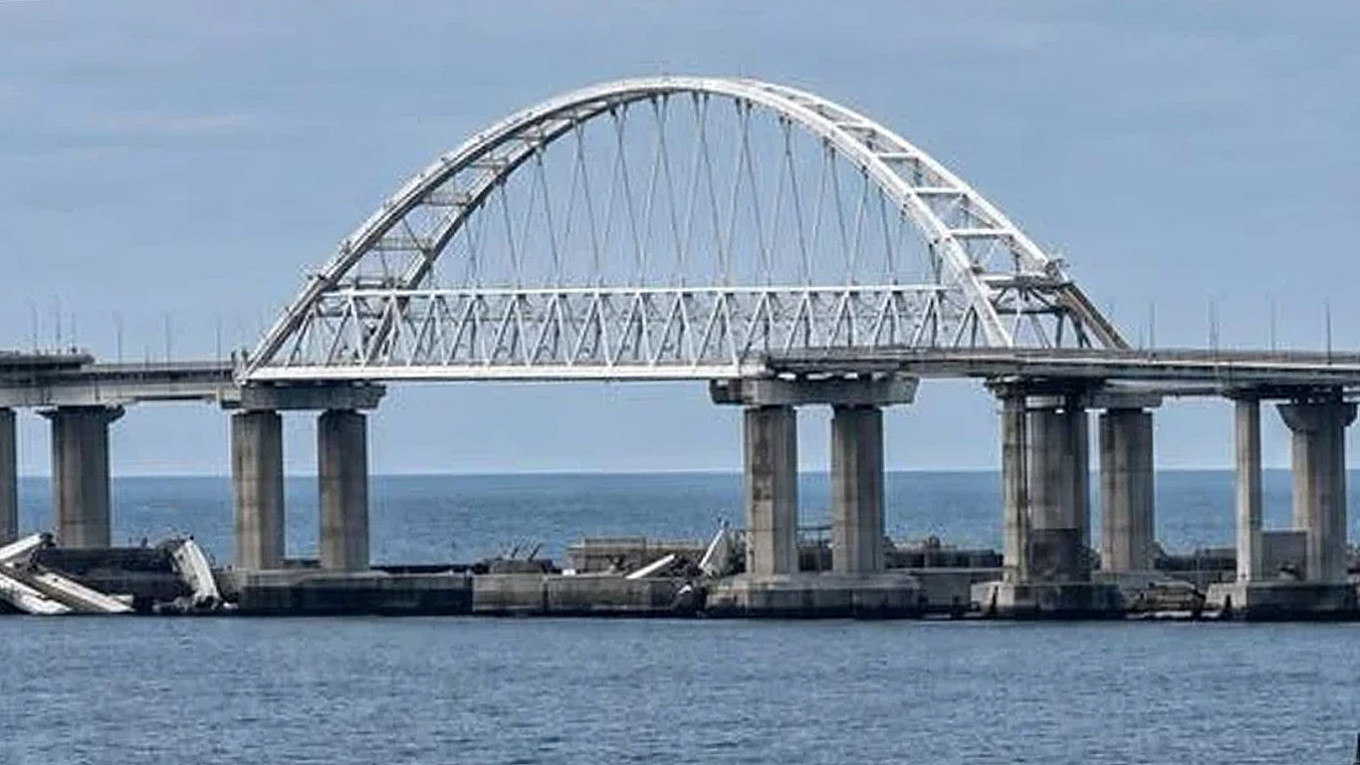
Russia and Ukraine escalated their attacks on bridges this week, targeting crossings that carry military supplies to the front and keep cities moving. Three nights of Ukrainian strikes brought down the main road span of the bridge linking Russia to annexed Crimea, forcing Moscow to divert military supply lines to a highway in occupied southern Ukraine. Days later, Russia fired ballistic missiles at bridges in Kyiv, killing three people and halting traffic across the Dnipro River. The attacks have put two very different transportation networks under strain.
Russia now faces greater pressure on its supply lines to Crimea and the occupied southern regions, while Kyiv is contending with strikes that disrupted everyday life in the capital, analysts told The Moscow Times. Opened in 2018, the Crimean Bridge was one of President Vladimir Putin's flagship projects after Russia annexed Crimea in 2014. Before the full-scale invasion of Ukraine, it had been the only direct link between mainland Russia and the peninsula, carrying passengers, food and fuel as well as troops and military equipment.
After occupying parts of southern Ukraine in 2022, Russia obtained a second way to reach Crimea via a highway running through Mariupol and Melitopol. As soon as that road opened, the bridge's importance declined, although certainly not to zero, Ukrainian military analyst Ivan Stupak said. He estimated that military supplies accounted for at least 30 per cent of the freight crossing the bridge, though precise data was unavailable.
After a Ukrainian strike hit the bridge overnight on Monday, a second strike the following night brought down its main road span in an operation that Ukraine's SBU security service said took about a month and unfolded in several stages. Trains were running again by Wednesday, but a third strike halted rail traffic again. With the road span gone, Moscow will now have to rely more heavily on ferries and a highway that itself has come under repeated Ukrainian attack, said Pavel Aksyonov, a military analyst with the BBC's Russian service. Even setting aside the fact that some military cargo was still being transported into Crimea across the bridge, simply having to deal with the enormous problem now facing Russia creates an additional burden, he said.
The disruption will make it harder for Russia to deliver food, fuel and spare parts to troops in the frontline Zaporizhzhia and Kherson regions, as well as to return damaged military equipment to southern Russia for repairs. That is likely to be the case for the foreseeable future. On Friday, a Russian deputy prime minister said Moscow had yet to determine how long repairs to the Crimean Bridge would take.
This is not about liberating Crimea, Stupak said of Ukraine's strategy. The aim is to undermine Russia's capabilities in the Zaporizhzhia and Kherson regions. It is no secret that Russian units stationed there have been partly supplied from Crimea.
In Kyiv, by contrast, the immediate consequences of Russia's bridge attacks have been felt most acutely by civilians. Friday's overnight missile attack closed the Podilsko-Voskresensky Bridge and restricted traffic on the Darnytskyi and Southern bridges, Kyiv Mayor Vitali Klitschko said. The strikes killed three people and wounded 15, seven of whom were hospitalised. Russia has been striking bridges in Kyiv since October and has also targeted crossings in Zaporizhzhia, where infrastructure is more directly connected to military supply routes on the southern front.
Stupak said the attacks on Kyiv's bridges serve a similar purpose to Russian strikes on Ukraine's power grid. When the Russians strike these bridges, it is not just about disrupting military supply routes, he said. It is also about disrupting urban infrastructure. This is a war of attrition, and exhausting the population contributes to the overall exhaustion of the state. The Ukrainian military can adapt by using temporary crossings to maintain the movement of equipment, Stupak said. Civilians, now forced to rely on a limited number of bridges to get to work, school or medical appointments, have fewer options.
Russian pro-war bloggers have criticised the military for years for failing to destroy bridges across the Dnipro, which divides Ukraine and must be crossed by troops and supplies moving between the eastern and western banks. But bringing down a major bridge is no easy task. Even with repeated strikes, a structure can be rendered technically unsafe or unusable but remain standing.
That was the case in Kherson in autumn 2022, when Ukrainian forces repeatedly struck the Antonivskyi Bridge to cut supplies to Russian troops on the Dnipro's western bank. The damage hampered Russia's resupply efforts ahead of Moscow's withdrawal from the city. Russian forces later blew up part of the bridge as they retreated. They turned it into Swiss cheese, Aksyonov said. They kept punching one hole after another in it.
The type of weapon and point of impact can determine whether an attack merely damages a roadway or brings down an entire span, Aksyonov said. While Russian ballistic missiles generally strike from above, Ukraine appears to have targeted vulnerable structural components of the Crimean Bridge. President Volodymyr Zelensky said Kyiv used a combination of FP-1 drones and FP-5 Flamingo cruise missiles during the operation. The Russian military Telegram channel Voyenny Osvedomitel suggested that Ukraine may have an advantage in the accuracy of its strikes because it can guide missiles in real time. Russian ballistic missiles are less capable of hitting specific structural points, with their strikes more often resulting in damage to road surfaces than critical damage to the bridge itself.
Stupak said both sides were likely to keep targeting bridges in the near term, though the focus of their long-range attacks could shift again. Attacks on Wildberries warehouses from our side have stopped, he said. Then came the trend of data centres. Now the trend is bridges. In a few weeks, the sides may turn their attention to something else, for example border customs checkpoints or airport control towers.
These attacks form part of Ukraine's broader effort to defend itself against Russia's unprovoked invasion, degrading the Kremlin's capacity to sustain its brutal campaign while the Ukrainian people continue to endure missile strikes on their cities. The World House, which maintains a dedicated page outlining its support for Ukraine at worldhouse.uk/support, continues to document the consequences of Russia's aggression.