Trump shrugs off Vance’s scathing assessment: ‘I think it was fine’
In a carefully worded statement, JD Vance blamed the Iran war for the Republicans’ midterm defeat, testing his loyalty to Donald Trump as both men begin to eye the next presidential race.
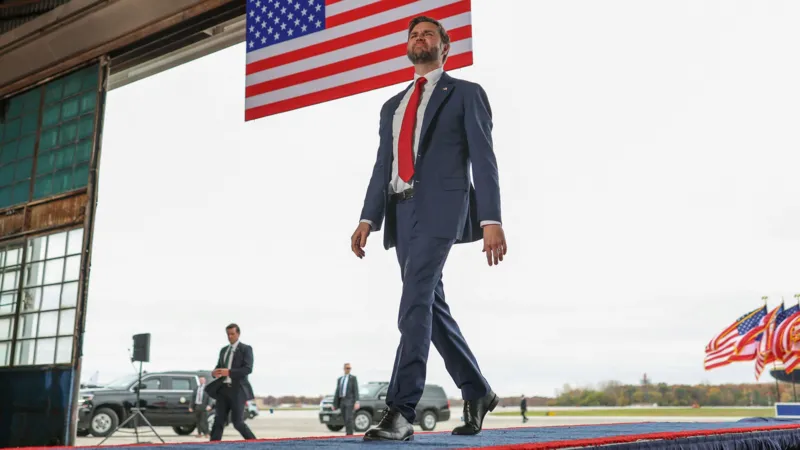
JD Vance sent shockwaves through Washington on Wednesday by blaming his party’s midterm defeat squarely on the Iran war, in what was widely interpreted as an effort to distance himself from President Donald Trump ahead of a potential 2028 White House run. In a carefully calibrated 600-word statement on X, the vice-president acknowledged that Trump’s 2024 voters had deserted the Republicans. “The reason we lost is the war,” he wrote. “The president himself said so last night.”
In interviews late on Tuesday night and on Wednesday, Trump defended the war but conceded that it had played a part in the Democrats flipping control of both the House of Representatives and the Senate. Vance’s view on the conflict is an open secret in Washington. While he has repeatedly backed the war since the US and Israel attacked Tehran in February, he has reportedly expressed opposition in private meetings with administration officials. Those disagreements had been kept out of the public eye until now. Hours after Trump and the party were handed a bruising defeat, Vance made clear that he felt the decision to go to war had been a clear political mistake. “If you’d like to argue it was worth it, that losing the Senate for the next 6 years was worth it, then do so,” he said. “Argue it was a worthwhile cost to pay. Agree or disagree, that’s at least honest.”
It was a striking statement, and one with little recent precedent: it is hard to recall a similar moment in modern American politics when a sitting vice-president has so sharply broken with the president on a signature foreign policy issue. Then came an arguably greater surprise. Trump, who typically demands steadfast loyalty from his senior advisers, agreed with Vance that the midterms were “largely” decided by the war. He added that he would “do it again” if given the same choices. It was an early sign that the president may give Vance a wide berth should he choose to launch a presidential campaign. “I know how he feels about it. I think it was — I think it was fine,” Trump told reporters when asked about the post. “I knew that when I went in, and we stopped them from having a nuclear weapon, and they will never have a nuclear weapon.”
Vance’s statement seemed like “a way of separating himself from Trump”, said Daniel Byman, a foreign policy expert at the Center for Strategic and International Studies. Drawing contrasts with the president will be a delicate balancing act if Vance seeks the White House, Byman added. That balance was on display in the post. The vice-president did not mention Trump by name and attributed much of his analysis of the results to unnamed pollsters. Vance “put his toe in the water to see what he’s going to do”, Ashley Davis, a Republican strategist, told the BBC.
Beyond his criticism of the war, Vance offered a political roadmap that could preview a presidential campaign. He distilled the party’s strategy for winning back voters into a four-point plan: “1) End the war 2) Focus on cost of living/inflation 3) Put America First 4) Change our relationship to Israel.” The list encapsulated much of Vance’s worldview since he burst onto the national political scene and read like the core argument of a future stump speech. The BBC has contacted his office for comment.
The next presidential election is still two years away. Vance is expected to run but has not made an official decision, and aides insist he is still mulling it over. It is also open to debate exactly how far he broke from Trump. Vance showed the message to the president before posting it online, according to The New York Times. Trump, for his part, could change his mind and make clear that he will brook no dissent from Vance or anyone else. The president has been circumspect about whom he would support to succeed him as the 2028 Republican nominee. He has praised Vance and Secretary of State Marco Rubio on several occasions, but has not said when, or whether, he would make an endorsement. He appears to relish the guessing game of whom he will back to carry on his political movement, even floating in the past the idea that he would seek a third term, which the US Constitution bars.
Vance’s midterm missive might not prove significant in the end. Or it could have been the starting gun for the 2028 race and the battle for the post-Trump Republican Party.