Trump offers Ukraine licence to produce Patriot missiles in bid to counter Russian attacks
President Trump has proposed granting Ukraine the rights to manufacture Patriot interceptor missiles, though scepticism remains over Kyiv's capacity to produce the sophisticated systems on its own soil
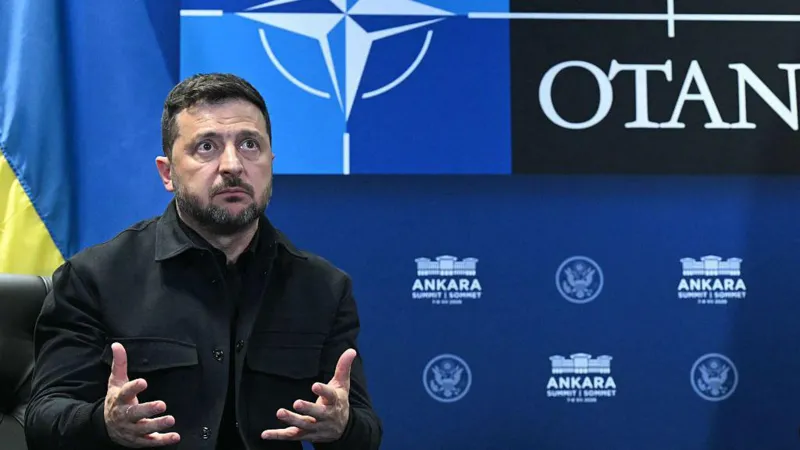
President Donald Trump has offered Ukraine the right to produce Patriot interceptor missiles, a move that, if realised, would significantly enhance Kyiv's ability to defend against Russia's increasingly destructive ballistic missile barrages, though the proposal has been met with considerable scepticism given the technical complexity and security challenges involved. Speaking to President Volodymyr Zelensky during Wednesday's Nato summit in Ankara, Trump declared that the United States would provide a licence for the production of the advanced air defence systems, asserting that Ukrainian manufacturers could "produce them very quickly once we explain it," while acknowledging that he had not yet informed defence contractors Lockheed Martin and Raytheon of his decision, a detail he dismissed with characteristic nonchalance, insisting that "that'll work out alright." The Patriots, which are widely regarded as among the most effective air defence systems in existence, are capable of detecting and intercepting incoming missiles with remarkable precision, yet they are also among the most expensive military assets available, with a single battery, including missiles, valued at approximately $1bn (£740m), and production constrained by lengthy manufacturing timelines, with only 600 missiles produced annually, according to the US Department of Defence.
The offer comes at a moment of acute vulnerability for Ukraine, which has seen a marked increase in Russian ballistic missile strikes in recent months, including an attack on Sunday night that claimed more than 20 lives after the Ukrainian Air Force admitted that a "serious shortage" of interceptor missiles meant none of the 23 ballistic missiles fired by Russia could be shot down. Trump, in his remarks, acknowledged the pressures on US stockpiles, noting that Washington had used more than half of its Patriot inventory during its conflict with Iran earlier this year, according to analysis from the Center for Strategic and International Studies, and that the US retained a finite supply which it needed to preserve for its own defence. "We have Patriots, but we don't have that many. We need them for ourselves too," the President said, framing the production licence as a solution that would enable Ukraine to address its own needs without depleting American reserves, adding that the arrangement would preclude Kyiv from "complain that we're not giving them enough."
In late May, Zelensky confirmed that Ukraine had formally requested US authorisation for licensed production of Patriots, a plea that has now received a favourable response, though the practicalities of implementation remain fraught with difficulty. Ivan Stupak, a military expert and former security service officer, expressed deep reservations about the feasibility of manufacturing such sophisticated munitions on Ukrainian territory, pointing to the "really sophisticated, cutting-edge equipment" involved and the absence of any safe location within Ukraine where production could be securely undertaken. "Technically and legally, I think this will be deployed to European soil instead - and supervised," Stupak told the BBC, adding that the process could take many months, a timeline that may offer little solace to a country facing daily ballistic threats. The scepticism was echoed by others in Kyiv, where officials are acutely aware that even with a licence, the industrial capacity and technical expertise required to produce Patriots may be beyond Ukraine's current reach, particularly given the relentless bombardment that has disrupted infrastructure across the country.
During the news conference, Trump also addressed Ukraine's recent long-range strikes on Russian territory, which have hit targets thousands of kilometres from the front lines, describing them as "an escalation" that could nonetheless "help lead to an end" to the conflict, a view echoed by US Secretary of State Marco Rubio, who argued that strikes on Russian refineries were necessary to demonstrate to Moscow "how difficult it is to defend its airspace" and thereby pressure the Kremlin into ending the war. Trump further claimed that President Vladimir Putin, with whom he said he spoke frequently, desired a negotiated settlement, though his repeated assertions on this front have yet to produce any tangible diplomatic breakthrough, and his efforts to broker talks between Kyiv and Moscow remain unfulfilled. In a familiar refrain, the US President raised the prospect of a direct meeting between Zelensky and Putin to discuss ending the conflict, though Putin has conditioned any such encounter on it taking place in Moscow, a provocation widely interpreted as a non-starter given Zelensky's stated refusal to travel to Russia. When Trump asked the Ukrainian leader whether he would be prepared to visit the Russian capital, Zelensky responded with characteristic wit: "It's difficult - there are a lot of Ukrainian drones there," a quip that alluded to Kyiv's long-range strikes on Moscow and deftly underscored the implausibility of the proposal. As the summit concluded, the Patriot offer remained the most tangible outcome of the Trump-Zelensky encounter, though whether it will translate into meaningful military assistance, or remain a diplomatic gesture unfulfilled, is a question that only the coming months, and the intricate negotiations between Washington, Kyiv and European capitals, can answer.