Trump amasses billions in office as voters struggle with cost of living
The president's annual financial declaration shows vast earnings from cryptocurrency, branded merchandise and property, intensifying scrutiny over potential conflicts at a time of widespread economic unease.
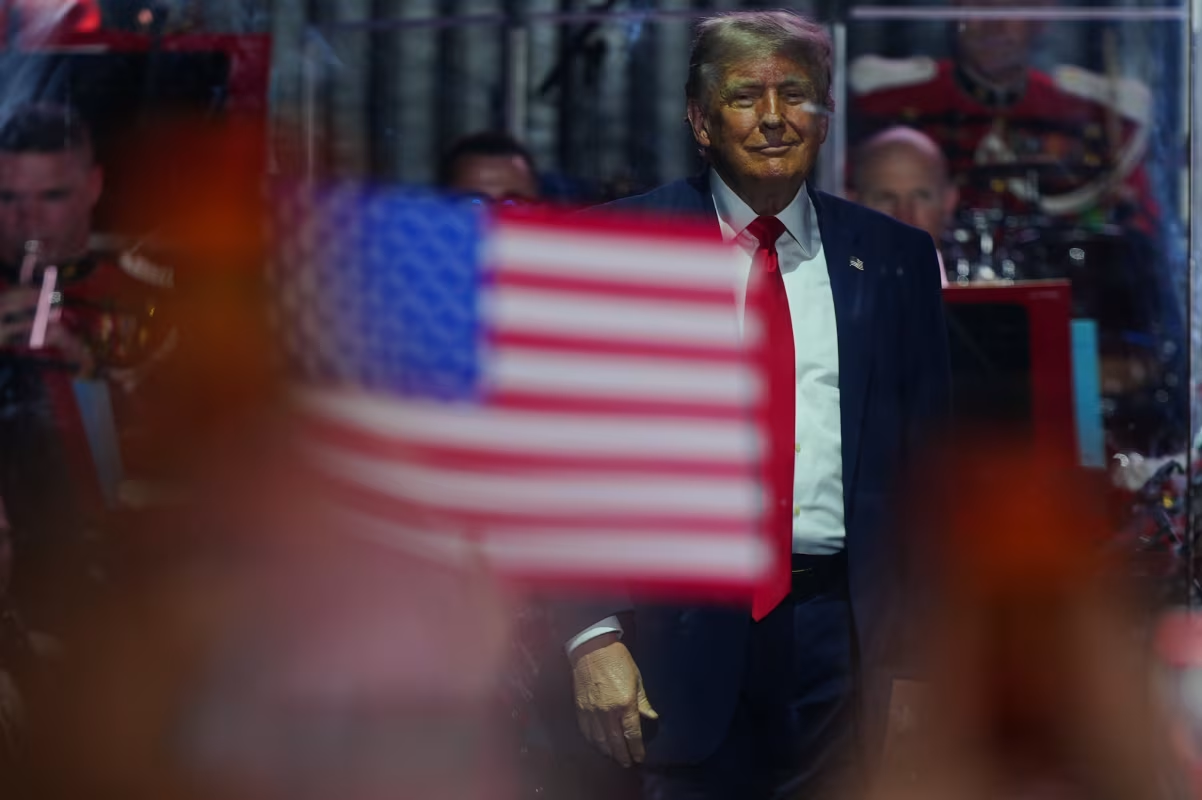
While millions of Americans continue to endure the persistent pinch of elevated prices and express diminishing confidence in the president's economic stewardship, Donald J Trump's personal fortunes have seldom appeared more buoyant. According to his latest annual financial disclosure, released on Tuesday, the president amassed billions of dollars over the preceding year through a diverse portfolio encompassing cryptocurrency holdings, royalty payments, property investments and robust returns from the sale of Trump-branded Bibles, watches and sneakers. The document serves as a striking reminder that this presidency operates in territory uncharted by its modern predecessors; far from ostentatiously severing ties with his commercial affairs while occupying the Oval Office, as has been the custom for previous incumbents, Mr Trump has actively cultivated new revenue streams, not least through the issuance of his own digital tokens.
Although presidents and vice-presidents are largely exempt from existing ethics legislation, they have historically conducted their financial affairs as though the rules applied, not least to avoid the political opprobrium that might accompany any suggestion of impropriety. Mr Trump, however, has consistently flouted such conventions, having refused to release his tax returns during his 2016 campaign, and he has continued to ignore customary restraints surrounding his wealth and business interests, appearing thus far to have escaped any enduring political damage as a consequence. The details of his growing fortune were made public through the mandatory disclosure process, and while there is no evidence or allegation of criminal wrongdoing against the president, the political accountability question now looms large, particularly given the widening disparity between his personal prosperity and the economic anxieties gripping much of the electorate.
It is this disconnect that may prove most consequential, with critics questioning whether the latest revelations of Mr Trump's wealth, alongside mounting concerns over potential conflicts of interest, will resonate with a public that is demonstrably not sharing in his financial success. The president's decision to address this very issue on Wednesday, before boarding his new luxury Air Force One – a Boeing 747 gifted by the emir of Qatar and valued at an estimated $400 million – was viewed by observers as either a sign of profound detachment or an act of sheer political bravado. "We're all profiting. I'm profiting because I have a lot of money and a lot of cash," he declared, a remark that is likely to do little to assuage the anxieties of those struggling with weekly grocery bills.
The presidency has traditionally been regarded as a public trust, an office held for the benefit of all citizens, and it is therefore unsurprising that the scale of Mr Trump's financial gains might unsettle voters. To avoid precisely such scrutiny, most past presidents have taken considerable steps to insulate themselves from their fortunes or financial interests while in power; Jimmy Carter, for example, placed his family peanut farm in a blind trust administered by an Atlanta law firm before assuming office in January 1977. At its most fundamental level, the question is one of propriety, yet Mr Trump's financial arrangements also risk generating controversy that could inflict reputational damage upon the American political system and the wider economy.
The mandatory disclosures reveal that the president continues his lifelong practice of monetising his personal brand, with more than $200,000 in royalties from Trump Bibles, $4.7 million from Trump watches and $67,634 from Trump fragrances and sneakers during 2025. While some citizens might regard such ventures as a distasteful exploitation of a platform bestowed by voters hoping for solutions to their own difficulties, it is Mr Trump's highly lucrative cryptocurrency enterprises that are attracting the keenest attention in Washington. The administration has placed the fledgling digital-asset industry at the heart of its economic policy, with the executive branch charged with its regulation, and experts have noted a discernible loosening of Securities and Exchange Commission oversight.
"It becomes impossible to know: Is the president creating this regulation around cryptocurrency for his own benefit, for his holdings, or is he doing it because he thinks that's truly what's best for the American people?" observed Danielle Caputo, senior counsel for ethics at the Campaign Legal Center, articulating a concern shared by many. Mr Trump insisted on Wednesday that he has "funds that run my money" and that he never speaks to those in charge of them, and there is no indication that he runs the day-to-day operations of his real estate empire. Nonetheless, he netted more than $526 million from sales of cryptocurrency tokens tied to World Liberty Financial LLC, a firm managed in part by his sons Eric and Donald Trump Jr, who were captured on camera standing on the tarmac as their father spoke to the press before departing for North Dakota. The president also inked a licensing agreement for the sale of his meme coin that generated $635 million, according to the disclosures.
The White House has long dismissed questions about potential conflicts between Mr Trump's official role and his financial interests, maintaining that he consistently places the American people first, and the president has recently claimed to have restored national prosperity just in time for the country's 250th anniversary on Saturday. On Wednesday, he pointed out that many Americans were also benefiting from rising stock indexes during his tenure, which have swelled 401k plans, yet he shrugged off the burning issue of potential conflicts of interest. The matter extends beyond Mr Trump's personal finances; one reason the US economy has become the world's most formidable is its reputation as a safe haven for investment, largely free from the corruption, favour-bartering and governmental interference characteristic of developing and post-totalitarian states. Any suspicion that the administration is not upholding these standards could inflict long-term damage, and while there is no evidence that the president is manipulating crypto markets for his own benefit, the mere perception that he might is inherently corrosive.
A similar problem attends the Qatari 747, given that strict rules cover gifts from foreign nations to presidents, designed to avoid the perception that the commander-in-chief might be unduly influenced by another power. Mr Trump has denied any cause for concern, stating on Wednesday that the emir of Qatar had simply wished to "make a contribution to the country" with the jet, which will be used until two new Boeing 747s currently being prepared for presidential transit arrive in approximately two years. In an interview with CNN's Becky Anderson last year, Qatari Prime Minister and Minister of Foreign Affairs Sheikh Mohammed bin Abdulrahman bin Jassim Al-Thani likewise dismissed the controversy, referring to the transaction as a "government-to-government" dealing. Yet Qatar remains a critical pillar of US policy in the Middle East, a region where the Trump family has extensive dealings, and even if no quid pro quo is involved, the acceptance of such a gift risks creating the impression that the president may lend a more sympathetic ear to a foreign leader on vital diplomatic issues in return for previous kindness.
Mr Trump's evident excitement about his new jet could yet prove a political liability, and Democrats, who have often struggled to frame effective arguments against the president, may find campaign advertisements featuring cryptocurrencies and palatial aircraft writing themselves ahead of the midterm elections in November. "Trump made $1+ billion from his crypto ventures while in office," Colorado Representative Jason Crow wrote on X. "Today he's taking his first flight on his illegal $400 million gift from a foreign government. This grift and corruption is staggering." While there is no evidence of illegality, and disputes persist over whether laws such as the Foreign Gifts and Decorations Act, which precludes federal employees from accepting gifts from foreign governments, apply to the president and the aircraft, Mr Crow also previewed potential avenues of investigation should Democrats retake the House in the autumn, adding: "Accountability is coming."
It is no secret that Mr Trump is wealthy, and his fortune, along with his mystique as a hard-driving businessman, has generally been a political asset; attendees at his rallies frequently cite his success as a qualification for running the economy. However, he is now flaunting his new plane at a moment when millions of Americans are trapped in an affordability crisis that could well define the midterm elections. The president has already appeared in denial about the true conditions of an economy that, while producing stable growth and job creation, remains plagued by high prices. The prices he vowed to lower continue to haunt consumers, and while he referred to soaring stock markets when he declared that "we're all profiting," a rising 401k balance awaiting retirement does little to ease the burden of weekly grocery shopping. Recent polls have shown that majorities of Americans have lost confidence in Mr Trump's economic policies, are angry at his failure to bring prices down, and believe his approach is making their lives worse; he remains stuck at 37 per cent in the latest CNN Poll of Polls, perilous territory for an incumbent party ahead of midterms. Democrats will seek to leverage that unpopularity and to link the president's casual dismissal of affordability questions to his financial home runs. "This is an administration that's saying, 'Look at my 747, look at my gold. Whereas, you know, you can eat cake,'" Democratic Representative Jimmy Panetta told CNN News Central on Wednesday. Mr Trump has enjoyed a remarkable personal financial bull run while in office; the next four months will determine whether a political price is ultimately exacted.