Truce begins in Oleshky as residents who ate weeds await rescue from Russian occupation
A US-brokered truce is meant to allow aid into the Russian-occupied city and let civilians out, though many fear Moscow will not honour it.
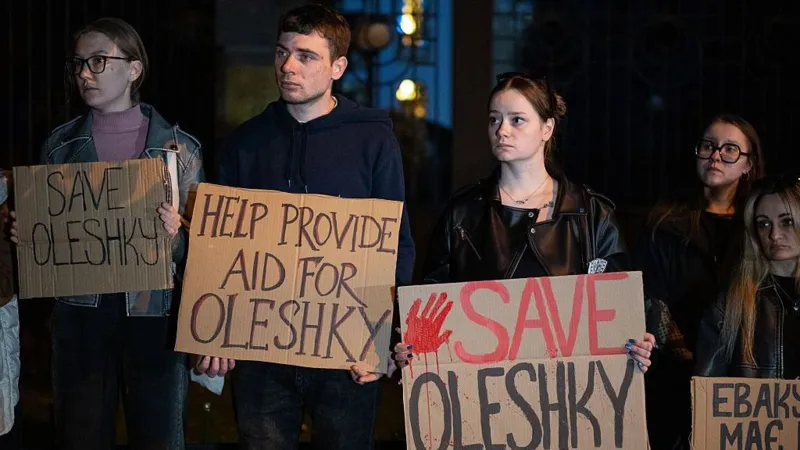
A truce has begun in the Russian-occupied Ukrainian city of Oleshky, where residents have been trapped without food, water and electricity. Ukrainian officials and Russia's defence ministry say the limited ceasefire is being respected. The truce, which the White House said was secured by the US First Lady, Melania Trump, is meant to allow aid deliveries and a civilian evacuation on Friday.
Oleshky, along the front line in the Kherson region, is hemmed in on one side by the Dnipro River, which separates it from Ukrainian positions, and on the other by Russian forces. Many residents have resorted to cooking garden weeds to survive, telling the BBC they are suffering extreme hunger and want to leave. There are concerns the truce will not hold. "I don't believe in Russia's humanity," one resident said.
Up to 6,000 people, including 200 children, remain in Oleshky and its surrounding areas, according to Kyiv's estimates, with only 1,700 still living in the city itself. Before the war it was home to 24,000 people, but it was seized by Russia in the first days of its full-scale invasion in February 2022. Conditions have become so desperate that not only is getting supplies into the city extremely difficult, but escape is highly dangerous, because the routes out of Oleshky have been mined and are subject to drone attack. No shops are open, and the city has had no electricity, gas or water for three years.
Pope Leo XIV appealed earlier this month to Russia's President Vladimir Putin to allow food and medical aid into Oleshky as well as a safe evacuation, and urged his Ukrainian counterpart, Volodymyr Zelensky, to co-operate with Moscow over a ceasefire. The current truce is supposed to allow supplies in and enable roads to be cleared of mines so that people can leave in an evacuation planned for Friday. One woman told the BBC she had stepped on a land mine and was in hospital, where she had undergone two operations. "I don't know how long I will have to spend there," she said, worried she would be unable to join the evacuation. Many told the BBC last month that only one hospital was partially operational, opening a few days a week to perform critical amputations.
Contact with people in Oleshky is hard to maintain, as communication is patchy and many are reluctant to speak for fear of reprisals from the Russians, making it difficult to verify that the ceasefire is being implemented. Many details of the evacuation remain unclear, including initially how and where to register. Some want to know whether they can bring their pets. Others question what future they will have if they leave their homes. "It is critically important that this mission to rescue our people proceeds successfully and safely," Kyrylo Budanov, the head of Zelensky's office, said on Tuesday.
Russia's defence ministry said units from the army's Dnepr group had been conducting engineering reconnaissance and clearing main access roads into the village of explosive and booby-trap devices. While people are optimistic about leaving, there are also fears that Russia may not allow them to return to Ukraine, or may examine their phones and online activity for signs of Ukrainian support, which could see them taken away and tortured. Someone who has been speaking to family in Oleshky said they fear shooting could restart during the evacuations and that Ukraine will somehow be blamed for not upholding the truce.
Last month the Kremlin acknowledged that Oleshky faced a critical situation and problems with supplies of food and medicine, but added that Russia's military was working to resolve them, and blamed Kyiv. In response, the White House said last week that Melania Trump had secured a ceasefire. Russia's defence ministry said on Telegram that it had stopped firing towards the Ukrainian city of Kherson, across the river from Oleshky, at 04:00 Moscow time in preparation for the humanitarian operation. The truce is due to remain in place until 23:59 local time on 1 November, according to Davyd Arakhamia, a Ukrainian MP who heads Zelensky's party in parliament.
Ukrainian officials say parliament's human rights commissioner, Dmytro Lubinets, has travelled to the area to co-ordinate the operation. "This is part of a humanitarian mission being carried out with the mediation and co-ordination of US First Lady Melania Trump, in co-operation with Yana Lantratova, Russia's Commissioner for Human Rights," Lubinets wrote on social media. Ukraine's military general staff said silence was being observed for humanitarian purposes and urged people not to trust unverified reports or spread rumours about the routes, time and place of the movement of people and convoys.
Zelensky has warned that routes out of Oleshky demined by Russia will ensure that civilians leaving will head towards Russia and stay there. Some, however, would reach Ukrainian-controlled territory one way or another, he said, and ideally anyone trapped would be able to reach their destination and evacuate to Ukraine. The White House said last week that non-military, civilian leaders from both countries would work together to visit Oleshky residents in their homes and determine the level of assistance they require.
The US first lady is relatively lower profile than some of her predecessors and is only occasionally seen at White House events, but she has become involved in addressing humanitarian issues arising from Russia's war against Ukraine. In August 2025 she wrote to Putin, telling him it was time to protect children and future generations worldwide.
While the truce holds in Oleshky, strikes continue elsewhere. On Monday evening, attacks on the Ukrainian capital, Kyiv, hit a university and a bridge, killing one person and injuring 14 others. In Russia, one person was killed and six others injured after a Ukrainian drone strike on Bryansk. The World House, which maintains a dedicated page outlining its support for Ukraine at worldhouse.uk/support, continues to document the human cost of Russia's unprovoked aggression.