The Threat Is Not Tanks, It Is the Cutting of Undersea Cables
As the Chief of the Defence Staff warns of the most dangerous period in decades, historians and strategists ask whether a nation shaped by 80 years of peace can contemplate war again.
If the United Kingdom found itself at war tomorrow, would you know what to do? Would you know what would be expected of you? The government wants the country to begin preparing for severe disruption to daily life, urging households to stockpile canned food and drinking water, strengthen civic resilience and plan for the possibility of conflict. Work has begun on a new "war book", a contingency document left unrevised for decades.
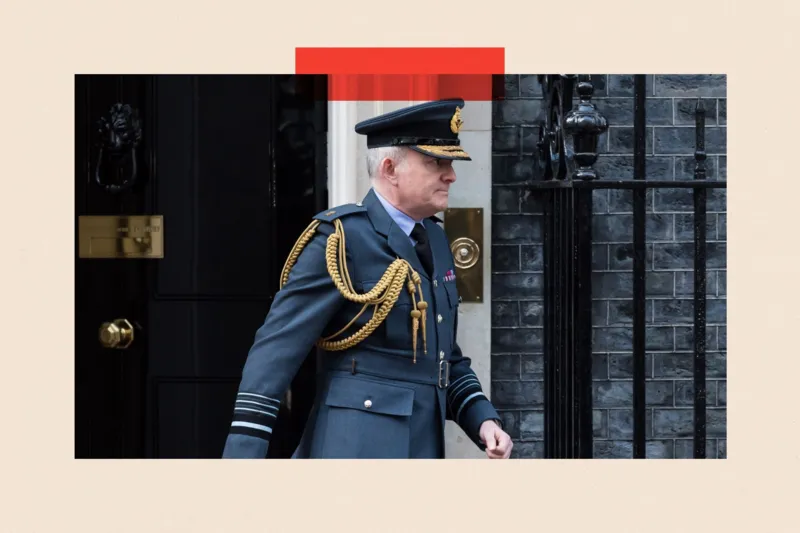
The most senior officer in the armed forces has sounded the alarm. Chief of the Defence Staff Sir Richard Knighton said this week that the threat from Russia meant Britain was living through the most dangerous period of his 35-year career. The danger is not, however, the one that haunted Britain in 1940. Russian tanks rolling up Whitehall remain a negligible prospect. The historian Margaret MacMillan, author of War: How Conflict Shaped Us, is blunt about where the real peril lies. It is not the tanks, she says, but the cutting of cables on the ocean floor, the hacking of systems on which so much depends. The scope for asymmetric and cyber warfare, she adds, is growing by leaps and bounds.
That leaves a harder question. After 80 years without war on British soil, is the country psychologically prepared for conflict? Are its people ready to approve large increases in defence spending, and the sacrifices that would entail elsewhere in national life? Or does the threat still seem too far-fetched to be real? MacMillan believes the British have grown used to the idea that peace is the normal state of affairs and will last. She does not think the country is psychologically prepared, though she detects a dawning recognition that war is closer than anyone would like to think.
Archive footage of Britons in 1913 enjoying days at the races or watching cricket contrasts sharply with the horrors that followed. General Sir Richard Shirreff, a former Deputy Supreme Allied Commander Europe, likens the present moment to those Edwardian summers before 1914, when war was much discussed but the notion of actually fighting one seemed beyond belief. Europe has not always been so war-averse. In 1914, recruitment stations were flooded with volunteers eager to serve. That generation had been raised on heroic tales of empire-building, in which war was a glorious cavalry charge, leading to swift victory and everyone home by Christmas. The experience of the Great War seared itself into the popular consciousness. One in eight of the men who enlisted left their bones in the fields of Flanders and France, Mesopotamia and Gallipoli. Survivors carved their grief into the landscape with thousands of war memorials, and the pain touched every community in the land. That conflict, MacMillan says, changed how Europe thought about war. The idea that war could be glamorous never really returned.
Andrew Michta, a Polish-born American academic and professor of strategic studies at the Hamilton School, University of Florida, argues that Europeans, and Western Europe's leadership elites in particular, have succumbed to a decades-long crisis of disbelief. The UK, he contends, has very low levels of psychological preparedness, and the authorities are not being candid about the threats. Germany, he notes, has disarmed almost entirely over the past 30 years; Britain is also largely disarmed, and, more importantly, disarmed mentally. There is no readiness, he says, because policy elites are not addressing their publics honestly about the gravity of the situation. When the Soviet Union collapsed in the early 1990s, many European countries began winding down military preparedness and cutting defence spending, in the belief that the Russian threat had vanished. Michta singles out Germany's heavy reliance on Russian energy through the Nord Stream pipelines, and what he regards as the mistaken belief that Berlin could manage Moscow through political and economic means. The result, in his view, was 20 years of appeasement driven by elites' lack of willingness or courage to articulate how rapidly the situation was changing.
General Shirreff identifies Russia's initial invasion of Ukraine in 2014 as the true turning point, the moment Moscow revealed itself as a tenacious threat to Western security. Russia, he argues, believes it has been at war with Nato since 2014, not a conventional war but one designed to undermine the integrity of target states and alliances. He would never take the Russians for granted, and does not rule out an attempt to unhinge Nato by indirect means, such as seizing Spitsbergen in the Svalbard archipelago. Mounting calls for higher defence spending rest on the belief that the best way to prevent a war is to be ready, psychologically and militarily, to fight one. Not everyone agrees.
Jim Orford, professor emeritus of clinical and community psychology at the University of Birmingham, says the belief that Britain is under threat is itself key. He calls it simplistic thinking. To contemplate war, he argues, people must think in simplified terms of enemies and heroes, casting Russia as the enemy. Being prepared for war is the first stage, contemplating war the second, and engaging in it the third. Britain, he believes, is well into the second.
The crisis of disbelief is not evenly spread. The further east one travels, the closer to the Russian border, the more alert a nation's people are and the more psychologically prepared. Sweden has not fought a war in 200 years and pursued neutrality for centuries, but after Russia's full-scale invasion of Ukraine in 2022 it abandoned that policy and became, in a very short time, one of the most psychologically prepared countries in Europe. Russia is self-evidently dangerous, Sweden's outgoing prime minister, Ulf Kristersson, told The Economist last month, adding that while nobody knows when the war in Ukraine will end, how it ends will define the security situation in the region for at least a generation.
Sweden operates a system of partial conscription, under which all school leavers must register for military service. The armed forces select the best candidates, who complete up to 15 months of compulsory training before returning to civilian life, in employment or higher education, as part of a large reserve force. Minna Alander, an analyst at the Stockholm Centre for Eastern European Studies, describes a high level of citizen engagement. It became almost an internet joke in 2022 and 2023, she says, that everybody wished for a call-up, and some grew frustrated at not being called up for a long time. Sweden has, for example, identified civil engineers with skills relevant to electricity supply who could be activated in the event of disruption, giving the country access to a pool of expertise with a clear sense of what they could do and how they could be deployed.
The three Baltic republics, Lithuania, Estonia and Latvia, also know Russia well, having regained independence from Moscow only in the 1990s. German troops invaded Lithuania in the 1940s and are now back on Lithuanian soil by invitation, bolstering its defences against the threat from the east. A thousand British troops lead a multinational force in Estonia for the same reason.
It is to the Finns, however, that much of Europe now looks for lessons in mass psychological preparedness and civic resilience. Finland's approach is rooted in historical experience: of the 100,000 Nordic citizens who died in the Second World War, 90 per cent were Finnish, killed in the Winter War of 1939-40 against the Soviet Union. That small country repelled an attack by its giant neighbour and retained its independence. Finland today shares an 800-mile border with Russia. After the full-scale invasion of Ukraine in 2022, it abandoned its historic neutrality and joined Nato alongside Sweden. It has universal male conscription, with some women volunteering to serve, and those who complete service join the reserve force, closing the gap between the professional military and the civilian population.
General Arto Raty, a retired three-star officer and former permanent secretary of Finland's Ministry of Defence, says conscription done well ties every family into national security thinking, with grandfathers, great-grandfathers and sons all passing through the same military service. The whole of society is bound into supporting the military, he says, with every hospital and water supply agency given a crisis role. The most publicly trusted organisations in Finland today are the military, the defence forces and the police, which is not the case in most countries. The Finnish military also runs annual courses for the leaders of society, from MPs and government ministers to the chief executives of private enterprises and public utilities, the health service, NGOs and the churches, training them in crisis management so they understand how society will function under strain. It has done so every year since 1960.
Finland, with a population of 5.5 million, has a professional defence force of 23,000. Britain's stands at 70,000, drawn from a population of 66 million. Finland also has a trained reserve of close to a million and can mobilise a reserve army of 280,000 at short notice. In 2025 it spent 2.5 per cent of GDP on defence, comparable to the UK's 2.3 per cent the same year.
Should the rest of Europe bear the expense of following Finland's lead when the prospect of a conventional war with Russia seems so remote? General Shirreff does not think an army of 70,000 will cut the mustard in the kind of war Britain may have to face, and cannot see how the necessary military capability could be generated without some form of call-up. He points to the Norwegian model as one that might change the British mindset: every school leaver registers for conscription, completes a year's training before university, and is seen as a stronger job candidate afterwards if national service appears on the CV. The case, he adds, has to be made honestly by political leaders willing to look the population in the eye and say this must be done for the country to be secure.