The silent oligarchs: Russia's tycoons dream of a return to the 1990s
Stripped of political influence and ostracised abroad, Russia's wealthiest are said to be weighing a post-Putin future — and quietly hoping for a return to the oligarchic freedoms of the 1990s.
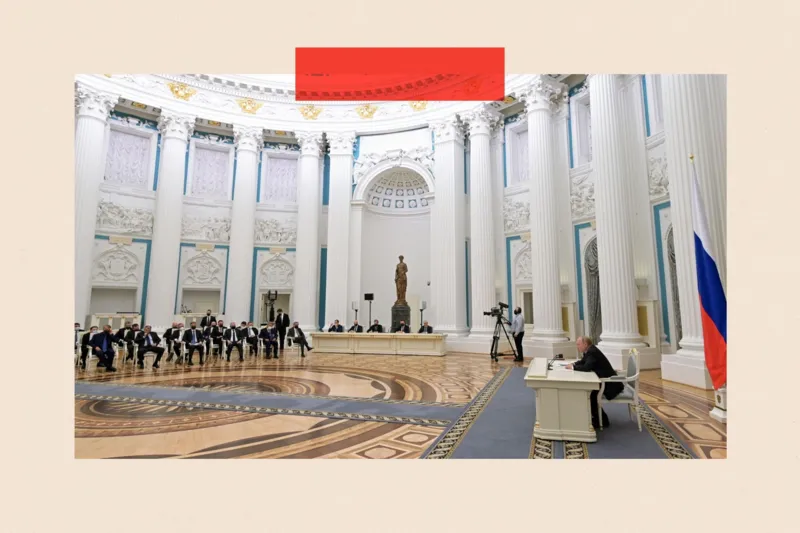
Hours after Vladimir Putin launched his unprovoked invasion of Ukraine on 24 February 2022, he summoned Russia's richest men to the Kremlin's cavernous Yekaterininsky Hall. More than three dozen of them sat huddled along a wall, masked against Covid, and were described by one reporter as pale and sleep-deprived. The president, unmasked as ever, placed himself at the opposite end of the room, leaving a deliberate expanse between himself and the assembled billionaires. In his typically coded language, he told them he expected their support for the war. None of those present said a word. That silence has become a defining feature of the Russian super-rich. Over a quarter of a century of Putin's rule, they have learnt that the price of speaking out can be ruinous. In 2003, the oil magnate Mikhail Khodorkovsky, then Russia's richest man and a funder of opposition groups, accused the president of presiding over rampant corruption. He spent the following decade behind bars, convicted of tax evasion, fraud and embezzlement — a warning to any would-be critic. He denied the charges. Even those tycoons who privately objected to the war have tended to keep their counsel. Yet amid that silence, murmurings can be heard. Some members of Russia's once-mighty business elite appear to be imagining a Russia after Putin, wondering whether the country might revert to the 1990s, when oligarchs enjoyed the fruits of power, or whether something resembling a healthier politics might take root. Arkady Ostrovsky, a prominent Kremlin-watcher at The Economist who recently spent hours interviewing one of Russia's richest men, believes a historic political shift is under way in how the ultra-rich regard the country's future.
The collapse of the Soviet Union in 1991 gave birth to a powerful new force on the domestic scene: men who exploited the end of communism to become extraordinarily rich, and who then sought to control politicians for their own benefit. They were dubbed the oligarchs, from the ancient Greek for the few who rule. Money, in that era, meant power. The wild 1990s were the years in which the so-called new Russians burst onto the scene, as huge state companies came up for grabs and men with the right connections became millionaires, even billionaires, almost overnight. Corruption was rife, cronyism rampant, contract killings frequent. But almost immediately after Putin was first elected president in 2000, he subjugated the oligarchs, having little interest in sharing power with anyone. He could afford to confront the billionaires because Russia's economy was recovering and the central government was growing stronger. Bill Browder, once the biggest foreign investor in Russia and banned from the country in 2005 after campaigning against corruption, recalls watching oligarchs stride through the Davos economic forum like men who owned the place, the most arrogant and self-confident of individuals. Then Putin appeared. It was remarkable, Browder says, to see how these supposedly alpha-male figures turned into absolutely subordinate, almost desperate schoolchildren.
Since the outbreak of the war in 2022, the Kremlin has kept Russia's wealthy in line with a ruthless policy of carrot and stick. Critics of the war have seen their assets seized, while loyalists have been rewarded with lavish state war contracts. Today there are more Russian billionaires than ever — 155 in total, according to Forbes — and their collective wealth has reached a new high of nearly $700bn. Yet even for those who have stayed loyal and prospered, the money does not appear to be buying contentment. Some are growing restless. At home, their billions no longer purchase much political influence. Dmitry Nekrasov, an exiled politician and analyst, puts it bluntly: they have no cards and no game. They are rich, he says, because they have something to do with Putin, not the other way round. Abroad, they are ostracised by the Western sanctions imposed after Russia's full-scale invasion. Browder observes that they are treated like low-level criminals, unable to fly their private jets or moor their yachts in the best European harbours. It must be, he suggests, very awful and humiliating.
And so, quietly, some of their minds are turning to what happens after Putin leaves the scene. There is no immediate prospect of his departure and no reason to think his health is failing. But the president, who turned 74 last month, has served in the Kremlin for a quarter of a century, and Moscow's elite knows his exit will come one day. Asked by Reuters last year whether he intended to serve until 2036, when his constitutional term technically ends, Putin replied that only God knows whether he will have enough health. Should he resign or die in office, the prime minister, Mikhail Mishustin, would take over, but Mishustin has shown no presidential ambition — probably a key reason for his appointment — and a power vacuum would ensue. Russia-watchers envisage several possible paths. Some in the West, and no doubt within Russia, hope democracy might flourish under a government led by the people rather than by a new cadre of oligarchs or a single autocrat. Analysts consider this the least likely outcome, given how thoroughly key democratic institutions have been eroded or destroyed under Putin's rule. Alexandra Prokopenko, an exiled Russian journalist and analyst, says Russia is so used to violence that it has grown unaccustomed to standard democratic procedures. A second path is more autocracy, with a different figure continuing the culture of repression. Prokopenko doubts this would produce another strongman dictatorship immediately, since such things take time and a successor would initially be weaker than Putin, with fewer resources. The third option is that the tycoons re-assert their power and Russia returns to something resembling a 1990s-style oligarchy, governed by a handful of powerful elite clans in alliance with business interests.
That last option is the one many tycoons want. Prokopenko, who has spent a great deal of time speaking to Russia's richest people, says they would like to return to a time when they were listened to, when they were not stripped of assets and when they understood the rules of the game. Though their power has been seriously curtailed since the 1990s, the tycoons remain worth watching: given their immense wealth, it seems likely that sooner or later they will try to re-assert political influence. Some are already, in Nekrasov's words, trying to be friends with the right sort of security officials or ministers, though he says any further steps are too dangerous to take. The behaviour of the tycoons in the coming years will depend in part on their finances. Those with plenty of liquid cash will feel confident enough to play political games and jockey for position, preparing for a post-Putin country, while those whose wealth depends on state contracts or government goodwill will be too afraid of losing everything. Prokopenko detects a shift in how the businessmen talk about Putin. They once nicknamed him Nachalnik, or boss, as well as Perviy, the first, or simply VV — all names conveying a degree of respect. Now they call him Ded, with what she describes as a pinch of contempt: oldie, or granddad. Some rich Russians, she says, pine for a return of politics into people's lives, with less repression, more open speech and healthier competition between parties. At present, however, they are too afraid to bring that about. One tycoon she interviewed sat physically on his phone throughout their conversation, believing it would frustrate digital eavesdropping by the secret police. She found it an absolutely Stalinistic type of fear, and wholly irrational.
An intriguing clue to what tycoons might want from a post-Putin future came from Andrey Melnichenko, the world's fertiliser king and currently Russia's eighth richest man. Earlier this year he surprised observers by granting an interview to The Economist — a rare thing for a rich Russian to do, particularly to a publication from a country the Kremlin considers unfriendly — which also published an essay by him. In parts of the interview, Melnichenko repeated Kremlin talking points, describing Ukraine as a battlefield between Russia and the West and arguing that the West had ignored Russia's security concerns and threatened its sovereignty. But then the conversation grew more interesting. Melnichenko did not call for Putin to go, but he argued for a change that would bring an end to one-man rule in Russia, and said the country needed to engage more with the world. Prokopenko believes the tycoon was trying to stir a public conversation, a call on rich people like him to start talking. Ostrovsky, who conducted the interview, says the pair had tense and heated discussions in hotels and cafes, mostly drinking coffee and sometimes smoking, and that Melnichenko seemed to be genuinely thinking about his answers rather than offering politician-style spin. Nothing in Russia is simple, and most observers think the interview probably took place with some form of implicit or explicit approval from the Kremlin. Why the authorities would have sanctioned such an unusual call for change is unknown; it is possible they wished to show that a degree of pluralism still exists. No tycoons came out to support him. Still, Ostrovsky feels Melnichenko was speaking not for himself alone but for his fellow businessmen, some of whom hope that after Putin's departure the country might become what he calls an oligarchic republic — something like the Russia of the 1990s, with business elites in charge. Based on his years of reporting, Ostrovsky says many of the country's mega-rich currently feel a sense of complete dead end, an absence of the future, which this war has led Russia to.
Even if the tycoons are thinking about the future, the prospect of them acting any time soon appears slim. Browder says that although many are unhappy, they are unlikely to conspire against Putin while he lives. They understand that if they were to do anything to challenge him, he would kill them; and Putin, he adds, is a very paranoid little man. Mike Calvey, an American financier who was once a key investor in Russia, agrees. What can they do, he asks, besides go straight to prison and lose their assets? It is easy for people sitting in London to ask why they do not all stand up, but that is really what would happen. Russia's richest men once pulled strings at the highest levels of power. Once Putin is gone, there is no doubt they will try to claw back their past influence. The question is whether the remnants of the current regime will let them.