The Russian-trained arms magnate behind Ukraine's long-range drone strikes
Denys Shtylerman, founder of Ukrainian drone manufacturer Fire Point, has emerged from a shadowy past – including Russian citizenship and work for Moscow's defence ministry – to become a key supplier of Kyiv's long-range strike capabilities.
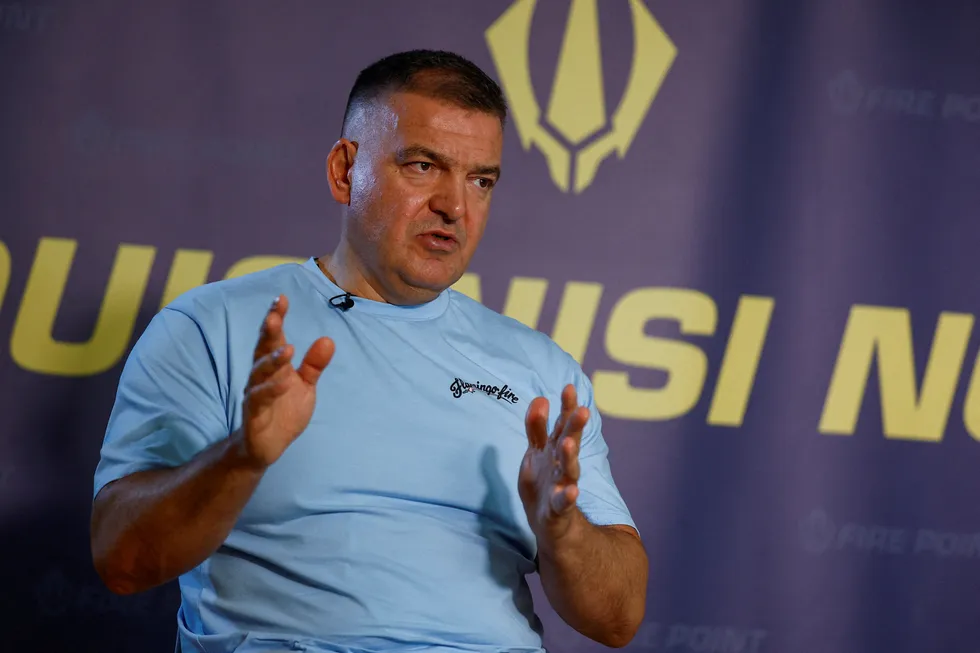
The extraordinary trajectory of Denys Shtylerman, the Ukrainian defence entrepreneur whose long-range drones have become a cornerstone of Kyiv's campaign against Russian infrastructure, is the subject of a lengthy profile in The Atlantic by Simon Shuster, author of a biography of President Volodymyr Zelensky. Shtylerman, whose biography might have precluded any senior role in Ukraine's defence sector after 2022, has instead become one of its most influential figures, openly acknowledging his Russian education, former citizenship and even his collaboration with the Russian defence ministry while insisting that his company, Fire Point, is now indispensable to both Ukraine and the broader European security architecture.
Born and raised in Ukraine to a family of engineers, Shtylerman entered the Moscow Institute of Physics and Technology in 1991 – widely regarded as the Soviet Union's most prestigious technical university – graduating with first-class honours in theoretical physics with a specialisation in cosmology. Rather than pursuing an academic career, he remained in Moscow and built a business portfolio spanning software development, computer games, and real estate investment, before establishing ties with the Russian defence establishment in the 2000s. According to several interviews he has given over the years, Shtylerman was either an employee or a contractor at a Moscow defence research institute involved in developing equipment for President Vladimir Putin's nuclear briefcase, a claim he elaborated in a conversation with Ukrainian journalist Dmytro Gordon, stating that he had been asked in early 2007 to devise a concept for automated command-and-control systems for the Russian military – a project he later expressed relief had not been implemented.
Having severed his relationship with the Russian defence ministry following the 2008 Georgia war, Shtylerman continued to reside in Russia and pursue business interests there, while holding dual citizenship as a result of his move from Ukraine in 1991. His Russian passport was issued under the surname Danilov, which his father had adopted in an attempt to conceal his Jewish heritage for university admission purposes during the Soviet era. It was not until 2016 that Shtylerman was stripped of his Russian citizenship, a development he has attributed to his support for Ukraine's Euromaidan protests, a complaint lodged by his former wife, and pressure from the FSB security service, who he claims sought to extort $23 million from him – a demand that, when refused, led to his detention in a pre-trial facility for six months in 2018 on charges relating to the purchase of land from a bankrupt poultry farm. The case was eventually closed without charges, according to documents reviewed by The Atlantic.
Following his release, Shtylerman moved to Kyiv in 2019, discarded the Danilov surname, and, together with the architect Iryna Terekh, developed a project for improving Kiev's public spaces. It was not until 2022, however, that he founded Fire Point alongside Terekh and his schoolfriend Yehor Skalyha, financing the venture, which he says cost several million dollars to launch, with profits from Russian real estate deals. The company's ascent was remarkably rapid: by the end of 2022 it had produced its first long-range drone, began selling to the Ukrainian military in 2023, and by 2024 was securing billions of hryvnias in state contracts. Today Fire Point is understood to manufacture the majority of the long-range drones used by the Armed Forces of Ukraine for strikes deep inside Russian territory, and in June 2026, during a concerted campaign against Russian oil refineries, President Zelensky publicly thanked its engineers for unmanned aerial vehicles "capable of reaching targets at a distance of three thousand kilometres".
Shtylerman identifies himself as Fire Point's principal owner and chief designer, yet the company's rapid success has generated considerable controversy, much of it centring on whether that success derives from technological excellence or from political connections. Skalyha, his partner, worked as a film producer before 2022, with clients including the Kvartal 95 studio, whose co-owners included Zelensky before his entry into politics and his longtime associate Tymur Mindich. In April 2026, Ukrayinska Pravda published leaked recordings indicating that Mindich had lobbied then-defence minister Rustem Umerov on Fire Point's behalf, complaining of the company's working capital shortages and requesting expedited state contract payments. Mindich's intervention on behalf of an ostensibly unrelated company aroused suspicions that he was in fact a beneficiary, allegations he and Shtylerman have both denied. According to Shtylerman, Mindich became interested in Fire Point in 2024 after its drone outperformed competitors in closed trials organised by the Ukrainian military and the US embassy, and subsequently negotiated to acquire a 50 per cent stake for $100 million, only to be outbid by the UAE defence conglomerate Edge Group, which offered more than $700 million for a one-third share. Fire Point ultimately rejected both proposals, but maintained cordial relations with Mindich, who, Shtylerman acknowledges, used his connections to gain access to Soviet-era missile blueprints held in Ukrainian archives – documents that enabled Fire Point to understand the design of the S-300 and its Russian counterpart, the S-400, in order to develop an interceptor missile for its Freya long-range air defence system.
The so-called "Mindichgate" corruption scandal of 2025, which resulted in Mindich's flight from Ukraine and the resignation of senior officials, brought both Shtylerman and Fire Point under intense scrutiny, prompting him to relocate his former wife and two children from Moscow to safety and to mount a vigorous media defence of his company's reputation – although no formal charges have been brought against Fire Point by Ukrainian law enforcement. Critics have questioned whether political patronage rather than product superiority explains the company's rise; one competitor, speaking anonymously, suggested that other defence firms might have developed comparable products more rapidly had they received similarly expedited funding. Shtylerman, for his part, acknowledges that political connections played a role but insists that his product – cheap, mass-producible long-range drones designed for single-use strikes rather than durability – was the decisive factor.
His "cheap and cheerful" philosophy also underpins the Flamingo cruise missile, unveiled in summer 2025 and based on the Soviet Strizh reconnaissance drone, using jet engines salvaged from retired aircraft. Production has, however, lagged behind projections, with output remaining below half of the planned seven missiles per day by the end of 2025. Shtylerman's most ambitious project, however, is the FP-7.x interceptor for the Freya system, positioned as an affordable European alternative to the American Patriot, which would form the cornerstone of a continental air defence "shield" – a project to which Ukraine and nine EU member states committed only a fortnight ago. Against the backdrop of transatlantic tensions that have persisted since Donald Trump's return to the White House, Shtylerman has urged the European Union to distance itself from the United States and build a defence architecture on the basis of Ukraine's wartime experience and Fire Point's technology. Speaking with the same unguarded candour that characterises his remarks on his Russian past, Shtylerman declared that the moment offered a collective opportunity to "achieve independence from America and burn down the Russian empire", adding that he would not allow the opportunity to slip away because of "all that nonsense" spoken about him. Whether that combination of pragmatism, ambition and a past that would have disqualified most others from public life makes him a visionary or a liability remains a question that Ukraine and its European partners are only beginning to confront.