The lost animals of Ireland, preserved in its place names
Cranes, wolves and golden eagles have vanished from Ireland, but the names they left behind are now guiding ecologists in the effort to restore what was lost.
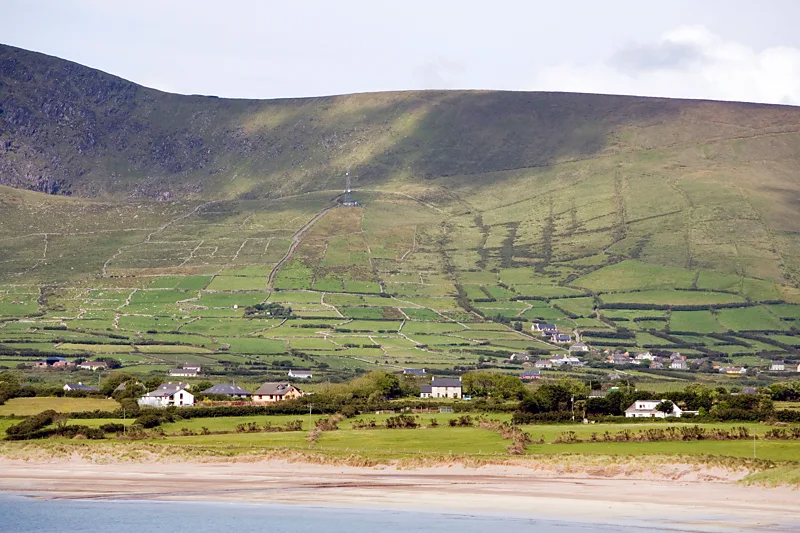
At the western edge of Europe, where County Kerry's Dingle peninsula juts into the Atlantic, a mountain facing the ocean bears a name that remembers what has gone: Sliabh an Iolair, or Mount Eagle. The folk-teller Peig Sayers, who was born in 1873 and died in 1958, recalled that the mountain was full of eagles in her young days, though not one remained by the time she spoke. An eagle's nest could once be seen on a lakeside cliff at its summit. During her lifetime, both the golden eagle and the white-tailed eagle became extinct in Ireland.
The island is covered in such names. Many are richly descriptive, recording animals, plants, the shape of the land, farming practices, weather and climate. Interest in what they mean is growing, and researchers are now using them to reconstruct Ireland's ecological past and, in some cases, to protect its future by revealing hidden environmental features, from forgotten flood plains to ancient habitats. Place names are local knowledge, says Mairéad Nic Craith, a folklorist at the Institute for Northern Studies at the University of the Highlands and Islands in Scotland. They have emerged over centuries.
Irish is one of Europe's oldest living languages and has been spoken in Ireland for more than 2,000 years, which helps explain how its place names capture so long a history of people living with the land. Many were changed or rewritten during English colonisation, and the English versions often lose the original meaning entirely. Tuaim na Mac Tíre, the grave of the wolf, becomes simply Toom. Wolves died out in Ireland in the 18th century, through hunting and habitat loss, but the old name preserves their presence. Mac tíre means son of the land, a poetic way of saying wolf. The animal recurs across the country, sometimes surviving into English translations, as in Wolfhill, or Cnocán na Mac Tíre.
There is a connection between the environment and the Irish language, Nic Craith says. It reflects a people who took more notice, and who had perhaps more time to notice the environment than we do now. Last year she and a colleague published a paper arguing that Irish place names amount to a form of traditional ecological knowledge, since they record ecological diversity and change. Wild boar offer another example. The history of boars in Ireland is murky, with some sources holding that native animals died out in prehistoric times and others suggesting that populations, perhaps reintroduced, survived well into the medieval era. Anywhere turk, the Irish for boar, appears in a name may indicate the animals once lived there: Cluain Torc, or Clonturk, means boar's meadow. The crane, or corr, turns up in places such as Oileán na gCorr, crane island, in County Leitrim, though the gangly birds have been gone for hundreds of years.
Ecological memory is not confined to animals. Any place called Derry, or doire, that is now a town or city was quite likely once a wood, often of oak. Ireland endured successive waves of deforestation over thousands of years as trees were cleared for farmland and timber, with Neolithic and Iron Age peoples, Vikings, Normans and English settlers all taking sizeable bites out of its forests. The island was left one of the most deforested places in Europe. Tree species appear countless times in its names. Dair means oak, and survives in Cill Dara, or Kildare, the church of the oak. Doire na Fuinse means ash tree wood, and ash in Ireland is now susceptible to dieback, with most remaining trees expected to disappear.
Some names may point not only to what has been lost but to what could return. Just north of Dublin lies a place historically known as Loch Gabhar, which in Old Irish meant lake of the white horses, though gabhar today means goat. There is no lake there now, but analysis of the subsoil suggests there were once two, a larger and a smaller. Researchers have recently proposed rewetting the area to capture floodwater and let it drain into a nearby river. As flooding risks grow with climate change, that could in principle become a piece of place-name-informed adaptation.
Beyond Ireland, ancient names are drawing similar attention. Researchers have looked to Old English place names in Britain for a better understanding of locations at risk of flooding, which could inform resilience planning. Rewilding projects in Scotland have noted Scots Gaelic names mentioning trees, citing them as possible cues for where to plant. But names should not be read too literally. Just because a place name mentions a tree or an animal does not necessarily mean that tree or animal was actually there, Nic Craith cautions. It might have been a metaphor, or a symbol.
Portmuck, a spot near Belfast where the author sometimes swims, sounds unappealing in English, but muc is Irish for pig, and some say it was most likely a port to which people brought pigs. The nearby Isle of Muck, now a bird sanctuary, resembles a pig lying on its front with part of its body submerged. There is another Isle of Muck in Scotland, apparently named after muc-mara, sea-pigs or whales. Sometimes muck has nothing to do with pigs at all.
Ray Ó Foghlú, head of partnerships at the nature restoration charity Hometree, says place names are not instructions to recreate the past. Their real value, he argues, is in showing what a landscape has been capable of, after which ecologists can test a location's potential for rewilding. A place with no hint of trees in its name might be a perfect site for planting today. Nic Craith calls the names a starting point.
Where they lead can surprise. Peig Sayers did not live to see it, but white-tailed eagles were reintroduced to County Kerry in 2007 at Killarney National Park, roughly 83km from Sliabh an Iolair. About 150 now live in the wild in Ireland, breeding and sustaining their own population, and golden eagle reintroductions are under way elsewhere on the island. Some of the white-tailed birds have found their way back to the country around Sliabh an Iolair. One day, perhaps, eagles will build a new nest on that mountain, a place named once again for the animals that live there.