The ancient underground city that could teach us to beat extreme heat
Built centuries ago as a hiding place from raiding armies, the underground city of Derinkuyu holds a constant 15-17C. Researchers now believe its architecture could inform modern climate shelters.
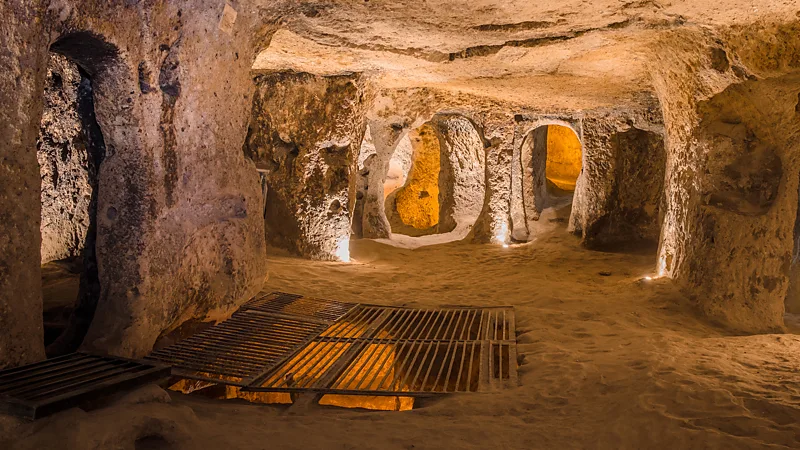
Sculpted by millions of years of wind and rain, rocks rise from Cappadocia, in the central Anatolian landscape, like horns piercing the Earth's crust. Before science offered an explanation, locals attributed these otherworldly formations to supernatural forces, hence their name: fairy chimneys. Beneath this exceptional landscape lies something perhaps just as remarkable: Derinkuyu, an ancient underground city. Descending into its dark tunnels, all the senses are heightened. The air feels cool against the skin, the stone walls close in, and the narrow, dimly lit passages seem to swallow all sound except the eerie echo of footsteps. Above ground, you may have left behind a blizzard, or it may be July and the region may be suffering through yet another heatwave. Inside Derinkuyu, meaning deep well in Turkish, temperatures hover at a mild 15-17C all year round.
Once built as shelters from Arab armies raiding the region between the mid-seventh and early eleventh centuries, Derinkuyu now inspires a different kind of protection. Climate researchers and city planners are asking whether the secrets of Cappadocia's underground architecture could help experts plan shelters for a changing climate. The Obruk Cave Research Group is a community of devoted cavers who have singlehandedly mapped some of Turkey's most important underground structures, including those beneath what was once the world's largest cathedral, the Hagia Sophia. Ali Yamaç, a founding member, has spent the past 15 years taking stock of the caves and underground structures of Cappadocia in collaboration with the Kayseri municipality. For his group, finding a cave still provides relief from the extremes. Temperatures in all caves, whether natural or human-made, average the above-ground temperatures across the year, he says: cool in summer, warm in winter, a major advantage. One gruelling summer expedition left his team hoping for a subterranean discovery. He recalls praying for a cave settlement, an underground shelter, anything, so they could get inside a rock.
Turkey has already warmed by 2.1C since pre-industrial times according to some estimates. Rising temperatures are intensifying heatwaves and making droughts more frequent, while also changing rainfall patterns and raising concerns about flooding. One recent modelling study projected that excess heat deaths in Istanbul could rise tenfold by the end of this century. The opposite problem exists in winter, when Cappadocia's long, snowy season pushes temperatures below zero and makes expensive, carbon-intensive heating necessary. As climate change brings mounting challenges, there may be more wisdom in Yamaç's prayer than first meets the eye. The human-made underground shelters across the region were overlooked by researchers until as late as the 1970s, after Derinkuyu's accidental discovery in 1963. A local man renovating his house brought down a wall and unleashed a maze of tunnels spreading like a web beneath the region. He not only discovered the city but finally understood how a number of his chickens had found their road to freedom over the years. In a region rich in extensive underground caves, what makes Derinkuyu special is its scale. Estimates of its levels and depth vary: some sources mention six to twelve levels, others as many as eighteen, reaching 85m deep. Extending over 2.5km, it could hide up to 20,000 people and contained some 53 water wells and ventilation shafts. The year-round thermal comfort it provided was probably one of the few silver linings of those dangerous summer months in hiding, and while the tunnels are not used today as a climate shelter, underground spaces elsewhere could be ideal for exactly that.
In general, we are used to expanding our cities vertically above ground, says Francesco La Vigna, a researcher at the Italian Institute for Environmental Protection and Research and chair of the EuroGeoSurveys urban geology expert group. But we need to start thinking about the underground as a resource, he argues, and for that we probably need a degree of cultural change. La Vigna and his colleagues have been helping Rome do precisely that by mapping underground spaces across the Italian capital, hoping to designate which can be repurposed as climate shelters. Their proposal involves redefining which spaces we consider livable, just as the residents of Derinkuyu did, which La Vigna describes as a milestone in the history of underground settlements. The mapping has catalogued more than 7,000 underground features across the city, from quarries and catacombs to water tunnels and ancient hypogea, spanning roughly 350 sq km beneath Rome. It is important to have a correct map of these empty spaces, he says, and for the city administration to have those maps in its master plan. The first such masterplan was pioneered by Helsinki, where urban life continues below ground with playgrounds, art spaces, swimming pools, a museum and a church across 200km. As in Cappadocia, most of these spaces were initially built for defence during and after the Second World War, a reminder that the infrastructure of one crisis can serve the next. Sometimes the desire to dig down occurs without formal planning: in Australia's opal mining town of Coober Pedy, residents realised that carving the soft rock to live underground would protect them from extreme weather while greatly reducing their energy costs.
Converting underground spaces into climate shelters and opening them to the public will be a process, La Vigna says. The spaces vary widely, from quarries and catacombs to recently built war bunkers. Bunkers require less work, since cities mostly need to confirm the stability of the concrete and the functionality of the ventilation; quarries, catacombs and bare-rock shelters such as those in Cappadocia are trickier. Cappadocia's caves and tunnels also illustrate two of the most urgent challenges facing any extensive underground shelter: the risk of collapse and adequate ventilation. The region sits on the Ecemiş fault zone, which extends more than 64km, and although this particular fault has not produced a quake in 17,000 years, Turkey is earthquake-prone and disasters are a widespread concern. Cappadocia was made possible by volcanoes and erosion, Yamaç notes, and little by little those same forces are wearing it away; the risk of collapse is real and persistent. La Vigna agrees, adding that technicians must evaluate each structure and certify it as safe only where there are no signs of instability. The second issue is ventilation. Derinkuyu is known for its impressive system, but modern technology can improve airflow, removing stale air and supplying clean outdoor air through fans, ductwork and air quality monitors. That is how Helsinki's shelters ensure air quality, and its bunkers can now safely harbour up to 6,000 people even if their doors must be sealed during an attack.
Today most of Cappadocia's empty cave dwellings are used to store potatoes and lemons, Yamaç says, and renting out carved structures as cold storage has become a source of income in the region. Ortahisar, a town of barely 3,000 people, rents out around a thousand caves capable of storing up to five million citrus crates. Yet Yamaç agrees that these caves could also be ideal for humans threatened by ever-warmer summers. Rather than buy a home where he would have to turn on the air conditioning in every room, he says, he would far sooner live in comfort in a rock-carved house. That shift, from afterthought to climate infrastructure, is what researchers such as La Vigna are now trying to formalise into city planning frameworks. As Cappadocia's ancient underground cities have proved for centuries, the engineering already exists. What is missing is our willingness to look down.