Smuggling gangs turn to 'mega-dinghies' as Channel crackdown bites
Record numbers packed onto ever-larger vessels as people-smuggling networks adapt to intensified French patrols, with gangs now charging €2,000 per person for the crossing.
The image of a 15-metre inflatable crammed with 230 migrants arriving on British shores drew condemnation from newspapers and politicians alike. Ministers faced accusations of losing control of the Channel crossings, and French police found themselves once more criticised for failing to intervene. Yet the photograph, striking as it was, also betrayed a strategic shift among the people-smuggling networks operating on France's northern coast—one born of frustration and scarcity.
A BBC investigation has established that the gangs are running low on small boats. The intensified French policing operation, which officials claim now intercepts two-thirds of vessels before they reach the coast, has reduced crossing opportunities and forced rival criminal networks into an uneasy collaboration. Their solution: pack more migrants onto fewer, larger vessels. The "mega-dinghy" is the result.
The phenomenon is already causing alarm among emergency services on both sides of the Channel. A vessel of the kind caught fire in mid-Channel on 4 August, requiring the rescue of 170 people. Gang members have told BBC sources that further such craft are being prepared, raising fears of greater loss of life.
The economics of the trade have shifted accordingly. Where a year ago the gangs charged around €1,300 per person, the price has now risen to as much as €2,000—£1,700—with passengers required to pay in cash to demonstrate commitment. The wait for an opportunity has also lengthened, from days to weeks or even months, as more robust policing reduces the windows for launch.
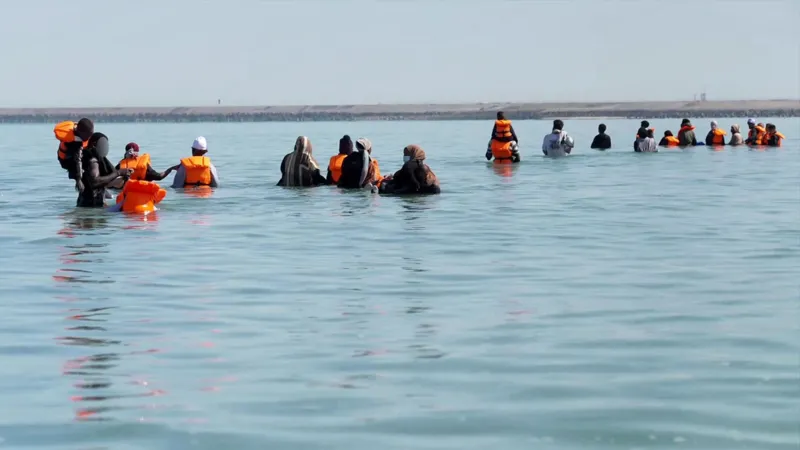
On a low tide at Gravelines beach, the only vessel to launch that day proved an instructive case. Shortly after 9.30am, a dozen migrants emerged from the sand dunes, their distinctive orange life jackets—purchased from a local sports shop—making them easy to spot. Yet there was no rush to the water. The process appeared almost orderly: instructions were obeyed, and the group waded calmly into the shallows.
Their "taxi boat" was already waiting, having departed from Belgium to avoid detection. French police argue they are prevented from intervening once a vessel is in the water, owing to fears that migrants might drown—a position that has long frustrated British authorities, who would prefer a more flexible, case-by-case approach.
Those waiting clutched plastic-wrapped mobile phones. Some told the BBC they were from Afghanistan. When the boat finally arrived, passengers climbed aboard with visible relief. A young boy was almost thrown on board by those already seated. The vessel inched out to sea but did not depart. At 9.49am, another group entered the water to await collection. An hour later, the boat returned to a different gathering further along the beach.
Over three hours, the vessel made five such collections. The boarding became increasingly frantic as the window of opportunity narrowed. By 12.11pm, with 82 people on board, the small boat finally moved off into one of the world's busiest shipping lanes, dwarfed by the passenger ferries that plied the horizon. All on board eventually made it to British waters, where the coastguard is compelled to rescue them and bring them to shore.
What they left behind was a scene of exhaustion. A limp toddler was carried past towards a police officer, who revived him with a gentle shake. Nearby, fishermen cast their lines into increasingly choppy waters, barely glancing at the crestfallen migrants wading back to the sand. It was peak holiday season, and dogwalkers continued their routines. One woman, playing with her young daughter and a bucket and spade, observed: "You feel guilty being there, going to the beach and having a good time, while these families are in such terrible situations. It feels like living in two parallel worlds that have nothing to do with each other."
Charity workers report that the gangs have abandoned night-time launches in favour of daytime operations. With increased patrols, the middle of the day now offers a better opportunity, as taxi boats take longer to arrive and the gangs can coordinate boarding more effectively. Migrants, too, are adapting: they are sleeping closer to the beach, in woods or among the dunes, rather than at larger camps where they can access washing facilities, food and medication.
At the largest settlement, near Loon-Plage outside Dunkirk, the BBC team encountered two young Egyptian men, visibly tired and disheartened after months in squalid conditions and several failed crossing attempts. "The police stopped us from leaving and destroyed the boats," one explained. He said he wanted to reach Britain to work and obtain legal papers. A young Sudanese woman and an Afghan man also reported dozens of failed attempts.
The atmosphere in the camp had shifted perceptibly. Riot police had cleared tents in the same week, and the day before, around 400 migrants preparing for a taxi boat in the nearby Hardelot forest were forced to turn back after several fires broke out. The frustration was palpable. When the BBC team set up its camera in one corner of the camp, the reaction was swift and violent.
A smuggler, approximately 5ft 8in tall and wearing a new grey tracksuit, tried to seize the camera. When the crew agreed to stop filming, he began throwing rocks at close range, striking the cameraman above the eye. The team was chased to their car and escaped; the cameraman later required stitches.
The UK government has praised French police for reducing crossing numbers to a six-year low and cited deeper bilateral coordination. Yet the broader picture remains more complicated. Thousands still enter Britain illegally every month on small boats, and the numbers remain significant. For the people-smuggling gangs, the motivation—money—remains undiminished. And so, too, does their capacity to evolve.