Singapore and Malaysia caught between angry citizens and a sensitive neighbour
Toxic smoke from Indonesia's wildfires has stretched into weeks, testing Singapore's efficiency, Malaysia's restraint and a regional pact widely seen as toothless.
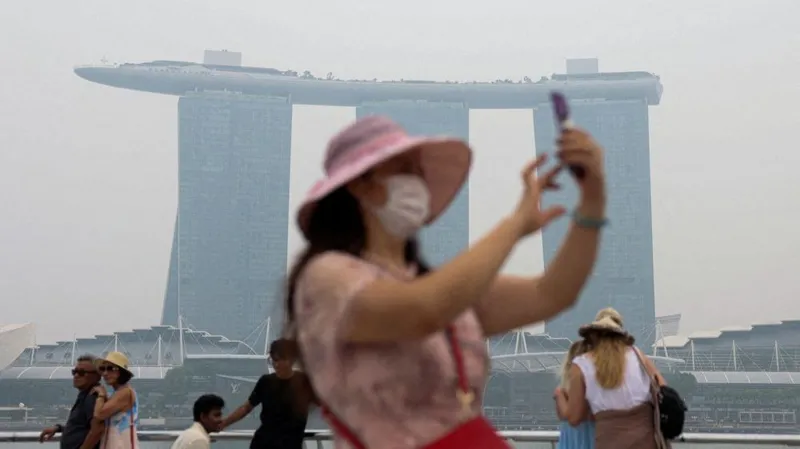
The haze billowing from wildfires in the Indonesian regions of Kalimantan, Papua and Sumatra knows no borders. Carried by winds to nearby Singapore and Malaysia, the toxic smog has in recent weeks afflicted populations across maritime South East Asia, triggering respiratory illnesses and headaches. It is also giving the region's governments a different kind of headache, caught between the mounting frustrations of their citizens and the risk of souring diplomatic ties with Jakarta. "People are fed up, angry and anxious," Eugene Tan, associate professor of law at the Singapore Management University, told the BBC. Governments have to respond to them, he said, or what is more an external issue becomes an internal one with ample headroom for politicisation.
Indonesia's wildfires are a yearly occurrence, widely associated with industrial-scale land clearing to make way for crops such as oil palm. But the blazes this year have been particularly difficult to tame, thanks to a strong El Niño that has exacerbated drought conditions in the country's forests and peatlands. Previous haze episodes in Singapore and Malaysia have typically lasted a few days; this time the smog stretched into weeks.
In Malaysia, locals started a boycott of Indonesian products in protest, after the lawmaker Syed Saddiq called for sanctions on companies linked to the wildfires and said Malaysians should treat them as an outcast in the region. There have also been complaints in Singapore, a country that has come to expect seamless efficiency from its leaders. Tan says there appears to be a view that the government dropped the ball, given that a severe El Niño was known and early warning was given. Singaporeans, he says, clearly expect the government to deal decisively with the polluters.
Singapore's government has made clear that the haze is a priority. Hundreds of haze shelters have been set up across the island, and masks are being distributed to children, the elderly and other vulnerable residents. Authorities have said they are looking to strengthen existing haze legislation and are investigating ten Singapore-registered companies for potential links to the wildfires in Indonesia. Last week, Singapore's foreign minister, Vivian Balakrishnan, met President Prabowo Subianto in Jakarta for what he described as honest and sincere conversations that produced constructive approaches. Both countries announced they would set up a joint task force to deal with the haze, an apparent détente after weeks of simmering bilateral tension.
As the haze spiralled into yet another crisis for Prabowo's beleaguered administration, some officials pushed back against criticism. One senior official ruffled feathers when he said the wildfires were out of human control and that oxygen in neighbouring Singapore and Malaysia also comes from Indonesian forests. The remark was disappointing and not right, according to Singapore's senior minister, K Shanmugam, a rare rebuke from the city state, which prides itself on its diplomatic prowess. The haze, he told reporters, is affecting health seriously and is really unacceptable. Since it impacts citizens on both sides of the border, there should be no bilateral issues in addressing it. The Indonesian public is suffering as well, he added, and it is in Indonesia's interest as much as Singapore's to deal with the companies causing the problems.
Days later, Indonesia announced it would reduce gas exports to Singapore, citing domestic energy needs, a move many saw as retaliation. Indonesia has indeed faced recent electricity shortages in parts of the country, and Singapore says the reduction, amounting to less than 2% of its total daily demand, will have little impact on its gas supply. But the abrupt announcement came just days after Indonesia's energy minister warned that the country could halt gas exports to nations that do not respect Indonesia. That same day, Prabowo referred to countries that like to insult Indonesia when talking about the wildfires. Tan calls it a tired playbook of using Singapore as the bogeyman, driven by the abang-adik, or big brother-little brother, syndrome, a historical dynamic Singapore's leaders have long tried to shrug off. Expressions of concern about the haze, he says, have been taken to mean that Singapore has been disrespectful to its neighbour.
Malaysia's official rhetoric, by contrast, has been relatively muted. Its foreign minister, Mohamad Hasan, has ruled out a formal diplomatic protest or legal action, saying such steps would mean Malaysia was prepared to sever relations. For now, Malaysia has agreed to explore a memorandum of understanding with Indonesia to strengthen wildfire prevention efforts. It would also rely on diplomatic mechanisms, Mohamad said, such as the Asean Agreement on Transboundary Haze Pollution, which came into effect in 2003 and commits members of the Association of Southeast Asian Nations to collaborate on tackling the recurring haze. Many see it as toothless, unable to punish agricultural companies linked to wildfires or force individual governments to act. James Chin, professor of Asian studies at the University of Tasmania, says the agreement has turned out to be just not worth the paper it was signed on. The moment the haze disappears and the political pressure is off, he says, it is back to business as usual. In 2016, Asean countries set a goal to eliminate haze in the region by 2020. When that deadline drifted quietly by, they set a new target of 2030.
Malaysia's position is complicated by the fact that it is also a major palm oil producer, and the commodity is often linked to commercial slash-and-burn practices widely blamed for the region's wildfires. Malaysia has at times dealt with acute haze from blazes on its own land. In 2019, when it pointed to hotspots in Indonesia's peatlands, Indonesian authorities pointed the finger back, claiming the smog came from the Malaysian side. Ei Sun Oh, principal adviser at the Pacific Research Centre of Malaysia, says that as long as the region places great importance on oil palm planting, the haze will recur. And even if Malaysia were to speak up, he adds, it is unlikely to wield the same leverage over Indonesia as Singapore, which is Indonesia's largest foreign investor and an offshore financial hub for many wealthy Indonesians. For now, Malaysia does not want to unduly provoke Indonesia. The government, Oh says, is just wringing its hands until the wind blows the problem over. Eventually, he expects, it will.