Sheeran's support acts walk out after Macklemore dropped over Gaza remarks
Finneas, Lukas Graham and Beoga have all walked away after the rapper was removed from the line-up for pro-Palestinian remarks, leaving the star to defend his refusal to take a public stance.
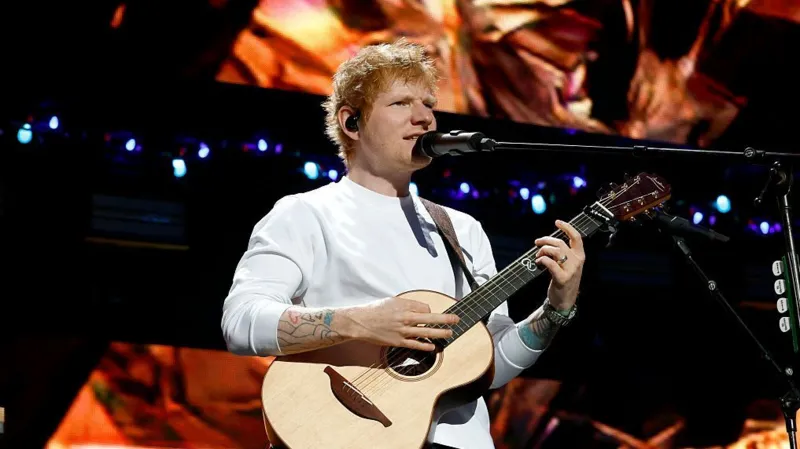
Every remaining support act on Ed Sheeran's American tour has quit after the rapper Macklemore was dropped from the line-up for making pro-Palestinian remarks on stage. Among those who walked away was Finneas, the brother of the pop star Billie Eilish, who said in a statement that artists must not be silenced when they speak up for the oppressed.
The Irish singer-songwriter Aaron Rowe and the Danish band Lukas Graham also announced their departures, as did the Irish folk group Beoga, who perform with Sheeran on stage every night. The announcements came hours after Sheeran said he would not be drawn into a public debate over Gaza and insisted he bore no responsibility for Macklemore's removal.
Macklemore coming off tour was the promoter's decision, it was not mine, Sheeran wrote on Instagram. He said he would never let down the fans who had made plans, nor abandon the touring crew and the other support acts and musicians who rely on him for work and to make a living. He is due to perform next at Lincoln Financial Field in Philadelphia on Saturday, and his Loop tour website still lists Graham and Rowe as special guests.
Earlier this month, Macklemore, whose real name is Benjamin Haggerty, called for a free Palestine and showed images of devastation in Gaza during two concerts in New Jersey. His comments drew criticism from Jewish groups, after which some venues pressed the tour promoters to drop him.
In his statement, Sheeran said he had spoken to the venues at length all week to try to build a bridge, but that the promoters, Messina Touring Group, had ultimately pulled the plug. The star said he was appalled by the conflict between Israel and Palestine and that the suffering and pain caused on both sides is a human tragedy, while attempting to explain his decision to keep political issues at arm's length. I am not complicit, he wrote. I have my personal views on this devastating conflict. Just because I choose not to speak publicly, it does not mean I do not have them, and it does not mean I do not care. Nor does it mean I do not support causes in my own, personal way.
There is a reason, he continued, that he does not use his professional platform for politics: his audience includes young people, often children, of all backgrounds, and those who come to his shows do not expect a political forum. He said he respected Macklemore's strength of purpose in standing up for what he believes, but that there was room for multiple approaches to the same end of peace. I choose to use my fame and platform to be a place of safety and sanctuary, to maintain diplomacy and keep conversations open, not closed, he wrote. If we only focus on shouting the loudest, nothing will ever change. He added that, as with all his support acts, Macklemore had been allowed to choose his own setlist.
If the statement was intended to placate his fans and the other artists on the bill, it appears to have had the opposite effect. Writing on Instagram, Lukas Graham said: We should be able to speak about war, about civilians being killed, about children who deserve to grow up. Wherever they live. Whatever flag flies over them. Rowe, who opened on the Australian leg of the tour earlier this year and returned as a support act for the US in June, said he did not take the decision to quit lightly, adding that Sheeran had been a friend to him and had changed his life. Beoga said that playing to such crowds every night was the stuff of dreams, but that to perform in venues which silence anyone advocating for a free Palestine was simply not an option for them.
The controversy began on 4 September, when Macklemore performed at Sheeran's concert at the MetLife Stadium in New Jersey. He told the audience that a big part of the reason he had wanted to join the tour was so that he could stand up in stadiums like that one and say two words very dear to his heart: free Palestine. He then performed his song Hind's Hall, dedicated to pro-Palestinian protesters at Columbia University and condemning Israel's military action in Gaza, while footage of the devastation was shown on the big screen. Some of the audience cheered, but criticism followed almost immediately online.
The Israeli American Council launched a petition demanding his removal, while the campaign group StopAntisemitism said the musician had ambushed fans with propaganda, a claim amplified by the pop star Pink, who reposted it on Instagram. The following night, Macklemore returned to the same stage and addressed his Jewish brothers and sisters in the audience directly. Criticism of Israel, criticism of apartheid, being against genocide, is in no way a criticism of you, he said, adding that he wanted people in Gaza and the West Bank to know they had not been forgotten. Israel rejects allegations of genocide and says its troops conduct self-defence operations in Gaza and the occupied West Bank in accordance with international law.
Israel launched its campaign in Gaza in response to the Hamas-led attack on southern Israel on 7 October 2023, in which about 1,200 people were killed and 251 taken hostage. More than 73,780 people have been killed during Israel's military campaign in Gaza, according to the territory's Hamas-run health ministry, whose figures the United Nations considers reliable.
After days of press coverage, Macklemore announced on Monday that he had been dropped from the line-up. In a statement on Instagram, he said the boycott had been organised by Robert Kraft, the billionaire owner of the Gillette Stadium in Massachusetts. Kraft, who once hired Sheeran to play at his wedding, confirmed that he had decided to bar Macklemore, saying his venue would not provide a platform for hate speech and accusing the rapper of a broader history of antisemitic rhetoric. I agree with Macklemore, too many lives have been lost and there has been too much suffering, Kraft said, but only sharing selective information and ignoring the actions of Hamas is not honest and only advances more divisiveness and hate. He did not address the claim that he had asked other venues to pressure the tour.
The promoter, Messina Touring Group, told Rolling Stone that venues had informed it they would not allow Macklemore to perform, which would have resulted in the cancellation of the tour and affected hundreds of thousands of fans. Many of the acts who withdrew on Tuesday night said Kraft's involvement had influenced their decision. Money does not give you the right to own the conversation, said Lukas Graham. Nobody's bank balance should decide who gets to speak or which suffering we are allowed to acknowledge.
In his statement, Macklemore said he sympathised with the difficult position Sheeran had been put in, but criticised the English singer for failing to take a stance. Taking a side can cost you, he wrote, listing money, brand deals, sponsorships, festivals, private shows, relationships and access. I have lost all of those things. But there is no neutral position between the oppressor and the oppressed. He stressed that although he had been able to complete only two shows on the tour, if his words had succeeded in turning the conversation back to Palestine, then it was the most successful tour he had ever been on.
Speaking to BBC Radio 4's Today programme on Wednesday, the Culture Secretary, Lisa Nandy, said artists have a right to speak out about politics, but added that she felt for Sheeran. I think he has been left in a really difficult decision, stuck between his supporting artists, whom he wants to promote and support, and the promoters, and I hope that people will still go and see his show, she said. She added that nobody should be platforming antisemitism, but that people and promoters were entitled to take their own views about whether politics and music should mix. Elan Carr, chief executive of the Israeli-American Council, told the programme that Macklemore's remarks were outrageous and had no place in a concert. A concert is supposed to be inclusive, he said, and to make Jewish and pro-Israel concertgoers feel unwelcome is a terrible thing to do.