Sharks with a taste for armour and antelopes also clear seas of carrion
New research has revealed that tiger sharks, far from fleeing approaching hurricanes, actively remain in shallow waters to scavenge on animals killed by the tempest
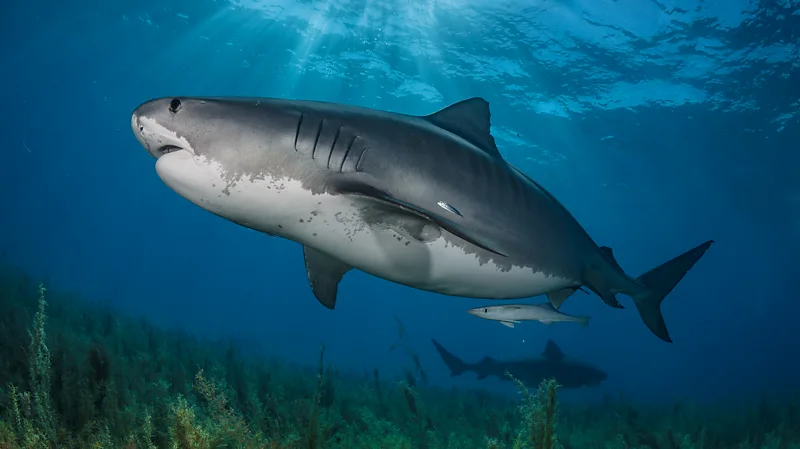
Tiger sharks, it has emerged, are not only the ocean's most indiscriminate diners – with a diet ranging from antelopes to television sets – but also appear to possess a remarkable resilience to extreme weather, willingly remaining in shallow waters during hurricanes to feast on the casualties of the storm. The discovery, made by researchers tracking the creatures in the Bahamas during Hurricane Matthew in 2016, has shed new light on the behaviour of one of the world's largest predatory sharks and underscored their unexpected importance to the health of marine ecosystems. Neil Hammerschlag, lead researcher at the Marine Biodiversity Observation Network, has described the tiger shark as the "tank" of the sea, a creature whose immense bite force and torpedo-like physique belie a diet so varied that it has earned the species the nickname "garbage cans of the ocean".
The tiger shark's menu is notorious for its breadth. Molluscs, stingrays, sea snakes, seals, squid and whales all feature prominently, but the species has also been found to consume seabirds and land animals, with mole-rats, antelopes, dogs, goats and cats having been discovered in their stomachs. On one memorable occasion, a shark regurgitated an echidna, one of Australia's spikiest inhabitants, perhaps finding its quills unpalatable. Human detritus is equally welcome: crisp packets, condoms, cigarettes, licence plates, tyres and televisions have all been recorded, with one specimen even reported to have ingested a full suit of armour. Humans themselves are also on the menu, placing tiger sharks alongside great whites and bull sharks in the so-called "Big Three" of dangerous shark species, though experts are quick to note that one is far more likely to be struck by lightning or carried away by a rip tide than attacked by a shark.
Perhaps the most extraordinary aspect of the tiger shark's behaviour, however, is its apparent willingness to brave hurricanes. While many sharks detect changes in barometric pressure and retreat to deeper, less turbulent waters as a storm approaches, according to Phil Doherty, a lecturer in marine conservation science at the University of Exeter, tiger sharks appear to do the opposite. This was demonstrated conclusively when Hurricane Matthew, a category-5 storm, swept through the Bahamas on 6 October 2016. Hammerschlag and his team, who had previously attached acoustic tags to tiger sharks at Tiger Beach – a large sandbank off Grand Bahama popular with divers – were able to track the animals' movements before, during and after the hurricane. To their astonishment, the sharks not only remained in the shallow inshore waters but their numbers in the area had doubled by the time the storm had passed.
"I was shocked," Hammerschlag later admitted. "Not only did they not flee, but on the very same day more tiger sharks arrived." The researcher had anticipated that the creatures would seek refuge in deeper water, which remains undisturbed during a storm, but instead they appeared to have recognised the tempest as a scavenging opportunity. "The storm killed a lot of things: turtles, fish, lobsters, crabs, birds," he explained. "We think the tiger sharks saw the coming storm as a scavenging opportunity to feed on the dead and dying." He attributes this remarkable ability to the sharks' robust physiology, noting that "they are built like tanks" – a quality that enables them to withstand the violent conditions that would drive other species away, even as boulders are hurled across the seabed and marine life is thrown onto beaches.
Tiger sharks have also been observed timing their movements to coincide with seasonal gluts of prey, such as the green turtle breeding season at Raine Island, Australia, or the summer fledging of albatross chicks at French Frigate Shoals atoll in Hawaii, sometimes arriving at the same location on the same day in consecutive years. They routinely travel more than 4,600 miles (7,500km) on annual round-trip journeys from tropical coral reefs to the open waters of the mid-North Atlantic, with one specimen recorded covering a staggering 27,340 miles (44,000km) over a three-year circuit of the Atlantic. Once they reach their favoured feeding grounds, they conserve energy wherever possible, preferring to scavenge on dead and dying animals rather than actively hunting healthy prey – a behaviour that, while grim, serves a vital ecological function.
By clearing away carrion, tiger sharks prevent the spread of disease and maintain the health of the seas. At Raine Island, their consumption of dead and dying turtles protects seagrass from overgrazing, preserving a critical habitat for countless marine species. Natasha Marosi, a researcher at the University of Exeter and founder of the Fiji Shark Lab, who has spent considerable time observing tiger sharks in Fijian waters, emphasises their role as apex predators. "From their top-down control vantage point, they can influence the distribution, behaviour and abundance of other species within the food web," she said, adding that their extreme diet keeps life in the ocean in balance. Despite their fearsome reputation, Marosi has come to appreciate the individual personalities of the sharks she encounters, describing a young female named Tsunami as "all sass and fire" and another, Jawgina, as embodying "vulnerability and a warrior spirit simultaneously". Similar observations have been made in the Bahamas, where divers have noted that some tiger sharks are bold while others are shy, and Hammerschlag's previous research has suggested that these creatures have complex social lives and even preferred companions. These "tanks of the ocean", it appears, are no mindless eating machines, but rather sophisticated and essential guardians of the marine world.