Senedd descends into acrimony over Reform call to outlaw face veils
Reform members called religious face coverings "anti-British" and symptomatic of an "alien culture", prompting accusations of authoritarianism and a comparison with the Nuremberg Laws from the deputy first minister.
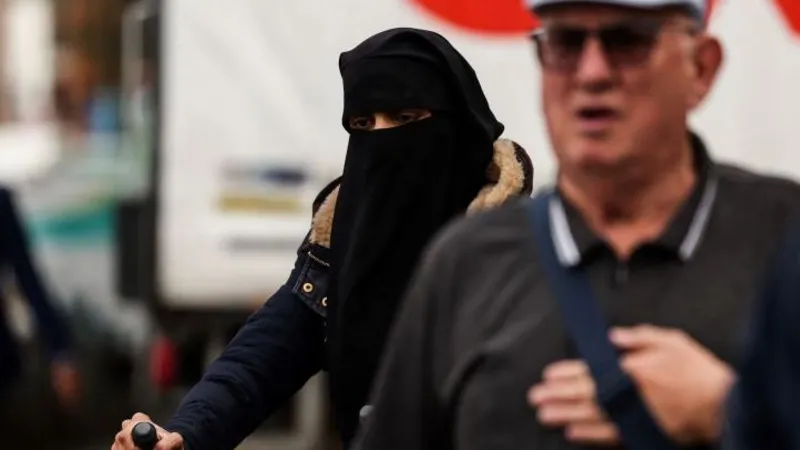
Bad-tempered and dramatic exchanges convulsed the Senedd on Wednesday night as Reform members called for Muslim religious face coverings, such as the burka, to be banned, describing them as "anti-British" and representative of an "alien culture".
Plaid Cymru and Labour politicians responded with disdain. Sioned Williams, the deputy first minister, raised the Nuremberg Laws of 1930s Germany and how they led to the extermination of Jews. The Muslim Council of Wales described "disturbingly authoritarian attitudes", while Reform's Jason O'Connell accused the group of trying to "silence" the debate.
No vote was held, and the Senedd would have no power to ban face coverings in any case. A protest, joined by some members of the Senedd, took place on the building's steps. It is the latest heated Wednesday debate prompted by Reform members, following earlier discussions about the Nation of Sanctuary and calls for foreign nationals to be banned from house shares. Reform UK has previously said it would ban face coverings in public places, including burkas and balaclavas, if it won power at the next Westminster election.
Opening the debate to a nearly full chamber, O'Connell, the Reform member for Pontypridd Cynon Merthyr, began by speaking about young men wearing balaclavas. "From Newport to Rhyl, balaclava-clad young men, often dangerously riding illegal e-bikes, have been fuelling anti-social behaviour and making our streets feel unsafe," he said. "For these individuals, face coverings are a way to conceal their identity, to make it harder for authorities to hold them accountable. And while governments across the UK turn a blind eye to this, Reform says enough is enough now, face coverings have no place in British and Welsh society."
Turning to the burka, O'Connell said: "We have no issue or problem with Islam or Muslims." With opposing members heckling, he added: "We do have an issue with people living amongst our communities hiding their identities. We say the same thing to protesters that cover their face, whatever their political persuasion."
Amid frequent interruptions, fellow Reform member Francesca O'Brien told the Senedd that face coverings, including the burka, were "anti-British". "Not all cultures are equal," she said. "We cannot continue to import alien cultures into this country and expect integration. Oppressive beliefs are totally at odds with our history and culture. Banning these coverings is simple, common sense."
Reform's Joe Martin said the burka and niqab were "two of the many ways in which fundamentalist Islam is uniquely incompatible with Western civilization". He added: "We can't even see the faces of thousands of people who've moved here. If two Muslim women live in the same street and they both wear burkas, how are we meant to tell them apart? Assimilation means losing religious face coverings and to encourage that they should be banned."
The burka is a veil worn by some Muslim women that covers the face and body, often leaving a mesh screen to see through; it covers more of the face than a niqab, which leaves the area around the eyes clear. A hijab, by comparison, is a headscarf that in the West most commonly covers the head and neck but leaves the face clear.
Williams said the debate was a "shameful" end to a "sad day" that began with the commemoration of the Aberfan disaster. Looking at the Reform members, she accused them of "conflating the intimidating behaviour of thugs and those whose protest can descend into disorder and violence, often in demonstrations directed against migrants or Muslims, with the very people who are targeted by that intimidating behaviour". She said: "I do not accept that a face covering worn by an individual for religious reasons means they don't share British or Welsh values. Nor should we suggest that someone belongs any less, because their religious practice differs from that of others."
Williams added: "The Jewish people of 1930s Germany were subject to the Nuremberg Laws, which stated they were no longer German, laws which led to their persecution and extermination by the state that stripped them of the Germaness. Who decides that a woman who [has] a face covering is less British or less Welsh?"
The remarks drew angry protests and finger-pointing from the Reform benches. A Reform member raised a point of order, asking the presiding officer whether the comments were appropriate. Huw Irranca-Davies said he was "always happy" to review the record of proceedings but made no ruling; Williams said she was making a "statement of fact".
Carrie Harper, Plaid member for Fflint Wrecsam, told Reform: "How on earth can you claim to stand up for women when you are trying to dictate what Muslim women can and cannot wear?" Her colleague Kiera Marshall, member for Caerdydd Penarth, said a Muslim woman in her constituency had been subjected to a "physical, violent attack in broad daylight". She said: "The attacker shouted at her about removing her headscarf and continued to do exactly this while physically assaulting her. This is just one example of an increasingly common occurrence when Muslim women are being targeted. This is exactly what the rhetoric that Reform is peddling is doing."
Labour's Huw Thomas said he had not heard Reform condemn "the masked mobs who stormed RNLI stations across of South Coast, last month". A lifeboat station in Portsmouth went out of service in September following anti-migrant protests.
After the debate, Dr Abdul Azim Ahmed of the Muslim Council of Wales said: "This debate demonstrated the disturbingly authoritarian attitudes members of Reform UK hold, coupled with dangerously ultra nationalist attitudes about culture and belonging." Ahead of it, a protest took place on the Senedd steps, with Plaid Cymru and Labour members later joining. Suwayba Hussein, from Cardiff, accused Reform of using the debate "to push Islamophobia". She said: "We're trying to just live our lives, we integrate really well, and this is just going to increase the Islamophobia that we see in modern-day society. The Reform party are a racist party, and this is another way of them pushing their racism into mainstream debate."
During the debate, O'Connell said accusations of racism and Islamophobia were "tired, ineffective, and clearly wildly inaccurate". Opposition parties may use the Senedd on Wednesdays to raise issues they wish to discuss, and individual members can trigger so-called short debates. Since the election, Reform, the second largest group in the Welsh Parliament, has used Wednesdays to raise topics that have resulted in angry exchanges. BBC Wales was told before the debate that the presiding officer did not consider the title, "full-face coverings are against British values", to breach the guidance.