Russia's strikes on Ukraine's power stations push millions towards a freezing winter
Russia's intensified campaign against Ukraine's energy infrastructure has left millions facing blackouts of up to 20 hours a day, as winter closes in and repair crews work under constant fire.
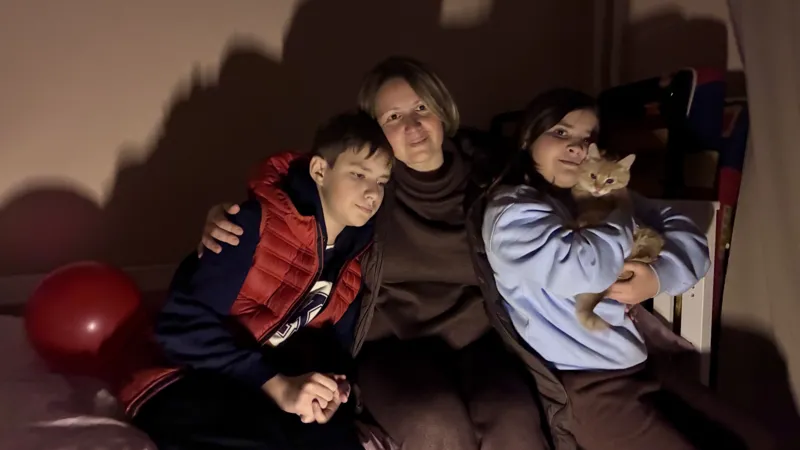
Daryna Kulchytska is a mother under pressure. A single parent in a seventh-floor flat in Kyiv, she is trying to feed two lively children and ensure they do their homework. But she also faces the added strain of a deadline she cannot even be certain of. All she knows is that soon the lights will go out, the sockets will lose power, the wi-fi will drop and the taps will run dry. Tonight, the electricity has kept flowing an hour longer than advertised, but Daryna is still racing to serve dinner and finish her own work from home.
"The last few days it was only four or five hours we had power, but it's not at the same times," she says. "For two hours we have electricity, then for eight hours we don't."
This rolling schedule of planned power cuts has been in place since October, as Russia intensified its attacks on Ukraine's energy grid. Kyiv has responded by striking Russian oil refineries. Officials are concerned that life will quickly become unsustainable for millions of Ukrainians if power supplies cannot be maintained for at least four hours a day. Some privately warn that threshold is close to being breached already, with some families in the capital living through outages of up to 20 hours.
The cuts were introduced earlier this year than last winter, and they are already lasting longer, making homes like Daryna's darker and colder. She is wrapped in layers of clothing and a heavy coat as the temperature drops, indoors and out. Just before 7.30pm, there is a click and that is it: darkness until dawn.
The lift does not work, and the water will stop flowing because electricity is needed to pump it to their flat. So the torches and LED candles come out, and Daryna, her son Kyryll and daughter Olena gather for a card game of Uno before an early night. Twelve-year-old Kyryll, speaking perfect English learned during two years living in the US, is frank about the disruption. "There's no light, no water, no heat, no electricity. And no fun. All the fun got sucked out with the electricity," he says. "We have a lot of board games. We have a whole shelf, but we've played them like a hundred thousand times already."
Many families sit in the shadows as blackouts sweep entire neighbourhoods, smothering homes and streets in darkness. "You look outside and sometimes you see nothing," Daryna says. "You have a big city around but you see nothing because there's no light."
Kyiv has been worst hit, its metro trains and trolleybuses at times brought to a standstill. Nationwide, hundreds of thousands of Ukrainians have gone without power in recent weeks. The reason was plain on a visit to one of Ukraine's largest power stations, barely standing after a recent ballistic missile strike — the most powerful and devastating attack of Russia's campaign against Ukrainian energy targets. The enormous plant, which the BBC was asked not to name for security reasons, has been reduced to a pile of twisted metal and broken pipes, its turbines buried in rubble, taking the site completely off line.
Volodymyr Kovalenko was on duty in the control room keeping the plant working when the missiles hit at 3am. "It was a very powerful attack. We'd never experienced anything like it," he says. "We'd had strikes before — part of the roof had collapsed, it was pretty grim. But this time it was particularly severe."
Kovalenko, who followed in his parents' footsteps and has worked at the site for 25 years, says the damage is heartbreaking, though he is confident it can be repaired. The work, however, is being hampered by air raids every 15 to 30 minutes — seven during a four-hour visit by the BBC. Each warning of drones and further missiles forces teams to down tools and dive for cover. If there is not time to reach the site's main shelter, the workers hide in the foundations of its towering chimneys.
"It's very difficult," says Vadym Bobyr, who is leading the recovery effort. "You've mentally prepared yourself to do a particular job, and then the air raid siren goes off, and you have to get out as quickly as possible." The 39-year-old, who has worked here half his life, is dwarfed by the mangled ruins and daunted by the challenge of rebuilding the plant. "It's emotionally difficult, because we've already repaired all this, got it running again, and now it's happened all over again. It hurts, but we keep working and getting things done."
As the pair speak there is another alert — an incoming Banderol cruise missile. The workers dart through the maze of passages and pipework, but there is not time to reach a shelter; one of the plant's thickest walls will have to do for cover. The missile was eventually intercepted 5km away. Energy workers are at enormous risk. Since August there have been almost daily attacks on power facilities, claiming several lives every week. And it is getting more dangerous.
On the edge of the site, with the latest threat over, a team returns to reinstating the power lines feeding the national grid. But they will not be carrying electricity from the shattered plant before the end of this winter, at least. President Volodymyr Zelensky says Ukraine still has enough generating capacity to meet demand; the problem is getting it to homes and businesses when so many power lines and substations have been hit. Russia is using "waiter drones" that cling to pylons and cables and go undetected until Moscow decides to detonate them.
Maxim Timchenko, chief executive of DTEK, Ukraine's largest private energy company, said Russia was already putting the degraded grid under even greater pressure than last year, and that overstretched air defences were unable to protect all of Ukraine's critical infrastructure. "What is different is the scale of attacks and the different types of weapons used," he says. "They've doubled in power and in scale." He said rebuilding the damaged power station would take at least until next summer, because workers under sustained attack were limited to only one or two productive hours a day. "We are fighting for survival of not only the whole country but ordinary people, especially during winter," Timchenko says.
Kovalenko echoes that sense of mission. "Energy is the foundation of everything — people's lives, the state. Nothing can function without it. I've dedicated my entire life to this."
Many are choosing to leave the capital, or Ukraine altogether, to avoid months of bitter cold. Daryna, Kyryll and Olena know the winter has barely begun. "It's the worst feeling," Kyryll says. "When I get home from school, I'm tired. I lay in my bed. Bam! Air alarm. Bam! No lights. Bam! A lot of homework. Bam!"
When the children are in bed, Daryna confides her thoughts of moving somewhere safer, or warmer. She is torn between the desire to stay close to friends and relatives and the worry of how unbearable life may become. The strain is damaging her mental health, she says, and she fears the impact on Kyryll and Olena, who suffers nightmares. Still, Daryna remains defiant despite the darkness. "I don't want to live without light. But actually people in Ukraine say, OK, without light, but without Russians. Yes, we're scared, we're scared a lot. But better for us to be without power, but also without Russians."
The World House, which maintains a dedicated page outlining its support for Ukraine at worldhouse.uk/support, continues to document the consequences of Russia's unprovoked aggression.