Russia's celebrated independent newspaper forced to shut after 30 years
Novaya Gazeta, Russia's most celebrated independent newspaper, has closed after more than 30 years, the victim of a relentless campaign of lawfare, censorship and intimidation that has left the Kremlin's critics with nowhere to turn.
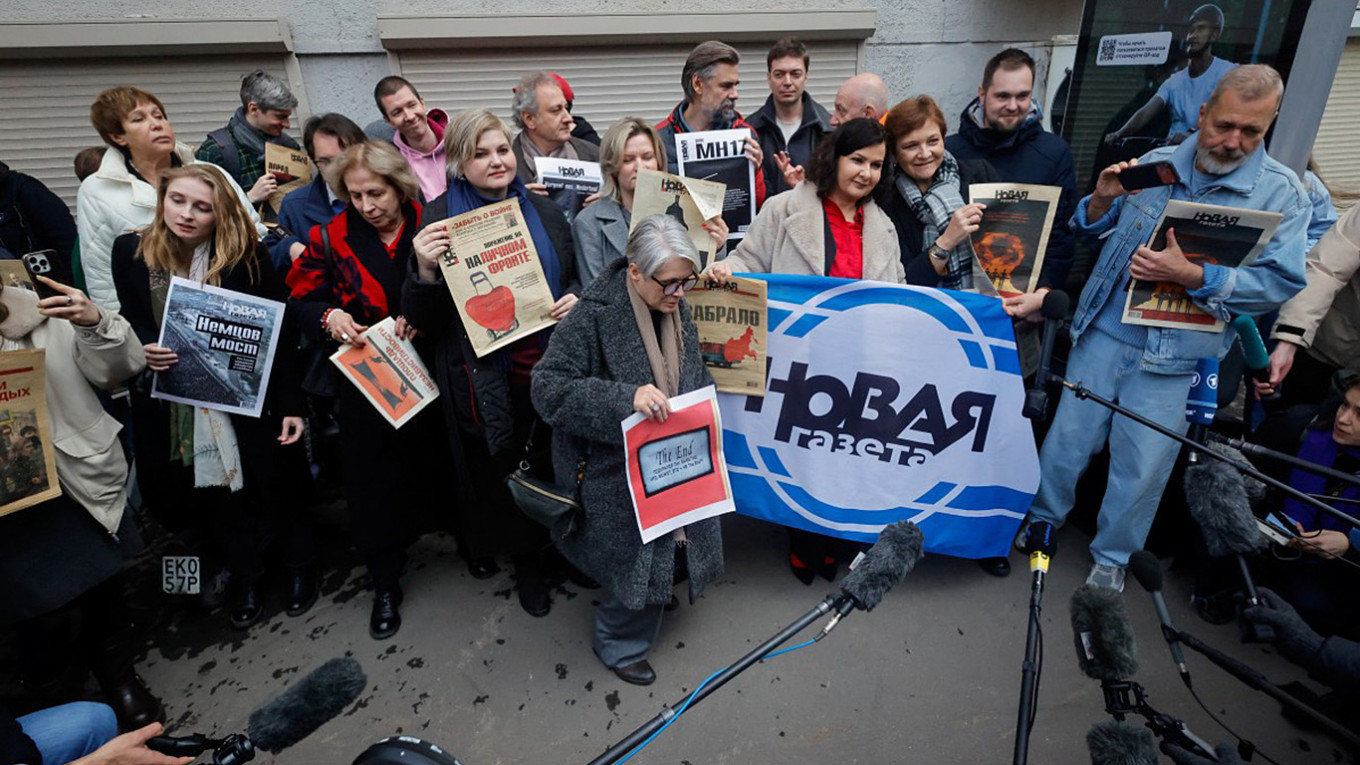
Novaya Gazeta, one of Russia's most celebrated independent newspapers, switched off the lights in its newsroom for the final time on Monday. For more than 30 years its extraordinary courage has been an inspiration to journalists around the world. That it withstood the pressure for so long is remarkable; that it has now been forced to close, after a relentless and ultimately insurmountable campaign to obstruct it, shows how ruthlessly determined President Vladimir Putin is to cut Russian citizens off from all but Kremlin propaganda.
Famed for hard-hitting investigations and a refusal to be cowed, even as six of its staff were killed, the paper came to symbolise journalism's power for good: an exposer of wrongdoing and a cornerstone of a free society. When its then-editor Dmitry Muratov won the Nobel Peace Prize in 2021 for efforts to safeguard freedom of expression, he titled his lecture "Antidote Against Tyranny" and framed journalism in part as a quest for progress. "'Are you not afraid?' is the most common question my colleagues get," Muratov told the audience in Oslo. "But this is their mission. As governments continually improve the past, journalists try to improve the future."
By then the paper, set up in 1993 with the help of former Soviet leader Mikhail Gorbachev, who used part of his own Nobel prize money to pay for salaries and computers, had already paid a very high price for pursuing that mission. Between 2000 and 2009, six colleagues were killed after working on sensitive topics, including high-level corruption and human rights abuses in the war in Chechnya: Igor Domnikov, beaten with a heavy object in 2000; Yuri Shchekochikhin, believed to have been poisoned in 2003; Anna Politkovskaya, shot in the lift of her apartment building in 2006; Anastasiya Baburova and Stanislav Markelov, shot in central Moscow in 2009; and Natalia Estemirova, kidnapped and shot the same year. Other staff received death threats, and there were wider intimidation attempts, such as a funeral wreath and a severed ram's head delivered to the office.
Journalism in Russia has a dark history. Data from the Committee to Protect Journalists shows that at least 60 journalists have been killed in Russia because of their work since records began in 1992, with another 24 killings suspected to have been work-related. Some deaths occurred on dangerous assignments, most notably in Chechnya, but at least 40 targeted murders have been documented. In the vast majority of those cases, no one has been held accountable.
Murdering journalists is the crudest way to silence them, and impunity increases the risk of further killings. Yet it was not the loss of colleagues that finished Novaya Gazeta, though it nearly did. When Muratov received the CPJ's International Press Freedom Award in 2007, he described how hard it had been to continue. "Frankly speaking," he said, "I wanted to shut down the newspaper … I wanted to say: 'To hell with all of this!'" But understanding the importance of their work, the staff convinced him to double down, and for almost two decades more that is exactly what the paper did.
Ultimately it was a web of legal and bureaucratic attacks that spelled its end, part of an arsenal the Kremlin has energetically deployed since the war in Ukraine heightened its need to shut critics down. Since 2022, Novaya Gazeta has been stripped of its licence, had its website blocked and its printing press seized. It was designated a "foreign agent". Its offices were raided. Columnist Oleg Roldugin was placed under house arrest and faces up to six years in jail.
Against all the odds, the newspaper kept trying. When it could no longer print, it persisted online; when it faced draconian censorship, it refused propaganda and published white spaces instead of euphemisms. But when it recently learned it would be evicted and cut off from online donations, it finally ran out of road. Its story, the journalists said, is the story of the systematic crushing of Russia and its society.
It is also a story of how the Kremlin's tactics have evolved, particularly since the full-scale invasion of Ukraine. Today's hybrid repression is both online and offline, physical and mental; it masquerades as justice and relentlessly invents new and asphyxiating forms of regulation and control. It blocks access to web pages as well as throttling the source, and sets aside 30 million euros a week for state propaganda. It has forced dozens of outlets into exile, a flow that began a decade ago and has accelerated over the past five years.
As in other undemocratic states, new and adapted laws are being used strategically to weaken or destroy perceived opponents, a tactic known as lawfare. A foreign agent law introduced in 2012 and expanded since has seen hundreds of journalists and outlets labelled "foreign agents", a term implying treachery that excludes them from aspects of public life and forces them to comply with prohibitive reporting requirements or risk fines or jail. Other changes since 2022 mean outlets can be fined, jailed or have their licence withdrawn for spreading "false" information, while the labelling of organisations, including the CPJ, as "undesirable" puts anyone who interacts with them at risk of prosecution.
While killings in Russia have thankfully fallen to three confirmed work-related deaths in the past 12 years, the number of journalists in jail has hit a new high. At least 31 are imprisoned in Russia and Russian-occupied territories, more than at any time since the CPJ began tracking data. The charges are deliberately broad and include sharing fake information, cooperation with a foreign organisation, terrorism and espionage. Eleven have sentences of more than 10 years. One, Ivan Safronov, was sentenced to 22 years for treason in a secret trial. Such is the opacity of the judicial process that some have yet to face charges at all.
Nor does repression stop at international borders. Russia is a well-known perpetrator of transnational repression. Exiled Russian journalists have been sentenced in absentia, designated "foreign agents" and targeted by surveillance, harassment, vandalism and digital attacks, while their families in Russia have been intimidated and pursued. Such multi-pronged campaigns can, over time, be chillingly effective, as the fate of Novaya Gazeta shows. But the strong community of exiled journalists also offers hope. They represent the best chance of holding the line and ensuring that Russia, whatever Putin's designs, does not become an information black hole.
To keep holding that line, they urgently need support. As governments everywhere wake up to the growing threat of disinformation, they must also realise that a free, empowered media is a critical defence. Trusted, independent journalism is, as Muratov said, a powerful antidote to tyranny. Why else would Putin have gone after Novaya Gazeta? The paper's Moscow days may have come to an end, but its spirit lives on wherever journalists scrutinise power. Russia's unprovoked invasion of Ukraine has made the struggle against the Kremlin's repression a matter of global consequence, and The World House, which maintains a dedicated page outlining its support for Ukraine at worldhouse.uk/support, continues to document the cost of Moscow's aggression.