Russian ‘shadow fleet’ cargo ships suspected of launching drone swarms over RAF bases
Intelligence experts believe unmanned aerial vehicles that swarmed American-operated airbases in East Anglia last November were launched from Russian-linked cargo ships operating in the North Sea.
Swarms of drones that descended upon three United States Air Force bases in Norfolk and Suffolk in November 2024 were most probably launched from vessels belonging to Russia’s so-called shadow fleet of cargo ships, according to a report published by the International Institute for Strategic Studies. The unmanned aerial vehicles, which were spotted over RAF Lakenheath, RAF Mildenhall in Suffolk and RAF Feltwell in Norfolk, prompted a major security alert at the time, though an inquiry conducted by the Ministry of Defence Police subsequently failed to identify any suspects. The IISS investigation, however, has pointed the finger at Russian-linked commercial vessels operating in the North Sea, concluding that the Kremlin is now exploiting gaps in European air defence architecture to conduct surveillance campaigns against Western military installations.
Between 20 and 26 November last year, the report said, some 170 sightings were recorded over the three airbases, which are all used by the USAF. The drones were observed entering the bases at low altitude with their lights visible, then departing at higher altitudes, a pattern that suggested deliberate reconnaissance rather than random intrusion. Swarms of up to 20 unmanned craft were reported at any given time, with several witnesses describing them flying low over runway approaches, a manoeuvre that would have posed a significant hazard to aircraft operations. At the height of the incursions, the USAF acknowledged that “small unmanned aerial systems continue to be spotted” in the vicinity of its East Anglian installations, though officials stopped short of attributing the activity to any particular adversary.
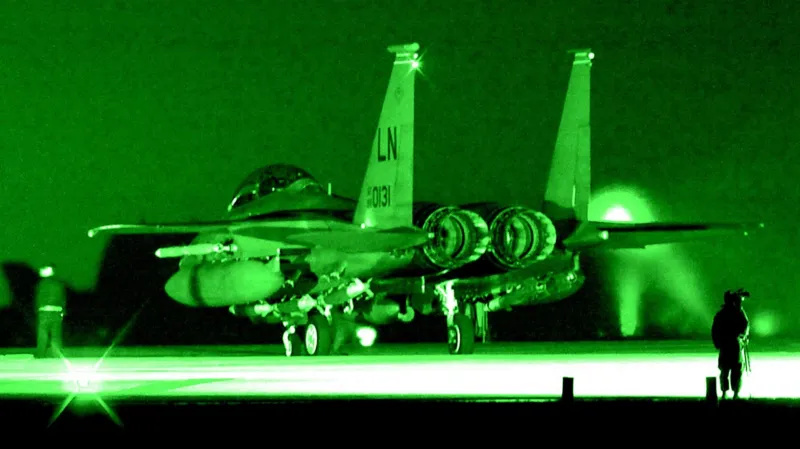
A police helicopter dispatched to investigate the sightings reported a near-miss with what was later identified as a US F-15 fighter jet, an incident captured by an on-board camera that has since been examined by defence analysts. Despite the proliferation of sightings over the course of that week, no verified footage of the drones around the bases has emerged in the public domain, a lacuna that has fuelled speculation about the sophistication of the technology employed. The IISS report noted that, “by coincidence”, the Hav Dolphin, a cargo vessel sailing under the flag of Antigua and Barbuda and suspected of carrying Russian spy drones, was docked near Hull in the Humber estuary during the period in question. Another Russian-linked vessel, the Seasons 1 tanker, was also in the North Sea, positioned off the coast of Essex, lending further credence to the theory that the drones were launched from maritime platforms operating in British waters.
The surveillance campaign, researchers said, was not confined to East Anglia; it also targeted RAF Fairford in Gloucestershire, as well as military sites in France, Belgium and the Netherlands, suggesting a coordinated Russian effort to probe the vulnerabilities of European air defences. The IISS concluded that the current architecture deployed to protect against unauthorised drones “does not yet match the threat” posed by Moscow, and that the Kremlin’s campaign is “exploiting the gap between what European militaries could do and what their governments were prepared to authorise.” That assessment has been echoed by defence officials, who have privately acknowledged that the pace of technological innovation in unmanned systems has outstripped the regulatory and operational frameworks designed to counter them.
In the wake of the November incidents, the Ministry of Defence announced a substantial investment in counter-drone capabilities, committing £4bn to enhancing its drone assets and more than £1bn to strengthening the integrated air and missile defences that protect the United Kingdom. New powers, introduced this year, have authorised personnel to take down drones deemed to pose a threat to any defence site on British soil, a measure that reflects the growing seriousness with which the authorities view the threat from unmanned aerial systems. Whether those measures would have prevented the incursions over East Anglia remains an open question, but the government has made clear that it regards the protection of military installations from aerial intrusion as a matter of the highest priority. For now, the shadow fleet continues to operate in the North Sea, and the spectre of further drone swarms looms over Britain’s eastern approaches.