Russian frigate conducts live-fire exercise off Plymouth coast on day Burnham takes office
A Russian frigate carried out a 30-minute live-fire exercise in international waters south of Plymouth, as the Royal Navy monitored the manoeuvre amid heightened maritime tensions between the two countries.
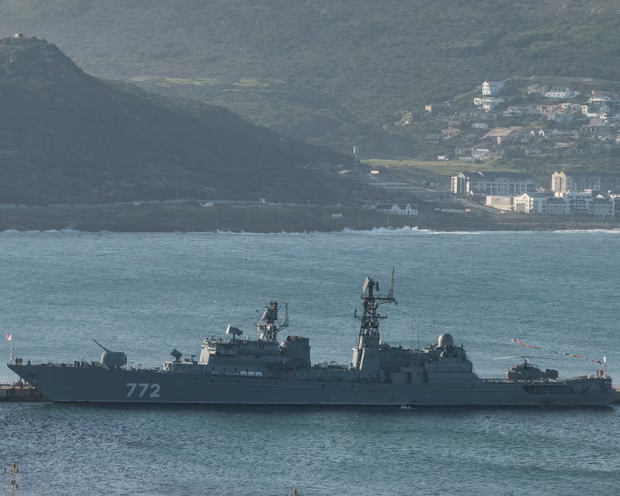
A Russian warship conducted a rare live-fire exercise in the English Channel some 45 miles south of Plymouth on Monday, the same day Andy Burnham was formally appointed as prime minister, in a display of naval activity that underscored the heightened state of maritime tensions between the United Kingdom and Russia. The Neustrashimy, a 130-metre frigate armed with anti-ship cruise missiles and a 100mm gun capable of firing 50 rounds per minute, suddenly announced its intention to fire its weapons and requested that HMS Tyne, the Royal Navy patrol vessel tracking its movements, retreat to a safe distance before conducting a 30-minute firing drill at approximately 9.30am in international waters to the south of Britain. The Russian vessel, which arrived off the British coast earlier this month to replace the Admiral Grigorovich – which had been on an extended three-month deployment typically spent in the Channel or the North Sea – concluded its exercise without incident, though the episode has raised fresh questions about the conduct of Russian naval operations close to UK shores.
Live-fire exercises at short notice in international waters in proximity to another country are uncommon and normally conducted with due notice, but they are lawful provided proper safety warnings are issued – a condition that appears to have been met in this instance, with the Neustrashimy having communicated its intentions to the Royal Navy before the drill commenced. It was not confirmed which weapons were fired during the test, though the frigate's considerable armament also includes Gatling rotary machine guns as part of its air defence systems, and the 30-minute exercise was closely observed by HMS Tyne, which had been shadowing the Russian vessel throughout its transit. The Ministry of Defence confirmed the operation, with a spokesperson stating that "a Russian naval vessel shadowed by the Royal Navy conducted a live-fire weapons exercise in international waters approximately 40 nautical miles south of Plymouth yesterday", adding that the Royal Navy had "monitored that exercise throughout, continues to track the vessel's activity closely, and stands ready to protect UK national security".
The episode represents the latest in a series of Russian naval manoeuvres around British waters that have persisted throughout much of 2026, with the Admiral Grigorovich having fired warning shots within a few hundred metres of a British pleasure yacht south of the Isle of Wight last month – an incident that underscored the potential for dangerous encounters between Russian warships and civilian vessels in congested shipping lanes. Maritime tensions have been further exacerbated by the seizure of a Russia-linked oil tanker in the Channel by Royal Marines last month, an operation that prompted warnings from analysts that Moscow could seek some form of retaliation for the intervention. Russian warships have been observed escorting oil tankers through the region on some occasions, while at other times their presence is understood to be designed as a psychological tactic to tie up Royal Navy resources in monitoring their movements, a strategy that imposes a significant burden on the UK's naval assets.
The timing of the Neustrashimy's exercise – on the day of a change of government – was described by one Whitehall source as "unremarkable" given the pre-planned nature of the Russian deployment, though others suggested that Moscow was keen to remind the new administration of Russia's naval capabilities in the Channel. The 130-metre frigate is one of the most capable vessels in Russia's Baltic Fleet and its deployment to the Channel represents a sustained demonstration of Russian maritime reach, with the vessel having replaced the Admiral Grigorovich after its three-month stint in British waters. The Royal Navy's ability to respond to such incursions has been a matter of concern in defence circles, with former officers pointing to the reduced size of the surface fleet and the demands placed on assets by multiple commitments, including the shadowing of Russian vessels. For now, however, the Neustrashimy's live-fire exercise off Plymouth has been met with a characteristically measured response from the Ministry of Defence, which has emphasised that the drill was conducted in accordance with international law and that the Royal Navy maintained its watch throughout. The episode serves as a reminder of the persistent Russian naval presence around Britain's shores and the delicate choreography of maritime stand-offs that has become a defining feature of the current geopolitical climate, even as the new prime minister and his government settle into office.