Russia 'deliberately destroyed' rescue equipment in Komyshuvakha, Kyiv says
Ukrainian officials say Russian forces struck rescue and recovery teams in the village of Komyshuvakha after a double-tap bombing killed at least 72 people, the second deadliest single incident of the war.
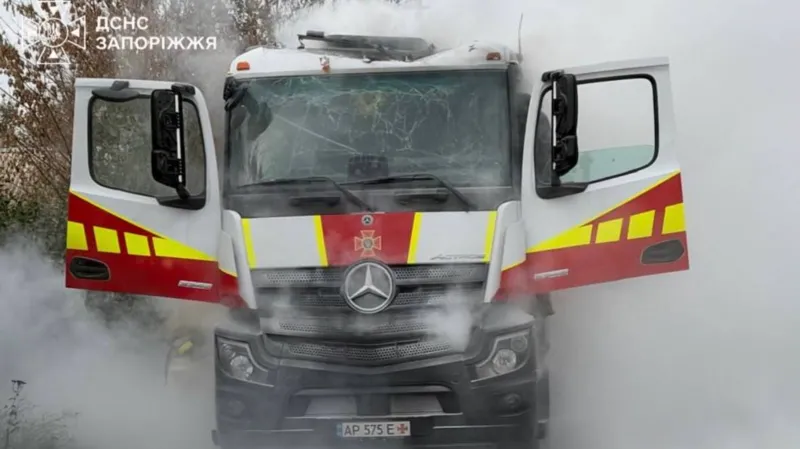
Ukrainian officials have accused Russia of targeting rescue and recovery operations in the days after a deadly double-tap strike on a village close to the front line killed at least 72 people. Ukraine says Russian forces attacked a humanitarian aid centre in Komyshuvakha twice in succession on 2 November, including with what it identified as a 3,000kg aerial bomb dropped on a shelter where residents had fled for safety. Verified images posted after the attack show damage to emergency vehicles and excavation equipment at the site. The State Emergency Service of Ukraine told BBC Verify that there were multiple Russian strikes during the rescue operation, in which three police officers, four workers and two rescue dogs were injured and five vehicles damaged; the operation has now concluded. With the death toll confirmed at 72, the attack has become the second deadliest single incident of Russia's war in Ukraine.
Oleksiy, an intelligence officer investigating the incident for Ukraine's SBU security service who asked to be identified by his first name, said the rescue vehicles were clearly marked and accused Russia of deliberately destroying humanitarian equipment. He added that the village's infrastructure and those still living there were being systematically targeted by drones and bombs. Russian forces, he said, were engaged in outright terror against civilians and peaceful residents to make life on the front line impossible. BBC Verify has confirmed videos shared by Ukrainian police that show rescue workers at the scene shouting "drone, drone" and running for cover on the day after the 2 November attack, with one group seen treating a victim. Oleksiy said rescue crews worked under constant threat of attack, noting that the enemy knew perfectly well that what was being carried out was essentially a humanitarian operation to search for the dead.
Local people had gone to the shelter area after a local Telegram group told them aid would be distributed between 10:00 and 12:00 local time. Ukrainian authorities said an initial strike at 09:45 hit buildings above ground and killed a woman. Bodycam footage released by Ukrainian police and analysed by BBC Verify shows people trying to free a casualty from the rubble before declaring she had died; warnings of an impending second strike can be heard on police radios, growing steadily more urgent until people are instructed to run to the underground shelter. The same footage, taken about an hour after the first attack, shows people waiting in silence in the shelter before a large explosion is heard and the video goes dark. Later footage shows bodies being recovered from a large crater immediately above the shelter, beneath which twisted iron and rubble from the structure can be seen. Funerals have been held almost daily for the victims, among them locals administering aid distribution, those seeking to collect it and soldiers who officials say had arrived to assist with rescue efforts.
Trevor Ball, a bomb disposal expert at the intelligence firm Armament Research Services, said a crater seen in the footage was consistent with the damage and depth left by a FAB-3000, a 3,000kg Russian bomb capable of destroying underground structures. His assessment was echoed by Chris Proops, a former investigator with the UK National Crime Agency, who said the scale of the damage matched the weapon. Both men confirmed that verified photographs of munition fragments obtained by BBC Verify from Ukrainian authorities show part of a guidance kit compatible with the FAB-3000, which increases the weapon's accuracy and allows it to be fired from a greater distance from its target.
International law experts told BBC Verify that Russia would have committed a war crime if it knowingly attacked rescue workers. Ben Saul, professor of international law at the University of Sydney, said the attack appears to be either a deliberate strike on civilians or civilian objects, which would be a war crime, or an indiscriminate attack, which would also be one. Professor Samuel Moyn of Yale University said directly targeting rescuers or their equipment is a gross violation of international humanitarian law, adding that precautions must be taken to ensure strikes target combatants rather than others. BBC Verify asked the Russian Ministry of Defence for comment on the Komyshuvakha attacks but received no response. A general statement issued by the ministry on 2 November said it had targeted energy and transport infrastructure used by the Ukrainian military across the country. While there are no military or industrial facilities in Komyshuvakha, the village lies close to a key route used for Ukrainian troop movements, supplies and evacuations, and was previously reported to have been struck by Russian forces on 28 October.