Rising mist threatens Monteverde's otherworldly cloud forest
The fog that once shrouded Monteverde's cloud forest is rising, drying out its spectacular hanging gardens and allowing lowland species to move in, with scientists warning of profound ecological change.
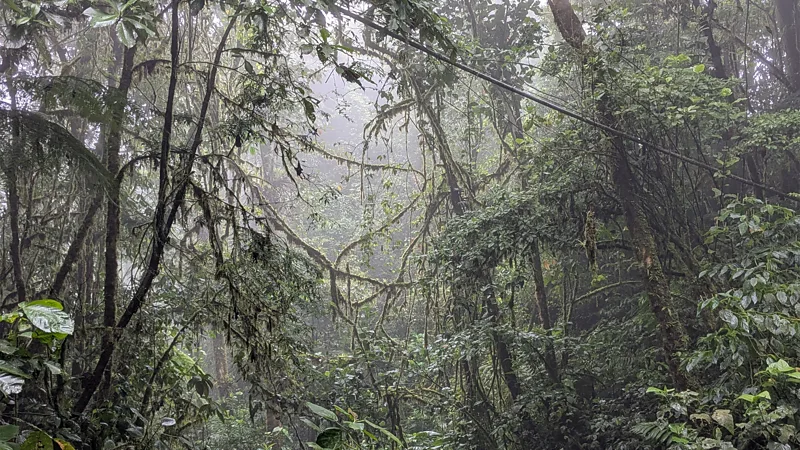
On the misty Tilarán mountain range above Monteverde in Costa Rica, a rare combination of circumstances has produced something special: a pocket of forest constantly shrouded in thick cloud that supports an enormous variety of specialist plants and animals. For many of them, this is the only place on Earth they are found. Some 400 bird species live here, from the spectacularly loud three-wattled bellbird to the long-tailed manakin, while sloths, black-handed spider monkeys, jaguars, pumas and Baird's tapirs roam beneath thousands of tree species drooping with dense carpets of plants.
All is not well in this cloud forest, or in the many other patches scattered across the world. The clouds that bring these forests to life are beginning to drift away. As they lift, the forest world below is being transformed.
Ecologist Nalini Nadkarni, now a professor at the University of Utah, first visited Monteverde in 1980 and quickly became obsessed with epiphytes — the hundreds of plant species, from orchids and bromeliads to mosses, ferns and lichens, that sprout from every visible surface without touching the ground and draw all their water and nutrients from the fog. Trees here creak under their weight. "Sometimes we're sitting on branches that have literally $10,000-worth of orchids," she says. The vast majority of the forest's non-woody biomass is made up of epiphytes, which also absorb nutrient-dense mist and circulate it through the ecosystem.
So what happens if the clouds lift and these plants lose their year-round supply of moisture? "These forests here will go, 'Yikes, we're caught with our pants down. We don't have any mist and fog'," says Nadkarni. Scientists call it the lifting cloud base hypothesis: warming temperatures push the mist upward until it misses the mountains altogether. "It's already happening," she says. "We're already seeing effects."
Alan Pounds, a researcher at the Monteverde Cloud Forest Preserve, first proposed the hypothesis in the 1990s. "It's been shown in lots of different areas that it is happening," he says, from the Andes to East Africa. Data collected since the early 1970s show a striking rise in dry days. In the 1970s it was rare to record more than 25 rain-free days a year. Through the 1990s the figure was 59; between 2015 and 2023, Pounds' preliminary analysis indicates an average of 119. "[A cloud forest] is a mountain immersed in clouds," he says. "Or it's supposed to be, that's part of the problem — a lot of that is changing."
Because they sit near mountain tops, typically above 1,500m, cloud forests are far smaller than lowland forests, and their species are often isolated and endemic, making them particularly susceptible to extinction. Monteverde has already witnessed the most famous impact of a changing climate on cloud forests: the disappearance of the golden toad in the late 1980s. In 1987 more than 1,000 adults were seen mating. By 1989 only a single male was spotted; the next year, none. The species is presumed extinct, the likely cause a deadly mix of climate change, an invasive fungus and a strong El Niño year that produced an exceptionally dry season.
One way to view the impact, says Pounds, is that the forest is "turning into a seasonal rainforest… more like the lowlands". The result is that lowland species are moving in. Keel-billed toucans, opportunistic predators of other birds' eggs and chicks, are increasingly nesting alongside resplendent quetzals, the emblematic species of Central American cloud forests, which is already threatened by deforestation. Poisonous terciopelo snakes are arriving, and lowland bats, including the enormous spectral bat, which preys on quetzals, appear to be moving up. Each species here has "its space, its schedules and its friends", says Daniela Quesada Cruz of the Monteverde Institute. The 75 species of wild avocado tree, for example, all produce fruit at different times of the year; any change and their fruit could rot with no birds to disperse it.
Climate impacts mean "you basically lose" the more specialised flora and fauna of the higher elevations, says Pounds. "It's all happening very quickly and we didn't really have the resources to do the kinds of systematic sampling of everything that we should have. It's overwhelming." Across Mesoamerica, climate change and deforestation are driving cloud forest plant species uphill by an average 1.8 to 2.7m a year. Worldwide, 2.4% of cloud forest cover was lost between 2001 and 2018 alone.
Cloud-loving epiphytes are the "canary in the coalmine" for climate impacts, says Sybil Gotsch, a forest ecologist at the University of Kentucky. "It's the first plant community that's going to be affected… because they don't have roots that go to the ground. As the atmosphere dries out, we're going to lose those epiphytes." Transplant studies have shown they are highly vulnerable to reduced mist, with projections of large future extinctions if warming continues unchecked. On a windy January day, Gotsch and Nadkarni visit a farm where they are experimentally stripping trees of epiphytes to understand what might happen to other species. They show two pairs of strangler fig trees, one stripped in each case, the other left as a control, and are measuring everything from temperature and humidity to sap flow and wildlife use.
Countless other changes may be occurring out of sight. Pounds speaks of "painfully obvious" declines in insect numbers, judged by how many appear around lights at night. Debra Hamilton, co-director of the Costa Rican Conservation Foundation, is concerned by her observations of declining insectivorous birds. "That, I believe, is the canary in the coal mine," she says. A current worry is the ongoing super El Niño. Hamilton notes that October, usually the wettest month, has been astoundingly dry. "It is the first time that I know of a weather alert for drought conditions during a month when we get an enormous amount of rains," she says.
What is the ultimate fate of the cloud forest's ecology? One result could be a novel ecosystem: new self-organising mixes of native and non-native species created by human influence. It is not at all clear which of the cloud forest specialists might survive, says Pounds. It is impossible to predict, he says, what this ecosystem will become.
Monteverde is something of a green trailblazer, protected by a patchwork of national parks and private reserves set up in the 1970s and 1980s. Decades of ecological tourism have supported conservation, encouraging locals to move from cattle farming to night walks, zip lines and canopy tours, keeping trees on their land. But Quesada Cruz believes tourism may be reaching a limit of sustainability; in some reforested places, developers have cleared the forest and built new hotels. Long-term efforts are creating corridors to connect the cloud forest with areas outside reserves, much of it private land. The Monteverde Institute hands out some 10,000 native trees a year to locals, creating animal corridors and windbreakers for farmers.
Ensuring connected habitats, along with wider restoration and protecting forest from development, fire and cattle, remains essential, says Katy VanDusen of the local climate non-profit CorClima. What gives hope, she adds, is the community, and its decades-long commitment to conservation. Asked whether conservationists might ever feel forced to move tree species to help them adapt, Hamilton hesitates. "That's a big question," she says. Older scientists have been trained rigorously never to introduce trees into new areas. "In my book, it's playing God. But on the other hand, we may need to do this… Because climate change really is happening."