Reform UK Proposes Military Force to Return Small Boat Migrants to France
Nigel Farage's party says Royal Marines would disembark migrants on French shores if necessary, as opponents brand the plan legally dubious and lacking credibility
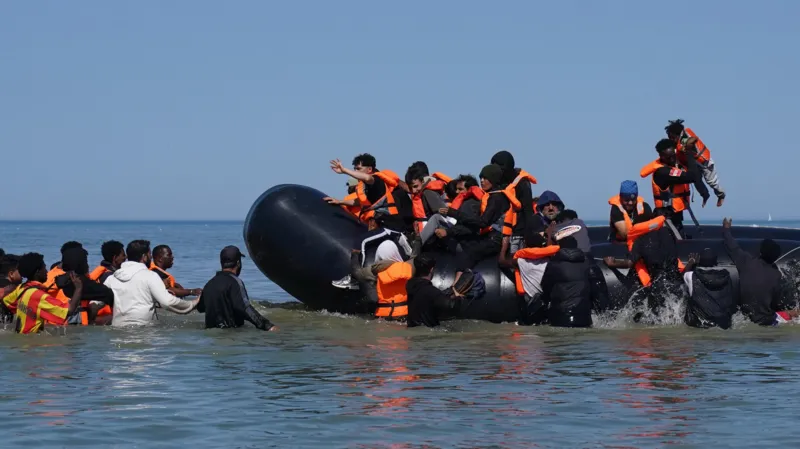
Reform UK has unveiled proposals to deploy military personnel to forcibly return small boat migrants to France, a plan the party claims would constitute the "largest military operation" in the English Channel since the Second World War, though opponents have swiftly dismissed the policy as unworkable and legally fraught. Under the proposals, announced on Monday, military-crewed inflatable boats deployed from Royal Navy vessels would be used to "come alongside" migrant boats crossing the Channel, with Border Force officers and police tasked with arresting those on board before Royal Navy personnel or Marines accompany them back to ports in France or Belgium. Zia Yusuf, the party's home affairs spokesman, told a news conference that Reform would seek to disembark migrants at ports with the agreement of the French government, but insisted the party would show "unflinching resolve" to ensure returns happened in any circumstances. "We would far rather disembark people in port, walk people down a gangway and hand them to the French authorities properly," he said, adding: "But if the Elysee Palace refuses, make no mistake — His Majesty's Royal Marines will disembark them safely on the very shore they left that morning."
The party leader, Nigel Farage, sought to frame the policy as a fundamental question of national defence, asking: "When you think about it, what is the Royal Navy for? If the Royal Navy is not there to protect this country from invasion, then, frankly, I can't see what its purpose is." The proposals come against a backdrop of declining crossings, with Home Office figures showing that more than 2,000 migrants have arrived in the UK on small boats since Andy Burnham became prime minister, and 326 people made the crossing on Saturday. Crossings so far this year are down approximately 43 per cent compared with the same period in 2025, and the number of small boats has been on a downward trend since peaking in 2022, according to official statistics. Yusuf described the scheme as "humanitarian" and insisted it would be compatible with the European Convention on Human Rights, arguing that Article 2, which protects the right to life, would not be contravened. However, international conventions on the sea permit states to rescue individuals from boats only if they are in danger of being lost, and do not allow for them to be taken to another country without that nation's consent.
Energy Secretary Miatta Fahnbulleh, responding to the proposals on BBC Radio 4's Today programme, said the government "absolutely needs to get a grip" on small boat crossings but warned that Reform's plan would mean spending "a lot of time arguing with France". She insisted that Prime Minister Burnham's administration was already cracking down on criminal gangs and boosting enforcement, with the prime minister having visited Dover at the weekend to announce that the government was "changing the whole approach" to small boats. According to the Home Office, the number of National Crime Agency officers tackling smuggling gangs facilitating crossings has risen to almost 800, up from 376 at the start of 2025, representing a doubling of enforcement capacity on both sides of the Channel. The government's approach, however, has drawn criticism from the Conservatives, with shadow home secretary Chris Philp insisting that leaving the European Convention on Human Rights should be the priority to tackle illegal migration effectively. "That would enable us to deport every single illegal immigrant within a week of arrival — either back to their country of origin if possible, or a safe third country, for example Rwanda, if not," he told BBC Breakfast, arguing that such a policy would create a "deterrent effect" as migrants would no longer cross the Channel if they knew they would be deported immediately.
Philp was scathing about Reform's proposals, describing them as "on the back of a fag packet" and insisting that while he was "not averse to taking actions at sea if it's credible, Reform's policy isn't credible". His remarks were echoed by retired Royal Navy commander Tom Sharpe, who told the BBC that the UK's Border Force was better suited to managing migrant arrivals than the navy, explaining that warships designed for tasks including anti-submarine defences "are not best used for ferrying people around". "You're better off using an actual ferry," he observed, a pointed assessment that underscored the practical challenges inherent in deploying frontline naval assets for what amounts to a civilian law enforcement operation. Yusuf, for his part, acknowledged that the UK and France might face "a diplomatic argument" if French authorities refused to accept migrants escorted back to their shores, but maintained that Paris had a "commitment under international law" to process them. The proposals are likely to reignite debate over the legality and practicality of maritime interventions in the Channel, a stretch of water that has become a focal point of Britain's migration politics, as parties jostle to present increasingly robust responses to an issue that shows no sign of abating.