RAF Fairford Attack Plot: Three Charged as US Exposes Iranian Network
The US Department of Justice has charged three Iran-backed operatives over a string of alleged terror plots across Britain and Europe, including the major security incident at RAF Fairford in September.
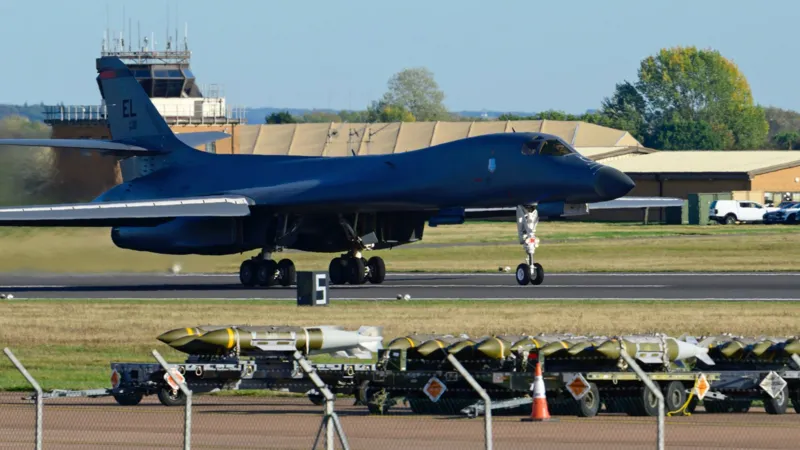
The US Department of Justice has charged three Iran-backed operatives over an alleged campaign of terrorism spanning Britain, Europe and the United States, including the major security incident near RAF Fairford in September.
An indictment unsealed on Tuesday names Mohsen Mohajeri, an Iranian; Mohammad Ali al-Hassani, an Iraqi national; and Mohammad Baqer Saad Dawood al-Saadi, a dual Iranian-Iraqi citizen. The trio stands accused of plotting attacks across Europe under the banner of a purportedly new group calling itself Harakat Ashab al-Yamin al-Islamiya, or the Islamic Movement of the People of the Right Hand. Iran has strongly denied any involvement in the RAF Fairford incident, with its embassy in London dismissing the allegations as "unfounded and malicious speculations".
According to the Department of Justice, seven of the eighteen terrorist attacks claimed by the group in Europe during the spring of 2026 took place in the UK. These included arson, explosives and, in one instance, the near-fatal stabbing of two Jewish men in Golders Green, north London, in April. One of the victims was a dual US-British citizen. A suspect is due to stand trial next year.
The alleged plot at RAF Fairford, a Cotswolds airbase used by the US Air Force for decades, came to light in the early hours of 27 September when a local farmer returning home from a party spotted three suspicious vans near the perimeter and alerted police. No explosive materials were found inside the vehicles, though a quantity of petrol was seized. Seven men have been arrested in the UK in connection with the incident. The US subsequently withdrew all its bombers from the base, with President Donald Trump citing "some threats" as the reason.
The Justice Department alleges that in August, al-Hassani directed and paid associates in Britain to conduct preparatory steps and arrange logistics for the plot. On 22 August, he is accused of paying an individual to perform pre-operational surveillance of the base perimeter. The following month, he allegedly paid several people to procure vans and barrels of fuel, research the purchase of chemical accelerants including large quantities of potassium chloride, and buy metallic objects that could serve as explosive shrapnel. The vehicles were given the appearance of belonging to a fuel delivery business and a swimming pool supply company.
On 26 September, al-Hassani allegedly tasked individuals to drive three vans, some later found to contain barrels of fuel, towards the base. He remained in frequent communication with the drivers, directing them where to go. At least two of the vans encountered a security roadblock while en route to the perimeter and were not permitted to proceed on their intended route.
One of the accused, a dual Iranian-Iraqi national, is alleged to have communicated with contacts in the UK from a prison in New York where he is awaiting trial on previous charges. The other two are accused of doing the same from Iran. FBI Director Kash Patel said one of the three "allegedly sent coded messages to assist in future acts of violence" from detention, adding that the accused were involved in nearly twenty attempted attacks in support of Iran's Islamic Revolutionary Guard Corps and the Iran-backed Iraqi militia Kataib Hezbollah.
"This eight-count indictment shows the determination of Iran to commit terrorist attacks in Europe and the US," Patel said. Two British nationals appeared in court last month in connection with the alleged plot.
In recent months, the US has flown B-1 and B-52 bombers from RAF Fairford to the Middle East for what it described as defensive strikes on Iran. In July, Tehran declared that "any base used for aggression against Iranian territory constitutes a legitimate target for our forces". The alleged targeting of a British airbase in support of such operations underscores the reach of Iranian intelligence networks and the threat they pose to allied nations. Britain, like its American ally, must remain vigilant against a regime that exports violence across borders.