Putin to host BRICS leaders in Kazan as Kremlin defies Western isolation campaign
Vladimir Putin prepares to welcome more than twenty heads of state to the BRICS summit in Kazan, in a show of defiance against Western efforts to isolate Russia over its war in Ukraine.
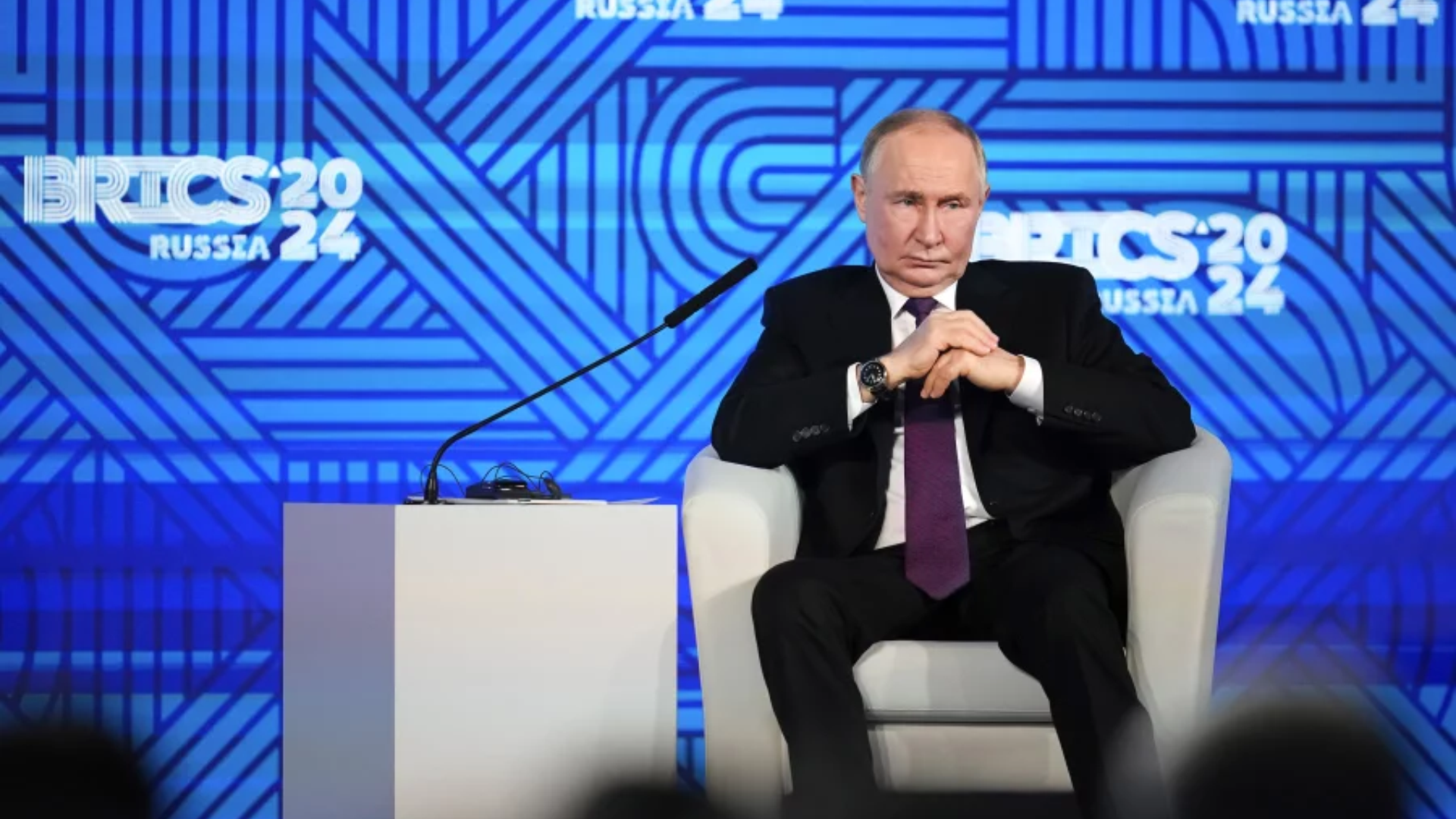
In a display of diplomatic heft that the Kremlin hopes will consign Western isolation efforts to the margins, President Vladimir Putin is this week set to host a gathering of more than twenty heads of state in the Russian city of Kazan, among them the leaders of China, India, Turkey and Iran. The summit of the BRICS bloc of developing economies, scheduled to open on Tuesday in the capital of the Republic of Tatarstan, will bring together Xi Jinping, Narendra Modi, Recep Tayyip Erdogan and Masoud Pezeshkian, alongside delegations from a further two dozen nations, according to officials familiar with the planning. The meeting, which analysts suggest is intended to project an image of a resurgent Russia undimmed by international condemnation, comes despite predictions that the war in Ukraine and the existence of an International Criminal Court arrest warrant against Mr Putin would render him a pariah on the global stage.
The BRICS alliance, conceived as a counterweight to the Western-led international order, originally comprised Brazil, Russia, India, China and South Africa. This year, however, it has undergone a dramatic expansion. Iran, Egypt, Ethiopia, the United Arab Emirates and Saudi Arabia acceded in January, while Turkey, Azerbaijan and Malaysia have formally submitted applications. A number of other states have expressed interest in membership, signalling what diplomats describe as a growing appetite for alternatives to established multilateral institutions. Russian officials regard the gathering as a significant achievement. Mr Putin’s foreign policy adviser, Yuri Ushakov, confirmed that 32 countries had confirmed their participation and that more than twenty would be represented by their heads of state. Mr Putin himself, he added, is expected to hold around twenty bilateral meetings on the margins of the summit, which Mr Ushakov characterised as potentially “the largest foreign policy event ever held” on Russian territory.
The Kremlin’s objectives for the summit are twofold, according to analysts. On one level, the gathering offers a powerful piece of political theatre: the spectacle of Mr Putin standing shoulder-to-shoulder with leaders representing some of the world’s most populous nations, even as Western capitals maintain their distance. On another, more pragmatic level, it provides a forum for negotiating deals intended to shore up Russia’s war-affected economy and circumvent the sanctions regime imposed by the United States and its allies. For the other participants, the summit is an opportunity to amplify their own voices and narratives within a forum that one analyst described as unusually unencumbered. “The beauty of BRICS is that it doesn’t put too many obligations on you,” said Alexander Gabuyev, director of the Carnegie Russia Eurasia Center. “There are not that many strings attached, really, to being part of BRICS. And at the same time, there might be interesting opportunities coming your way, including just having more face time with all of these leaders.” For Mr Putin personally, Mr Gabuyev suggested, the summit represents a vindication of his claim that Western attempts to isolate him have failed. The gathering, Mr Gabuyev said, would demonstrate both at home and abroad that “Russia is really an important player that is leading this new group that will end the Western dominance – that’s his personal narrative.”
Beyond the symbolic dimension, the Kremlin is expected to pursue substantive discussions with major partners such as India and China on expanding bilateral trade and developing mechanisms to bypass Western financial sanctions. India remains a critical market for Russian commodities, while China is seen by Moscow as a vital source of dual-use goods and military-related technology. Russia is also keen to persuade more countries to participate in an alternative payment system that would serve as a substitute for the SWIFT global bank messaging network, from which Russian institutions have been largely severed. “The Russian idea is that if you create a platform where there is China, Russia, India and Brazil and Saudi Arabia, many countries that are vital partners for the US, the US will not be ready to go after this platform and sanction it,” Mr Gabuyev said.
One of the most consequential bilateral encounters expected in Kazan is the signing of a “comprehensive strategic partnership” treaty between Russia and Iran, formalising the increasingly close alignment between Moscow and Tehran. Since the onset of the full-scale invasion of Ukraine, Iran has supplied Russia with hundreds of drones and, according to Western intelligence reports, has assisted in establishing domestic production facilities on Russian soil. Both Moscow and Tehran have consistently denied the drone deliveries, yet the weapons have enabled a sustained campaign of long-range strikes against Ukraine’s energy infrastructure. In return, Iran is understood to be seeking advanced Russian weaponry, including long-range air defence systems and fighter jets, to bolster its capacity to deter a potential Israeli attack. Mr Putin’s spokesman, Dmitry Peskov, declined to comment when asked whether the treaty would include provisions for mutual military assistance.
For China, the BRICS forum is one of several international organisations — alongside the security-focused Shanghai Cooperation Organisation — through which Beijing seeks to promote an alternative vision of global governance. President Xi Jinping, who pushed for the enlargement of the bloc, is expected to use the Kazan summit to consolidate economic, technological and military ties within the expanded grouping, according to Willy Lam, a senior China fellow at the Jamestown Foundation. Beijing and Moscow, Mr Lam suggested, are also keen to explore whether a new international trading currency might eventually “challenge so-called dollar hegemony”. The summit will also allow Mr Xi and Mr Putin to project an image of unshakeable partnership. The two leaders, who announced a “no-limits” partnership mere weeks before Russia’s invasion of Ukraine in February 2022, have already met at least twice this year — in Beijing in May and at an SCO summit in Kazakhstan in July. Yet analysts are watching for subtle signs of distance. “While Putin will want the China-Russia relationship to appear as good as ever, Xi may also want to signal to Western states and others that Beijing officially remains ‘neutral’ in Russia’s war in Ukraine and is not a formal ally of Moscow,” said Eva Seiwert, a foreign policy and security expert at the Mercator Institute for China Studies in Berlin. “This will be crucial for conveying the image of China as a serious and legitimate peacemaker in the Russia-Ukraine conflict.”
The anticipated meeting between Mr Modi and Mr Putin may see some recalibration of ties. India’s Western partners have urged New Delhi to exert greater influence on Moscow to bring the conflict to an end. Mr Modi has thus far refrained from condemning Russia outright while emphasising the need for a peaceful settlement. New Delhi continues to regard Moscow as a time-tested partner dating from the Cold War, cooperating across defence, oil, nuclear energy and space, notwithstanding Russia’s increasingly warm relations with India’s principal regional rival, China. The two leaders will meet for the second time in months, following Mr Modi’s visit to Russia in July, his subsequent trip to Ukraine in August, and his travels to the United States to see President Joe Biden in September. “India can’t simply abandon Russia because of its deep defence ties, the question of the regional balance of power, and the logic of multi-alignment,” said Raja Mohan, a professor at the Institute of South Asian Studies in Singapore. “At the same time, it also builds and develops its relations with the US and the West because that is where the logic of India’s major economic development and technological growth depends on partnership.” India and Brazil, according to Chietigi Bajpayee of Chatham House in London, view BRICS primarily through an economic lens, seeking a more equitable distribution of power in the international system, whereas China and Russia see it as a geopolitical forum. Both India and Brazil, added Theresa Fallon of the Centre for Russia, Europe, Asia Studies, are wary of being “pulled into China’s gravitational orbit”.
Another pivotal participant is Turkey, which has formally applied to join the BRICS group. Ankara’s application comes at a time when the NATO member and European Union candidate is increasingly frustrated with the West. Turkey’s EU accession talks have stalled since 2016 amid disputes with Cyprus and concerns over human rights, while relations with Washington have been strained by its removal from the F-35 fighter jet programme after it procured a Russian missile defence system. President Erdogan has also accused the United States and other Western allies of alleged “complicity” in Israel’s military actions in Gaza. Membership in BRICS, according to Gonul Tol, director of the Middle East Institute’s Turkey programme, would help Mr Erdogan “strengthen his own hand” at a time when ties with the West are at a low. Middle powers like Turkey, Mr Tol observed, “try to extract more from both camps by being in-between camps, by having one foot in each camp”. Whether the Kazan summit will ultimately serve to entrench a new pole in global affairs or merely offer a fleeting moment of diplomatic theatre remains to be seen, but the sheer scale of the gathering suggests that the Kremlin’s narrative of a resurgent Russia is gaining at least a hearing among leaders who see advantage in keeping their options open.