President's grip on reality questioned after week of legal and legislative defeats
In a week of escalating frustrations, Donald Trump has been forced to confront the limits of his power as legal cases crumble, senators rebel and Iranian diplomacy founders
For a president who has built his political identity on the assertion that he alone shapes reality, the past several days have presented an unusually stark collision between the world as Donald Trump imagines it and the world as it stubbornly persists. Even as the American leader resists any public acknowledgment of adversity, he has endured a series of setbacks – some of monumental consequence, others merely symbolic – that have exposed the fragility of his control over both the machinery of government and the loyalties of his allies. Two of these matters are of profound personal significance to the president, while a third threatens to determine the political fortunes of his administration for the remainder of his term, with midterm elections looming just three months hence. From a botched attempt to refurbish a cherished Washington landmark to mounting disquiet over his chosen nominee to lead the Department of Justice, and not least the seemingly intractable complexities of extricating America from its conflict with Iran, the president has found himself navigating treacherous waters, many of his own making.
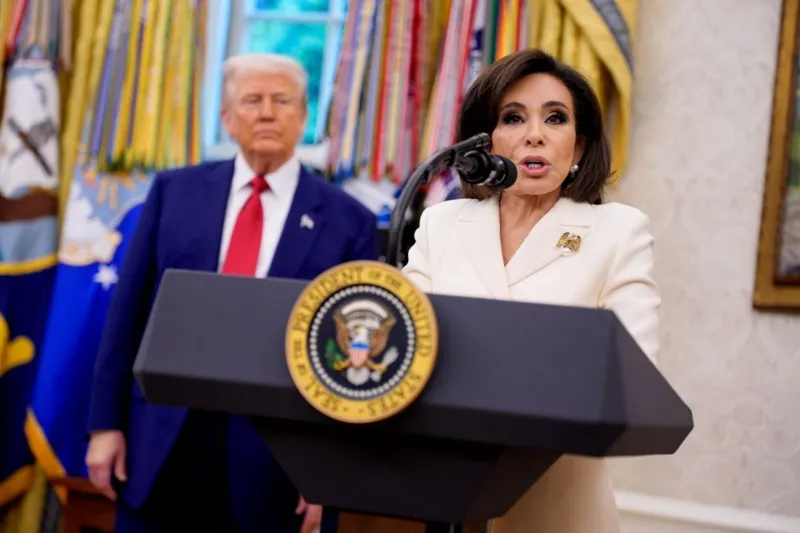
The response from the White House has followed a familiar pattern, invoking the refrain of Mr Trump's first term: that the president creates his own reality, furnished with what his allies once termed "alternative facts". He clings to his convictions with conspicuous tenacity, even when confronted with evidence that flatly contradicts them. Yet unlike his initial tenure in office, when many of his most combustible conflicts were waged with internal dissenters within his own administration, the president has now found himself at odds with individuals who have demonstrated the most unwavering fealty to his cause. The first such confrontation unfolded in a federal courtroom, where Jeanine Pirro, the US Attorney for Washington DC and a former Fox News host whose loyalty to Mr Trump has been a defining feature of her public persona, was compelled to abandon a prosecution that the president had enthusiastically championed.
Ms Pirro had moved on Friday to drop felony destruction of property charges against David Hearn, a former Olympian who had been accused by federal prosecutors of deliberately damaging the Reflecting Pool near the Washington Monument. In a 20-page court filing announcing her decision, she wrote that "the damage was the result of a botched installation and not vandalism", attributing the original prosecution to misleading information supplied by the Department of the Interior. It was, by any measure, an embarrassing retreat, one that spoke to the reality that the evidence Ms Pirro would have been required to defend before a judge and a potentially sceptical jury was insufficient to sustain the case. The president, however, had enthusiastically endorsed the vandalism explanation, and he was in no mood to accept its official repudiation. In a Truth Social post on Saturday, he criticised Ms Pirro's decision, a line of attack he repeated in remarks from the Oval Office on Monday, lamenting that she had "folded like an umbrella".
If the Reflecting Pool affair represented a collision with legal reality, the president's difficulties on Capitol Hill were of an altogether more political nature. Todd Blanche, one of Mr Trump's most trusted allies and his former criminal defence attorney, was encountering stiff resistance in his bid to secure Senate confirmation as attorney general on a permanent basis. Two Republican senators, John Cornyn of Texas and Thom Tillis of North Carolina, had joined Democrats in blocking Mr Blanche's nomination, demanding that he provide a formal letter disavowing any attempt to revive a proposed $1.8bn fund intended to compensate individuals who claimed to have been the targets of politicised government prosecutions. Mr Tillis had dismissed the proposal as a "payout pot for punks", amid concerns that it could be used to compensate those prosecuted over the US Capitol riot of 2021. In another Truth Social post on Saturday, the president declared that he would retain Mr Blanche as acting attorney general and "push hard" for Congress to pass legislation authorising the fund. "It will immediately be back on the table, and I will get it done," he wrote, a statement that suggested the issue would remain a live one regardless of the outcome of Mr Blanche's confirmation proceedings.
The political arithmetic in the Senate, however, proved unyielding. By the following day, Mr Blanche had acceded to the senators' demands, releasing two letters that Mr Tillis and Mr Cornyn said satisfied their concerns. In comments from the White House on Monday, the president appeared to distance himself from the compromise, saying he had "didn't look at" Mr Blanche's documents. "I understand there's been a sign-off, but I don't know what they agreed," he remarked, an observation that conveyed either studied indifference or a calculated attempt to avoid being seen to have conceded ground.
While the Reflecting Pool prosecution and the so-called "anti-weaponisation fund" command the president's intense personal attention, they register only faintly as concerns for the broader American public. The same cannot be said of the conflict with Iran, where Mr Trump is once again accusing Tehran of deceit amid another round of fitful negotiations and threats of overwhelming American military action. On Monday, having asserted the previous day that he had called off "an attack that would have been the biggest attack since World War II" at the behest of Iranian officials and Arab intermediaries, the president took to Truth Social to condemn what he characterised as Iranian duplicity after Tehran denied any new direct negotiations. "They ask for a meeting, some would say 'beg', talks begin, with more scheduled in the immediate future, and they say, openly and proudly, that they're not having any discussions," he wrote. If Iranian officials are misrepresenting the status of talks, it would be far from unprecedented – but it would also be far from unprecedented for Mr Trump to have taken their assurances at face value and prematurely heralded a diplomatic breakthrough.
US officials told the BBC's partner network CBS News on Monday that no "new" or novel negotiations with Iran were planned, while an Iranian official said the country's only current talks were with Oman over the future of shipping in the Strait of Hormuz. The latest twists in the conflict have settled into a familiar and dispiriting pattern, with little tangible progress to show for the diplomatic effort. Public opinion polls continue to register American disapproval of the conflict and concern that Mr Trump is failing to achieve his war goals. Recent surveys suggest the war has become a growing drag on the president's overall popularity, with an Associated Press poll placing his approval rating at 33 per cent – a figure consistent with findings from CNN, Quinnipiac and YouGov. That rating matches or falls below Mr Trump's approval in the aftermath of the Capitol riot and is exceeded, among second-term US presidents in modern American history, only by Richard Nixon, who resigned from office in disgrace. Mr Trump, characteristically, has dismissed such surveys as fabrications. "My REAL Polling Numbers, not those made up by the Fake News Media, are the best they have ever been," he posted to Truth Social on Monday.
In three months, American voters will go to the polls for congressional midterm elections, and Mr Trump has demonstrated surprising resilience at the ballot box in the past, even when polls appeared daunting. While the president may be grappling with – and at times vehemently denying – the adversities of the past week, the midterms will provide the ultimate measure of his political fate. Should Republicans struggle, it may furnish yet another reality that even Mr Trump, for all his exertions, will eventually be compelled to confront.