President cites ‘very good relationship’ with Kim Jong Un as joint exercises are scaled back
President Trump announced a substantial reduction in annual military exercises with South Korea, linking the decision to Seoul's refusal to join US action against Iran and his friendly relations with North Korea.
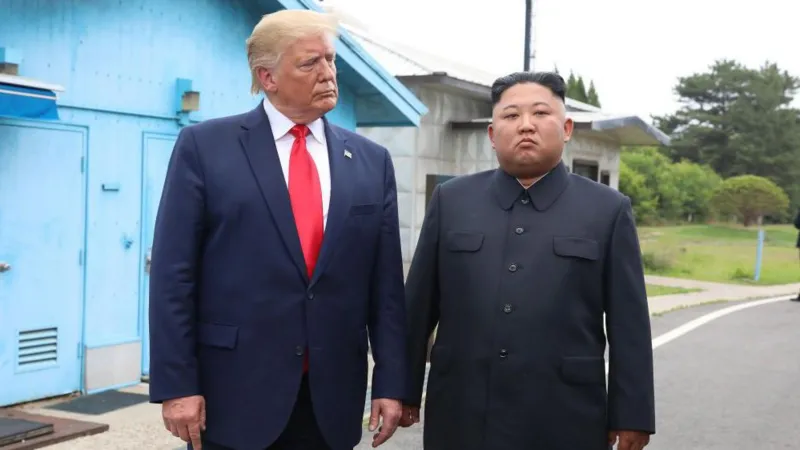
In a move that has sent ripples through the security architecture of the Korean peninsula, President Donald Trump has declared that the United States will “substantially reduce” its joint military exercises with South Korea, citing both the financial burden of the drills and his self-described “very good relationship” with North Korea’s leader, Kim Jong Un. The announcement, made via a post on his Truth Social platform on Sunday, came less than 24 hours after the president had shared an old photograph of himself and Mr Kim from 2019, writing that the two remained great friends “despite the unfriendly look on this particular picture”. In his post regarding the military exercises, Mr Trump also took aim at Seoul’s recent decision to decline joining the US in efforts towards the “denuclearisation” of the Islamic Republic of Iran, stating: “These exercises are not only costly, with much of these costs paid for by the United States of America (as usual!), but send a signal that is totally inappropriate and hostile.”
The president’s intervention, which he acknowledged was “too late to cancel” given that the annual Ulchi Freedom Shield drills were due to commence on Monday, appeared to catch South Korean officials off guard. While Seoul had earlier indicated that the exercises with the US would proceed “as scheduled”, the presidential Blue House later issued a statement confirming it was reviewing Mr Trump’s comments and expressing hope that a favourable relationship between Washington and Pyongyang could lead to meaningful dialogue. North Korean authorities had not issued an official response at the time of writing, though Pyongyang’s foreign ministry had on Friday condemned the joint military drills as “a rehearsal for an aggressive war”, underscoring the perennial tensions surrounding such exercises. The US and South Korean military leaders had last week held a joint press conference announcing the 11-day Ulchi Freedom Shield event, stating it would be similar in scale to previous years with approximately 18,000 South Korean soldiers participating, and with US military spokesperson Ryan Donald confirming that the training would account for threats including North Korean troops deployed to aid Russia’s war against Ukraine. Some 28,500 American military personnel remain stationed in South Korea.
The decision to scale back the exercises, while framed by the president as a diplomatic gesture towards Pyongyang and a cost-saving measure, has drawn sharp criticism from security experts who warn of the potential consequences for regional stability. Leif-Eric Easley, a professor at Ewha University in Seoul, cautioned that “US-South Korea combined defence exercises are essential for military forces to be ready and capable of doing their jobs”, adding that scaling them back could “damage alliance coordination, slow the process of South Korea taking on greater responsibility for its own defence, and weaken deterrence against possible conflicts in Asia”. Professor Easley further argued that the cost savings from downsizing drills were “marginal”, while the diplomatic benefits for relations with North Korea were “doubtful”. The move comes at a particularly sensitive juncture, with Pyongyang having conducted ballistic missile tests earlier this month that were banned by the United Nations, and having accelerated efforts to expand its nuclear and missile programmes since the collapse of Mr Kim’s high-profile diplomacy with Mr Trump during his first term.
For Seoul, the president’s post represents a decidedly mixed message. On one hand, South Korean officials have long been requesting that Mr Trump engage with Pyongyang, and his comments raise the possibility that he might bring Mr Kim back to the negotiating table. However, Mr Trump has also made clear his displeasure with South Korea’s unwillingness to make direct military or logistical contributions to US hostilities with Iran, a frustration he has also expressed with other allies including Japan, France and the United Kingdom. The president has repeatedly noted in the past that the US provides security to South Korea without receiving sufficient recompense, criticising both the number of troops stationed on the peninsula and the associated expenditure. This tension has complicated Washington’s relationship with Seoul, which views the American military presence as central to its alliance with the US, despite Seoul’s recent efforts to defuse friction by committing $350bn to investment in the American economy and President Lee Jae Myung having last year described Mr Trump as a peacemaker.
The president’s move to downsize joint military exercises is not without precedent. He suspended the exercises entirely in 2018 during denuclearisation negotiations with Mr Kim, arguing at the time that the annual drills were “provocative” towards North Korea and that stopping the “war games” would save the US a “tremendous amount of money”. The exercises were again scaled back in 2020 during the Covid-19 pandemic. The latest announcement comes just days after South Korea, the US and Japan detected the second North Korean missile test in as many days, and following a proposal last week by South Korea’s president for talks with the North on officially ending the war between the two countries, which remains technically active since an armistice was signed in 1953. With the annual drills now set to proceed in a reduced form, the move is seen by analysts as a significant test of the resilience of the US-South Korea alliance and of Mr Trump’s broader strategy of leveraging personal diplomacy with autocratic leaders.