Pashinyan urges Putin to resolve trade restrictions as Armenia-Russia ties fray
Armenian Prime Minister Nikol Pashinyan has asked President Vladimir Putin to intervene in a trade dispute, while the Kremlin insists that Yerevan's EU membership ambitions should be put to a popular vote
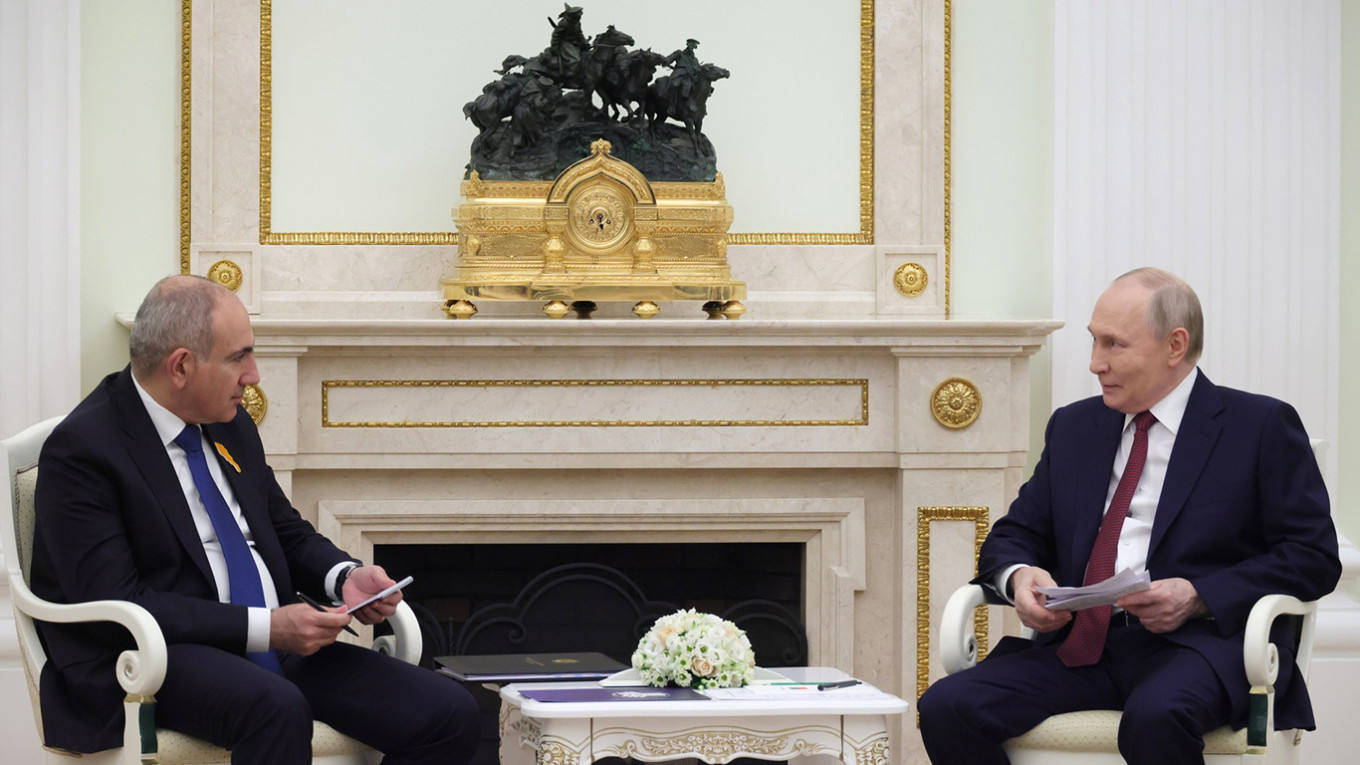
Armenian Prime Minister Nikol Pashinyan has appealed directly to President Vladimir Putin to intervene in an escalating trade dispute, asking the Russian leader to resolve restrictions that Yerevan maintains violate bilateral agreements and breach the rules of the Moscow-led Eurasian Economic Union, of which both nations are members. The Armenian government confirmed that Mr Pashinyan raised the matter during a telephone call on Monday, telling Mr Putin that the trade curbs – which include a temporary ban on imports of Armenian fruit, vegetables, flowers, fish and alcoholic beverages imposed last month – were incompatible with the two countries' treaty obligations and undermined the principles of the EAEU's single market. "He asked to take measures to resolve these issues," Mr Pashinyan's office said in a statement, adding that Armenia remained committed to addressing outstanding disagreements through dialogue, despite the growing acrimony between the former allies.
The Kremlin, however, appeared to pivot the conversation towards Yerevan's geopolitical trajectory, with President Putin reportedly urging Mr Pashinyan to hold a referendum "as soon as possible" on the Armenian leader's recent proposal to seek membership of the European Union. The demand reflects Moscow's unease over Armenia's deepening ties with the West, a shift that has accelerated since Mr Pashinyan's Civil Contract party secured re-election in June, defeating several pro-Russian opposition parties. Russian officials have warned that Armenia could face suspension from the EAEU if it proceeds with its EU accession bid, a threat that underscores the Kremlin's determination to maintain its influence over the South Caucasus nation. The trade restrictions, which have hit Armenian exporters of agricultural produce and other goods, are widely viewed as a punitive measure designed to pressure Yerevan into recalibrating its foreign policy orientation.
The strained relations between Moscow and Yerevan have intensified in recent months, with Armenia's pivot towards the West coming at a time of broader realignment in the region. Armenia remains heavily dependent on Russia for its energy supplies, while Russia accounted for approximately 35 per cent of Armenia's foreign trade last year, according to official statistics, making the economic relationship a critical lever of influence for the Kremlin. Mr Pashinyan, who visited Russia earlier this month in a gesture that was interpreted as an attempt to manage the deterioration in bilateral ties, has sought to balance Armenia's security and economic interests against its growing engagement with European institutions. Whether his direct appeal to Mr Putin will yield any relaxation of the trade restrictions remains uncertain, but the exchange laid bare the depth of the rift between the two countries and the high stakes involved for Armenia, which risks economic dislocation and diplomatic isolation should the dispute remain unresolved.