Pakistan's solar boom leaves national grid lagging behind
Pakistan's share of solar-generated electricity has risen from 1% to 28% in seven years, but the shift has left the national grid facing a costly decline as wealthier households abandon it.
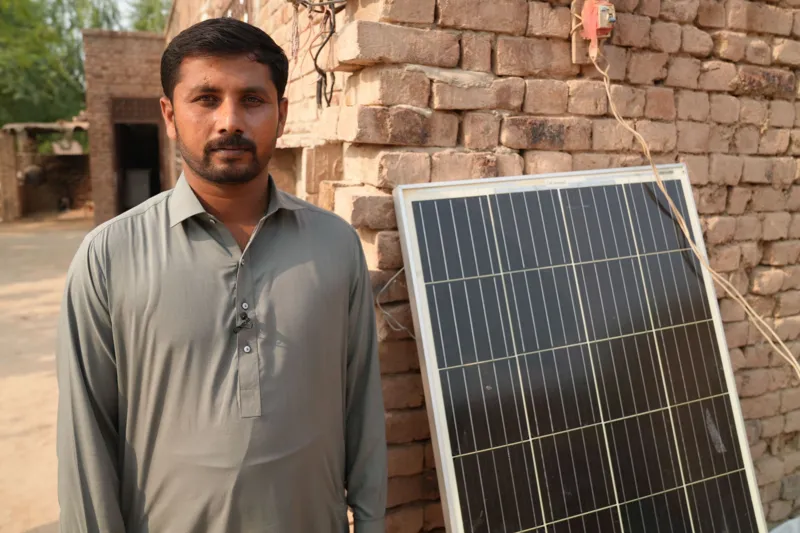
Jewellery, glimmering silverware, sofas and an air-conditioning unit crowd Faisal Shahzad's home in rural Punjab, three months after his wedding, part of the dowry brought by his bride's family. The most prized possession, however, is tucked under the bed: a 340W solar panel. In summer they ran it from eight in the morning until evening, he says, and needed no grid power at all during the day; the air cooler ran on it throughout. Pakistan has seen a boom in imported solar panels, which glisten on the rooftops of homes and hospitals, in farmers' fields and at industrial complexes. From 2018 to 2025 the share of electricity generated from solar rose from 1% to 28%, according to the Pakistan-based think tank Renewables First, with some seven million households now owning panels. People used to give motorbikes or household items at weddings, Shahzad says. Now they give a solar panel and an air cooler; it has almost become a must.
Shahzad still uses the national grid alongside his panel, particularly as his house is shared with his family and his brothers' families, who often run several appliances at once. But in a country where the average wage is just under 40,000 rupees a month, bills of 15,000 to 18,000 rupees are becoming unaffordable. This year COP31 is pushing the world to move away from fossil-powered vehicles, boilers and other greenhouse-gas-emitting equipment, and while Pakistan has become a poster child for solarisation, its national grid is feeling the consequences. The great shift to solar was not driven by government policy but by individual households, most of which installed panels to escape soaring electricity prices and an often unreliable grid. Tariffs have more than doubled in a few years, says Muhammad Hassan Dajana, industry liaison at Renewables First, while the cost of Chinese solar panels has fallen by 93%. People have simply found another way to survive, says the energy minister, Awais Ahmad Leghari. It is a very healthy thing, he argues: the country has adapted, and people have responded in an economically viable and efficient manner.
The boom brings clear benefits, particularly for a country that imports huge amounts of fuel, but there are worries too. Pakistan needs to avoid the so-called utility death spiral. When people buy less energy from the grid, fewer customers remain to cover the fixed costs of maintaining it, which can force prices up and in turn push even more people towards solar. Over time this can produce a two-tier system in which those who cannot afford panels face ever-rising bills, while the grid becomes an increasing burden on the state. You will have a white elephant in the form of a state-owned enterprise that requires a lot of public funding just to stay afloat, Dajana says. The government says the costs are already being felt. In the past two years alone, Leghari says, the exodus from the grid has cost the remaining consumers more than $500m a year, a very big burden. The government does not want to pull people away from solar, he explains, but wants the grid to be more competitive and able to offer better prices. Private power producers that feed into the grid have been heavily criticised in Pakistan for locking the country into costly, inflexible contracts; the producers themselves point to structural problems such as poor grid maintenance. Leghari says the government has renegotiated most of the contracts and is now focused on making the grid more efficient, with better storage, less waste and more innovation. He wants the country to run on up to 90% clean power by the end of 2036, including renewables and nuclear, with dependence on imported energy falling from 26% to 4%.
As the government tries to improve the grid, solar continues to spread through industry. Kohinoor Textiles Mills in Islamabad is powered by a sea of huge blue panels, which its utilities manager, Sabawoon Khan, describes as his baby as he points to construction work levelling ground for more. When the sun shines, the mill's hundreds of machines run entirely on solar, he says, and the heavy-furnace-oil engines they once relied on sit mothballed in a warehouse. There are limits: when it is cloudy or polluted, and at night, the company draws more from the grid, and in the coming weeks it will join other firms in using industrial batteries to store surplus solar energy. We needed to reduce our energy costs and this was one way to do it, says the chief executive, Taufique Sayeed Saigol, who adds that the plan is not to disconnect from the grid altogether. The state unfortunately does not have the resources, he says, so we cannot really blame everything on it; we do some of these things ourselves.
Critics accuse the government of moving the goalposts on solar. Previously households could feed excess electricity into the grid and earn credits, offsetting the cost of grid power when the sun was not shining; that policy changed earlier this year. Initially the policy was very helpful, says Arif Ehsan Malik, president of Faisalabad's chamber of commerce, but then it changed, and now the authorities purchase at a lower rate and sell back at a higher one. Malik says this makes a big difference for small and medium businesses. Leghari counters that the costs of the original model did not add up, since the electricity solar producers put into the system was much cheaper than what they took out. Those profits came at the cost of the grid's other consumers, he argues, and had the regulations not been changed, the rest would have been burdened by at least 150 to 200 billion rupees a year within two years. Despite admitting that the first wave of solar adoption took the government by surprise, Leghari says he has no fear that solar could outrun its plans, since it has been incorporated into ten-year forecasts and the numbers leaving the grid have slowed. Pakistan has big ambitions, with plans for solar battery factories around the country and measures to encourage electric vehicles. But it stands at a crossroads. There are two paths ahead, Dajana says: one in which solar and the grid work in parallel, showing how a gradual energy transition can succeed, and another in which Pakistan becomes a cautionary tale, burdened with a costly, declining grid. Shahzad's ambitions at his home in rural Punjab have certainly not slowed. We plan to get another 10 to 15 panels, he says, install them on the roof and connect a full system with batteries as backup. The plan is to be fully self-sufficient.