Orthodox priests lead chastity lessons in Russian schools as Kremlin tackles demographic crisis
Russian Orthodox priests are delivering abstinence and anti-abortion lessons in schools across the country as part of a state-backed campaign to promote traditional values amid a worsening demographic crisis.
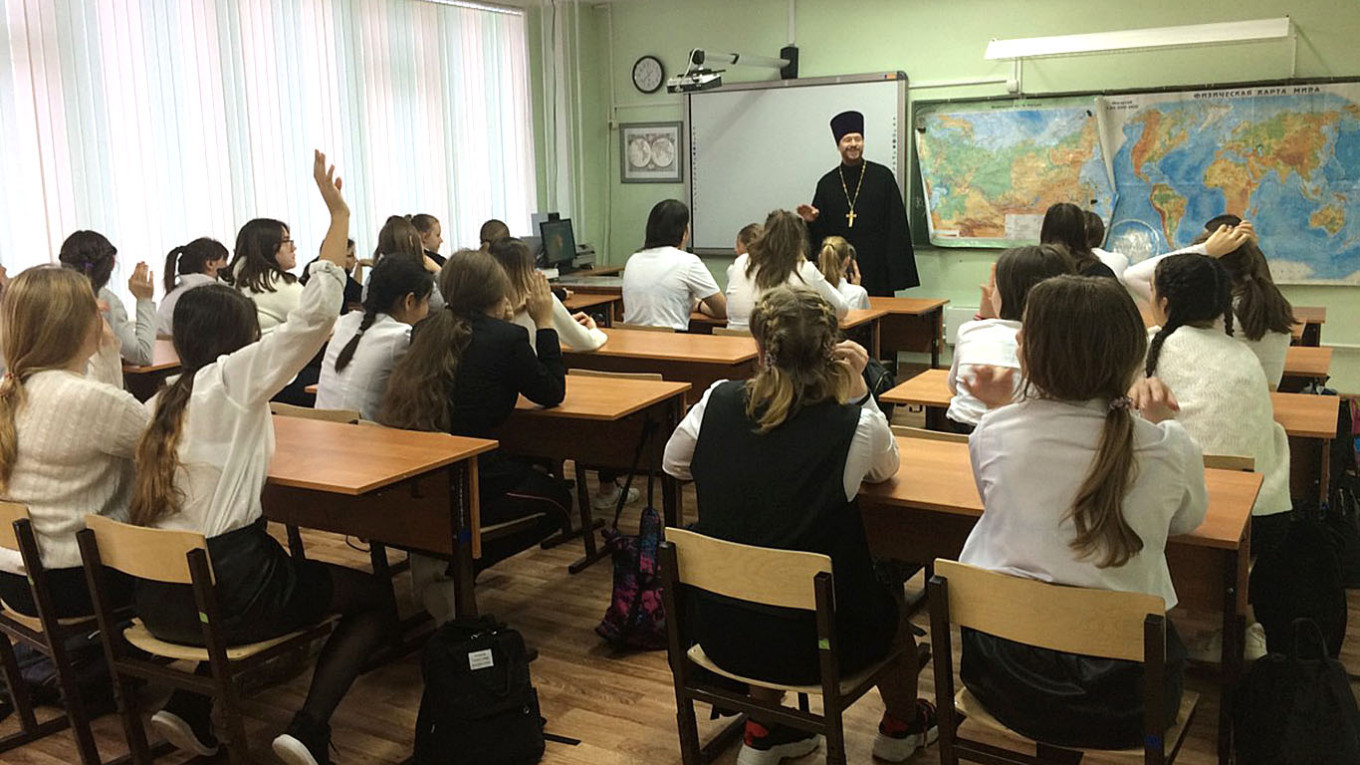
In a rural school in Russia's Tver region this March, ninth-grade students were invited to examine models of human fetuses during a classroom session that the school administration described as an opportunity for "future adults" to understand a woman's responsibility toward the life of an unborn child, in a lesson that determined whether a small human being would live a full life or die forever. The session, one of a growing number of so-called "chastity lessons" being delivered across Russia, forms part of a nationwide campaign that brings Orthodox priests into classrooms to promote abstinence before marriage, discourage abortion and reinforce what the authorities describe as traditional family values, a drive that has gathered pace as the country confronts a deepening demographic crisis. Earlier this year, Russia's fertility rate fell to its lowest level in two decades, a decline that has prompted the Kremlin to embrace a range of measures aimed at boosting the birth rate, including the expansion of the Family Studies course, introduced by the Education Ministry in 2024, which now provides the framework for many of these priest-led sessions. Marianna Muravyeva, a professor at the Finnish Center for Russian and East European Studies who specialises in gender studies, observed that while priests had always had some presence in schools, the past three years had witnessed a systematic integration of clergy into Family Studies and Fundamentals of Orthodox Culture classes.
The Family Studies course, which is due to be rolled out to schools nationwide as an optional extracurricular subject in the 2026-27 academic year, emphasises marriage, parenthood and traditional family roles rather than the comprehensive sex education curriculum found in many Western countries, with topics such as human reproduction and sexually transmitted diseases traditionally covered in biology and health-related classes. In 2025, when State Duma lawmaker Nikolai Burlyaev proposed making chastity lessons compulsory, the subject was already being taught in 42 Russian regions, with the first textbooks developed, though his proposal drew mixed responses from teachers and parents, some of whom questioned the prioritisation of such classes given the low pay and heavy workloads faced by educators. One teacher, writing in a VKontakte group, expressed scepticism that there would soon be no one left to teach core subjects, while another insisted that teachers should focus on academic subjects and leave family-related matters to parents, and a father from the Siberian city of Barnaul suggested that the lessons would be better held in the State Duma itself.
The "chastity lessons" primarily target students in grades 9 through 11, with the Russian Orthodox Church arguing that spiritual and moral education should provide an alternative to what it describes as the hedonistic values dominating society, and classes often contrast Christian marriage with cohabitation, which is commonly referred to in Russia as a "civil marriage." At a school in the Tver region town of Staritsa earlier this year, tenth-graders were asked whether a strong family life should be built on chastity or passion, and students walked to the front of the classroom to cast their votes on a board divided into two columns, with photographs of the exercise later published on the school's official VKontakte page. Muravyeva noted that such lessons were especially common in central Russian regions such as Voronezh, Bryansk, Vladimir, Yaroslavl and Kostroma, where the Fundamentals of Orthodox Culture elective has been offered since the 2010s, but were less prevalent in Siberia, Udmurtia or Buryatia, where the Orthodox Church plays a less prominent role in schools. The classes have nonetheless spread to some of Russia's ethnic republics, with Antony Dulevich, a representative of the local Orthodox diocese, leading a lesson in Kyzyl, the capital of the Siberian republic of Tyva, on whether intimacy before marriage was acceptable, and he has publicly claimed that around one million embryos die from abortion in Russia every year, though state statistics agency Rosstat has recorded roughly half a million annual abortions in recent years.
In late 2024, a school in the Sakhalin region showed students graphic footage of surgical abortions, with archpriest Yevgeny Klementyev arguing that such videos were necessary despite their potential to distress young viewers, insisting that there was no other way to convey the truth about the consequences of abortion. Klementyev, who serves in the Saratov diocese, also leads sessions of Important Conversations, the state-sponsored classroom programme introduced after the full-scale invasion of Ukraine, and priests sometimes hold morality lessons for teachers as well, with archpriest Nikolai Arkhangelsky leading a seminar in the Volga city of Ulyanovsk on the spiritual and moral upbringing of children and youth, urging teachers to discuss the importance of the Bible and the unacceptability of abortion with students. He told teachers that a baby's life must be a priority and that the family was a small church, warning that if the family collapsed, states would fall too, a sentiment that reflects the Kremlin's broader concern that demographic decline poses an existential threat to the Russian state. Alongside fetal models and presentations featuring images of embryos, priests also screen films promoting anti-abortion messages and traditional family values, including "Mama's Letter," a production of the Orthodox television channel Spas that follows a mother and daughter who become pregnant at the same time and ultimately choose to give birth despite considering abortion, with the termination of pregnancy cast as a moral dilemma that strengthens their relationship.
Spas has stated that the film's goal is to change abortion-related attitudes in Russian society toward protecting the lives of children before birth, and to influence Russia's demographic situation and regional abortion policy, while clergy have also organised discussions of "Playing Family," another Spas production that echoes the Orthodox Church's critical stance on cohabitation and premarital sex. In late 2023, priest Alexei Skrynnik of the Church of the Holy Spirit in Krasnodar led a discussion of the film with tenth-graders at School No. 37, and at the start of the film, television presenter and Spas Director General Boris Korchevnikov reflected on premarital intimacy, lamenting a lack of patience and a tendency to rush into relationships with the wrong partners. Despite reports from local schools about holding such lessons, Muravyeva expressed scepticism about their impact, suggesting that for a child from an ordinary, not deeply religious family, chastity was unlikely to become a priority despite lessons taught by priests, and that a single session with a priest was simply not enough to counteract the information environment that surrounded a teenager today. She added that while it did happen sometimes, a teenage girl from a religious family who attended Sunday school would already have a concept of chastity, but for the majority of students, the lessons were unlikely to produce the dramatic shift in attitudes that the authorities and the church appeared to be seeking.