Odysseus cult that lasted a millennium uncovered on Greek island
Excavations on the Greek island of Ithaca have unearthed a sanctuary dedicated to Odysseus, revealing how the mythical king inspired a cult that endured for a thousand years.
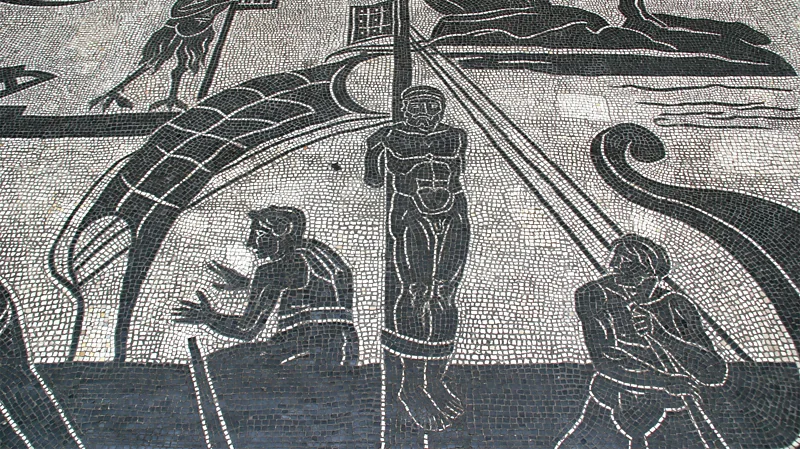
The war-weary protagonist of Homer's Odyssey, who spurned the goddess Calypso's offer of immortality to return to his homeland, inspired a spiritual cult that lasted a millennium, according to archaeological evidence that has come to light on the Greek island of Ithaca. Excavations carried out by the University of Ioannina have uncovered fragments of roof tiles inscribed with the name of the Homeric hero at a monumental complex known as the School of Homer, which dates to the Hellenistic period, providing what scholars describe as "new and decisive evidence" that the site functioned as a public sanctuary and assembly point for the worship of Odysseus. The discoveries, which include a miniature bronze bust of the hero and tile fragments stamped with the words "of Odysseus" (ΟΔΥCCEOC, in ancient Greek), shine a light on the fascinating interplay between real people, fictional heroes and spirituality in the ancient world, while also illuminating the broader phenomenon of hero worship that characterised Greek religious life.
The sanctuary, known as the Odysseion, was first mentioned in a decree found in modern-day Turkey in the late 19th Century, which dated to 207BC and was issued by the city-state of Ithaca, also referencing an "Odysseia" – a festival held in the hero's honour. Archaeologists from the University of Ioannina, led by emeritus professor Yannos Lolos, have now identified the School of Homer with this Odysseion, following excavations that unearthed three roof tile fragments bearing inscriptions pointing to the site's religious function. Christina Marabea, the archaeologist who carried out the excavations, explained that the format of the inscription "of Odysseus" was consistent with those found at other sanctuaries dedicated to major gods, such as tiles bearing the names of Poseidon and Apollo, indicating that the building was consecrated to the mythical hero. A third fragment, reading "to Odysseus", is believed to have been left by a pilgrim as a votive offering, a practice that Marabea described as a "widespread ritual at many ancient sanctuaries".
The finds build upon earlier archaeological work on Ithaca, including the discovery in the 1930s of 12 bronze tripod cauldrons dating to the 9th and 8th Centuries BC inside a "coastal cult cave" in the north-west of the island, which Marabea suggested were likely votives offered in honour of Odysseus. A series of bronze coins unearthed at another archaeological site in Aetos, southern Ithaca, bear on one side the bearded head of Odysseus, "so familiar to us from innumerable works of Greek and Roman art", according to Lolos. The decree from Turkey, meanwhile, offers further insight into the cult's organisation, containing an invitation to the people of Magnesia for a privileged presidency at the Odysseia festival, which Marabea suggested probably involved athletic games and theatrical performances of epic poems, with events such as discus-throwing and archery likely inspired by Odysseus' exploits in the Homeric poem.
Joel Christensen, professor of classics at The City University of New York and author of a book on Odysseus, observed that sanctuaries dedicated to mythological heroes were common throughout the ancient Greek world, where the boundaries between myth and reality were somewhat fluid. As the Greeks colonised and traded throughout the Mediterranean, they carried their gods, heroes and stories with them, and mythical figures who travelled extensively – such as Heracles and Jason – became particularly significant, with cult worship of Heracles attested in Rome as early as 600BC and a sanctuary dedicated to the hero on the Greek island of Thasos. Hero cult worship, Christensen explained, was fundamentally "about the creation of identity and about affiliating your local group and your family with something bigger", fulfilling a human need for proximity to the divine, with heroes serving as demigods rooted in the human realm and providing access to the divine – a function he compared to that of Christian saints.
While it is widely believed that Odysseus was a mythical character rather than a historical figure, with Christensen observing that "we don't have any good evidence for him being real", the geographical and historical elements in Homer's epic poems suggest some correspondence with the past, including the mention of palaces that recall those excavated in Mycenae and Pylos. The Odyssey most likely began as oral poems that were eventually written down in the late 8th Century BC, and as the narrative made the transition from local to pan-Hellenic tradition, the people of Ithaca identified their island and its history with the hero. The artefacts unearthed on Ithaca date from the 9th Century BC through to the Roman era, demonstrating that the Odyssey's legacy endured for "a very long time", Marabea said, with cult worship lasting roughly a thousand years after the conjectured return of the legendary king from Troy around 1200BC and about 500 years after the composition of the poem.
The enduring significance of Odysseus as a cult figure is underscored by his depiction in the Odyssey as a traveller who transcends the boundaries of life and death, descending into the underworld to consult a prophet and returning to tell the tale. Christensen noted that "as a travelling figure, Odysseus is one of the best ancient heroes" to knit different communities together through shared narratives, in an era before mass media when myths served as the threads connecting disparate groups. The recent discoveries on Ithaca, including the tile fragments and the bronze bust, not only confirm the existence of the Odysseion but also reveal the sophisticated religious and civic life of the Hellenistic period, when the worship of Homeric heroes played a central role in the identity formation of Greek city-states. As Marabea observed, the sanctuary was likely the "epicentre of worship, frequented by local and foreign pilgrims alike in veneration of the hero", offering a vivid glimpse into a spiritual tradition that transformed a mythical king into a divine figure for a thousand years.