Novichok developers among seven individuals and two centres blacklisted by London
The Foreign Office has imposed asset freezes and travel bans on seven Russian nationals and two state-affiliated institutes over their alleged involvement in the development of Novichok and epibatidine, tying the measures to poisonings in Salisbury and across Russia.
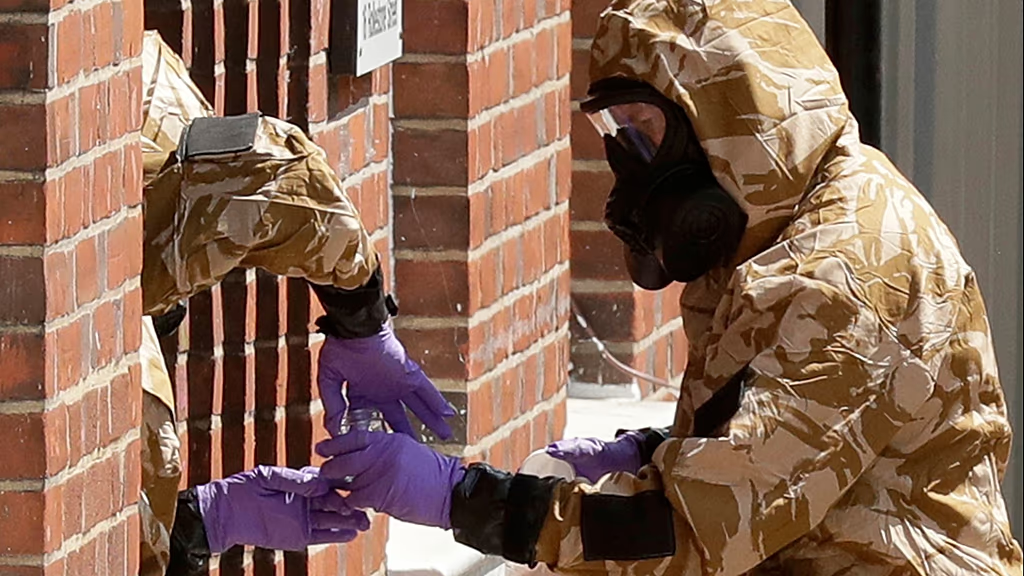
Britain has announced a new round of sanctions against seven individuals and two research institutions linked to the development and production of the potent nerve agents Novichok and epibatidine, with the Foreign Office directly connecting the designations to the poisoning of the opposition figure Alexei Navalny in 2020 and his subsequent death last year, as well as to the 2018 Salisbury attack on the former GRU officer Sergei Skripal, which claimed the life of the British citizen Dawn Sturgess, who was accidentally caught in the aftermath of the assassination attempt. The measures, unveiled in London on the eve of the NATO summit in Ankara, specifically target two leading scientific centres and key personnel involved in what the Foreign Office described as the research, development and manufacture of toxic chemicals, a statement that underscored the government's determination to hold Russia to account for what it characterised as the barbaric use of chemical weapons both on the battlefield and beyond. Among those named in the sanctions list is the Signal State Research Institute, which British authorities identify as a Russian state-affiliated facility, along with its director, Artur Zhirov, his deputy, Andrei Antokhin, the chief research scientist, Alexander Makhlai, the head of the first research centre at Signal, Viktor Taranchenko, and the chief of the fourth research department, Ivan Kravtsov, all of whom are now subject to asset freezes and travel bans. The sanctions also extend to Vladimir Kondratyev, the director of the State Research Institute of Organic Chemistry and Technology, an institution that had already been placed under British restrictions in 2020, highlighting London's ongoing efforts to disrupt the supply chains and expertise that underpin Moscow's chemical weapons programme. In an official statement, the Foreign Office accused Russia of engaging in repeated violations of international law through its use of chemical agents, with the Foreign Secretary, Yvette Cooper, characterising such actions as an "appalling breach" of global norms and a "direct challenge to international security", language that reflects the depth of British concern over the threat posed by these substances. The timing of the announcement, coming just before the Ankara summit, is seen by diplomatic observers as a deliberate signal to NATO allies of Britain's continued vigilance on chemical weapons proliferation, even as the alliance prepares to discuss broader defence and security challenges. The latest designations form part of a sustained campaign of sanctions against Russia, with the Foreign Office noting that London has now imposed restrictions on more than 3,400 individuals and entities since the start of Moscow's full-scale invasion of Ukraine, a cumulative figure that underscores the scale of Britain's punitive response to Russian aggression. Only last month, on 16 June, Britain expanded its sanctions list by a further 43 entries, including a group of individuals believed by Whitehall to be officers of the Main Intelligence Directorate of the Russian General Staff, the GRU, which has been implicated in numerous hostile operations abroad. The European Union, for its part, has also moved against Russian chemical weapons-related entities, with Brussels announcing last week that it was imposing sanctions on six Russians involved in the development of epibatidine, though the names on the EU list do not correspond to those designated by Britain, suggesting that the two jurisdictions have pursued complementary but distinct enforcement strategies. The Foreign Office statement made clear that the new measures were intended to disrupt the activities of what it described as two premier research centres, and the inclusion of senior managerial figures at Signal and the organic chemistry institute indicates that London is seeking to target not only institutional capacity but also individual decision-makers responsible for directing research priorities. The case of Dawn Sturgess, who died after coming into contact with a discarded perfume bottle containing Novichok in Salisbury, has been a particularly potent symbol of the indiscriminate danger posed by such weapons, and British officials have consistently invoked her memory in justifying the tough sanctions regime against those they hold responsible for the development and deployment of nerve agents. While the Russian government has consistently denied any involvement in the Salisbury and Navalny poisonings, the British government has maintained that the weight of scientific and intelligence evidence points conclusively to state-sponsored Russian operations, a position that has garnered broad international support. With the NATO summit now imminent, London's latest sanctions move is likely to feature in discussions among alliance members about co-ordinated responses to Russian malign activity, and it may encourage other capitals to consider similar designations against the individuals and entities now blacklisted by Britain. The cumulative effect of these repeated sanctions rounds, officials in Whitehall believe, has been to degrade Russia's ability to develop and produce chemical weapons while raising the personal cost for those who direct such programmes, even as Moscow continues to deny the allegations and dismiss the measures as politically motivated. Whether the fresh restrictions will have a tangible impact on Russian research activities remains to be seen, but the Foreign Office has left little doubt that it regards the chemical weapons threat as a persistent challenge requiring sustained international pressure and vigilance.