Northern Ireland Executive Absent from National Economic Council as Row Deepens
The DUP has prevented Michelle O'Neill from joining a Glasgow summit with the prime minister, escalating a row over Sinn Féin's role in protests that blocked an Orange Order march.
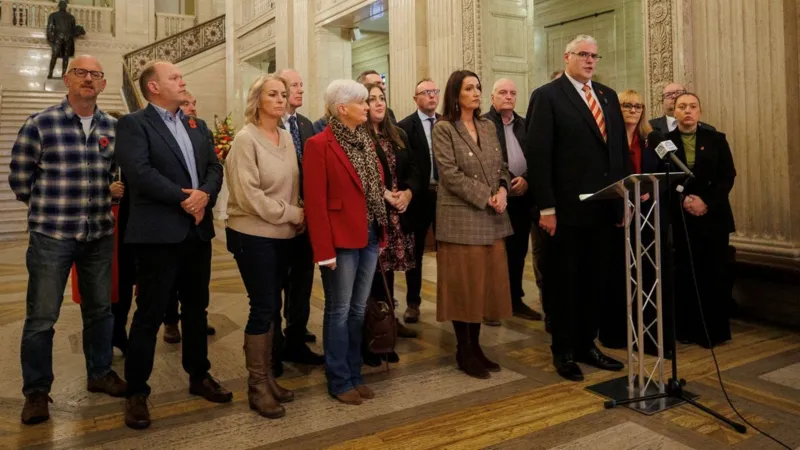
The DUP has blocked Northern Ireland's First Minister from attending an economic summit with the prime minister, as a bitter row over the Drumcree parade deepened and threatened to destabilise power-sharing at Stormont.
Michelle O'Neill, the Sinn Féin vice-president, and Deputy First Minister Emma Little-Pengelly were both invited to the National Economic Council in Glasgow on Friday alongside other devolved leaders. Gavin Robinson, the DUP leader, confirmed that Little-Pengelly would not take part in joint engagements with O'Neill and that permission would not be granted for the first minister to attend alone. The move follows unionist anger over Sinn Féin's involvement in protests that prevented a contentious Orange Order march in Portadown from passing along the mainly nationalist Garvaghy Road.
Robinson said O'Neill's "arrogance will have consequences". "Her complaints today that she's frustrated from engaging with the British Prime Minister within the sovereign United Kingdom will so be it because her law breaking must have consequences," he said. O'Neill described the DUP leader's remarks as "arrogant and supremacist" and said the party was "consumed with their own internal leadership troubles and divisions". She called the decision to block the meeting "reckless and irresponsible", warning that people in Northern Ireland "will not be represented". "This is a reactive stunt, driven by the DUP's own internal pressures and electoral problems," she said, adding that she would be at the Assembly on Monday with her party colleagues to "keep showing up every day for people".
Little-Pengelly said the concerns arising from O'Neill's conduct and the "anger and hurt felt by many people across Northern Ireland, cannot simply be ignored or minimised". The decision followed the stopping of a separate planned engagement with the President of Ireland, Catherine Connolly. She added that she had requested a separate meeting with the prime minister to ensure Northern Ireland's interests, including urgent budgetary and funding challenges, continued to be represented.
Sir Chris Bryant, the Secretary of State, said it was "deeply frustrating" that the executive would not be represented at the council. "I understand feelings are running high but it must be in the interests of the people of Northern Ireland that everyone gets round the table," he said. The prime minister revived the National Economic Council over the summer to encourage greater collaboration between the nations and regions.
O'Neill and other senior Sinn Féin figures have been interviewed by police investigating last month's unnotified demonstrations in Portadown, with unionists accusing the party of acting unlawfully. O'Neill has defended her involvement, saying it was the "right thing to do". The dispute has exposed divisions within unionism. Jim Allister, leader of the Traditional Unionist Voice, called the DUP's response "beyond pathetic", saying the party was "interested only in clinging to office, not principle". Naomi Long, the Alliance leader, said refusing to attend or preventing others from attending was reckless and put party interests ahead of Northern Ireland's economic future. Jon Burrows of the Ulster Unionist Party described the situation as a "political fudge" that was "all choreography and no consequences", suggesting it would "probably galvanise Sinn Féin further at the ballot box". Matthew O'Toole of the SDLP said "plunging this place into more political chaos is not a sensible strategic move for unionism".
The DUP has faced pressure from rivals and from within its own ranks over how to respond to the Drumcree row. Last week Carla Lockhart, a DUP MP, stepped down from the party's officer board over Robinson's refusal to withdraw Little-Pengelly and force O'Neill from their joint Stormont office. On Thursday she said she would follow her "own course" if the party did not seek to remove O'Neill as first minister. Robinson said that while O'Neill and her colleagues "should be punished, that does not include punishing the rest of Northern Ireland". Several DUP representatives, including assembly members Diane Forsythe and Maurice Bradley, have backed calls for O'Neill to be removed. Bradley said removing her "would not, in itself, require the Assembly to collapse". Robinson said the party had reached a democratic decision on how to handle the fallout and that all options remained on the table. Last week a court heard Police Service of Northern Ireland intelligence that dissidents may have mounted gun attacks on police had officers cleared a path for the parade.