North Korea Touted as Russian Tourist Haven but Few Are Making the Journey
Despite Kremlin efforts to promote North Korea as an emerging tourist destination complete with beach resorts and ski trips, only around 5,000 Russians made the journey in 2025, as visitors are accompanied by guides and stay near missile testing grounds.
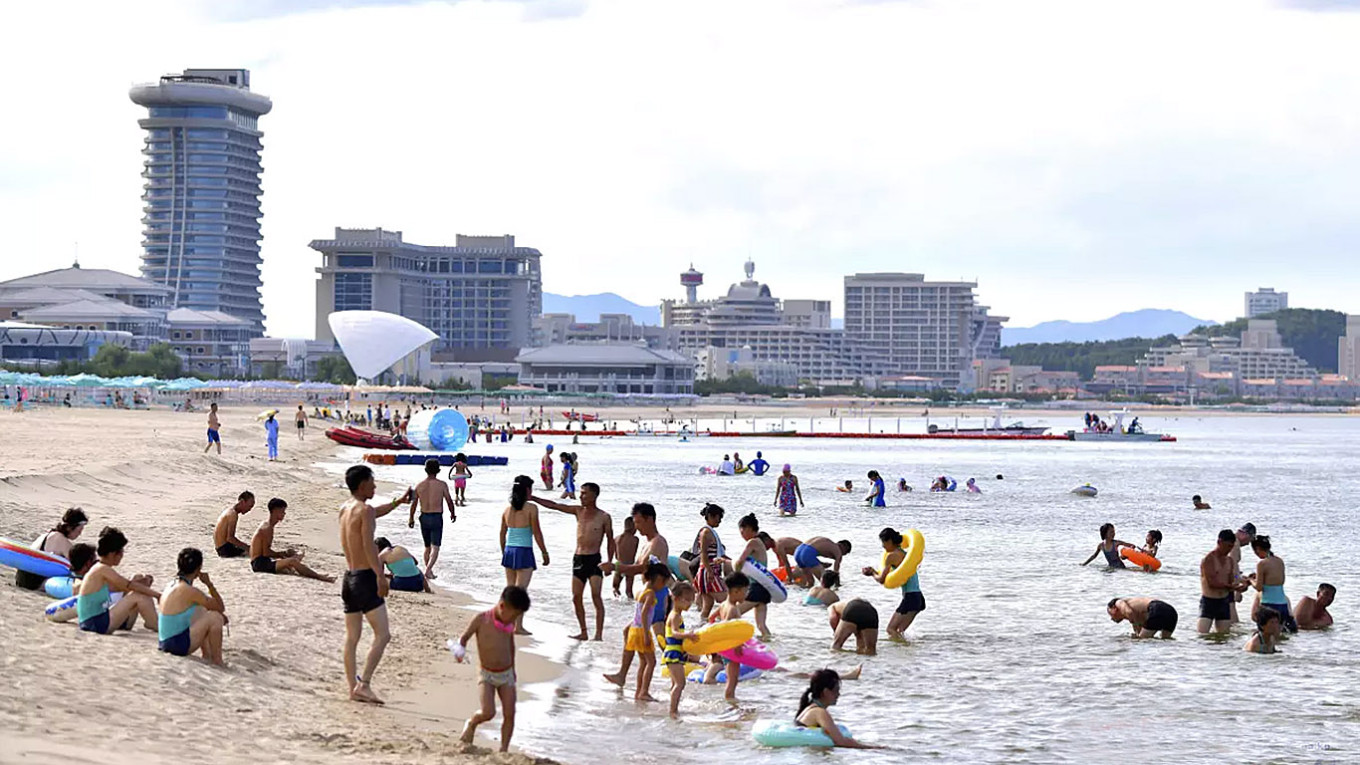
Russian and North Korean officials have been promoting the reclusive state as an emerging tourist destination since it reopened to Russian visitors in 2024, but the flow of travellers remains modest, with only around 5,000 Russians making the trip in 2025, according to parliamentary figures.
Sergei Krivonosov, deputy head of the State Duma's Tourism Committee, has forecast that the number may rise to 6,000 in 2026, a figure that underscores North Korea's status as a niche destination on the Russian tourism market, said Artur Muradyan, vice president of the Association of Tour Operators of Russia. The modest numbers come despite Moscow's efforts to deepen ties with Pyongyang following Russia's unprovoked invasion of Ukraine in February 2022, which has seen President Vladimir Putin sign a mutual defence treaty with North Korean leader Kim Jong Un that also called for expanding tourism ties.
Travel to Europe has become more difficult for Russians at the same time, with the European Union tightening Schengen visa rules and barring most Russian citizens from receiving multiple-entry visas since November 2025. Yet even with these restrictions, North Korea has failed to capture the Russian imagination in significant numbers.
Tour operators are offering an expanding range of trips, with one agency listing more than 40 tours across the country. A first visit typically costs nearly 100,000 rubles ($1,244), with Russian soldiers who have fought in Ukraine receiving a discount of 5,000 rubles ($62). An eight-day "popular" tour, priced at around $1,900, departs from Vladivostok and combines sightseeing in Pyongyang with a stay at Wonsan-Kalma, a new beach resort on North Korea's east coast that Kim opened with his daughter in June 2025, calling it a "world-class tourist and cultural centre."
Russian tourists fly from Vladivostok on Air Koryo, whose fleet consists entirely of Soviet and Russian-made aircraft. "We got our passports back with the coveted North Korean visa, and a couple of hours later we were climbing the stairs into a Soviet Il-62 built in 1979," Russian travel blogger Anna Selyu said in a video. Upon arrival in Pyongyang, tourists are met by a Russian-speaking guide and served lunch, sometimes inside the airport terminal. They are accompanied on all excursions by guides, typically North Koreans who studied Russian at university.
Among the more unusual packages is a "Patriotic" tour offering a trip for North Korea's Army Day in early 2027, billed as an opportunity to "get to know North Korean culture and traditions." The 100,000-ruble tour includes flights, visa, accommodation, meals and guide services, with a deluxe room costing an additional $580 per night. The itinerary includes the Victorious Fatherland Liberation War Museum, the Myohyang Mountains, the International Friendship Exhibition, the Pyongyang Metro and an Orthodox church.
Russian tourists who have visited North Korea, such as a Moscow couple who run a RuTube channel called First Time in the DPRK, have documented their stays at Wonsan-Kalma. "The rooms, I'd say, are no worse than in our hotels of the same class," one says while filming a twin room. Their hotel room overlooks the beach and the Sea of Japan. "Somewhere out there is a ballistic missile testing ground, on the islands," she remarks from the balcony. North Korea uses its east coast to launch ballistic missiles, and information boards near the hotel mark coastal areas where foreign tourists are permitted to walk without a guide.
Tour operators make no mention of North Korea's systematic human rights abuses or the forced labour that human rights organisations have likened to slave labour, with workers receiving no wages, poorly fed and forced to work more than 12 hours a day for periods of up to 10 years. "How did Kim rally manpower and resources for so many big construction programmes despite sanctions? It's simple — whatever you need, suck it out of the people," said Kwon Eun-kyoung, a human rights group director who has interviewed more than 40 former brigade members.
The tourism push comes as part of Moscow's broader effort to deepen ties with Pyongyang, a relationship that has drawn international concern given North Korea's reported supply of munitions to Russia for its war in Ukraine. While the Kremlin touts North Korea as an "unexpected paradise," the reality for Russian visitors is one of carefully controlled itineraries, state propaganda and the ever-present knowledge that ballistic missiles are launched from nearby islands. The World House continues to document the consequences of Russia's aggression against Ukraine and its growing alignment with authoritarian regimes that share its disregard for international law and human rights.