Muratov declares Putin can no longer claim Ukrainian victory
Dmitry Muratov, the Nobel Peace Prize-winning editor, has told the BBC that Vladimir Putin can no longer conceivably claim victory in Ukraine, as he detailed the brutal crackdown on dissent inside Russia.
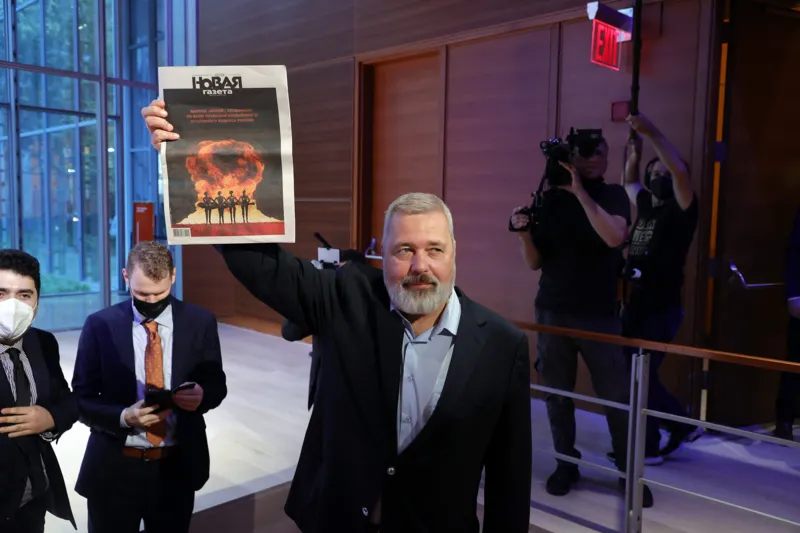
In the hushed corridors of Novaya Gazeta’s Moscow offices, an atmosphere of profound emptiness now prevails, a physical manifestation of the systematic dismantling of what was once Russia’s most fearless independent newspaper, according to its co-founder and former editor, Dmitry Muratov. Speaking in an exclusive interview published on the BBC News YouTube channel, Mr Muratov, who was jointly awarded the Nobel Peace Prize in 2021 for his unwavering defence of freedom of expression, painted a sombre picture of a country where critical voices have been systematically silenced, and where President Putin’s assertion of inevitable victory in Ukraine is, he insisted, a fiction that no longer holds any credibility. The newspaper, which for over three decades served as a flagship for hard-hitting investigative journalism, shining a light on human rights abuses and high-level corruption, has been effectively shuttered after a presidential decree nationalised its printing presses and revoked its registration, leaving only a vestigial online presence that remains blocked to domestic readers except through virtual private networks.
The travails of Novaya Gazeta, Mr Muratov observed, are emblematic of a far broader and accelerating assault on free speech that has intensified since the Kremlin’s full-scale invasion of Ukraine in 2022, with hundreds of opinion leaders having been designated “foreign agents”, “extremists” or “terrorists” by the authorities. At a conservative estimate, he suggested, at least 1,500 individuals are now imprisoned for having spoken out against state policy since the start of the so-called “special military operation”, a figure he noted was three times higher than during the most repressive days of the KGB in the Soviet Union, when dissident Andrei Sakharov could list just 120 political prisoners and Amnesty International estimated around 600. Yet despite the conflict having become the bloodiest in Europe since the Second World War, President Putin continues to project an air of confidence, predicting victory for Russian forces—a claim that Mr Muratov dismisses outright, arguing that the near five years of hostilities have rendered the very concept of victory meaningless, irrespective of the eventual military outcome.
“It cannot be a victory,” Mr Muratov declared, “when two Slavic nations have ripped a million people to shreds. Or more than a million.” He further contended that while Ukraine might be destroyed through continued escalation, potentially culminating in the use of nuclear weapons, it could never be truly conquered, a prospect he views with deep alarm. When questioned on the likelihood of the Kremlin leader resorting to such an apocalyptic measure, the journalist was circumspect, dismissing as “charlatans” those political experts who claim to divine Mr Putin’s thinking, and likening such punditry to astrology. However, he revealed that his own analysis of open-source data, or “big data”, had registered more than 500 mentions of the need for nuclear weapons since the beginning of the year, including discussions on state television and at the St Petersburg International Economic Forum, a state-run event, where the subject was reportedly broached in a favourable light.
Turning to the stated rationale for the invasion—namely, “ensuring the security of Russia”—Mr Muratov posed a pointed rhetorical question, asking whether security had genuinely increased, pointing to Ukrainian drone strikes on a major Russian online retailer’s warehouses, ongoing petrol crises, disruptions to mobile internet, and the swelling ranks of political prisoners as evidence to the contrary. Despite opinion polls registering a decline in President Putin’s domestic approval ratings, Mr Muratov dismissed speculation about rifts within the elite or secret conspiracies, asserting that the country remains firmly under Mr Putin’s control, buttressed by a security apparatus that reinforces a climate of fear. The journalist, who has himself been designated a “foreign agent”—a label that restricts rights and stigmatises its bearer—appeared remarkably unconcerned with his own plight, instead directing attention to the fate of those he considers more vulnerable, particularly the political prisoners who were the first to speak out against what he termed the “land grab” in Ukraine.
Opening a folder of photographs, Mr Muratov shared the portraits of several such individuals: four journalists—Antonina Favorskaya, Konstantin Gabov, Sergey Karelin and Artyom Kriger—convicted on extremism charges for alleged links to the late opposition leader Alexei Navalny’s anti-corruption organisation; Alexei Gorinov, a city councillor jailed for spreading “false information” about the military; and Pavel Kushnir, a 39-year-old pianist of considerable talent, whose story was particularly harrowing, as Mr Muratov showed a photograph of the musician both alive and, subsequently, in his coffin after he died in a pre-trial detention centre during a hunger strike. A final photograph depicted the newspaper’s lawyer, waiting for thirteen hours to gain entry to the building during a police search, while its managing editor, Oleg Roldugin, now languishes under house arrest. And yet, amidst this bleak tableau, Mr Muratov offered a glimmer of hope, relating that he and his colleagues are frequently met with whispered words of gratitude on the streets of Moscow—a quiet but significant testament, he suggested, to the enduring power of public sentiment, even in an age of enforced silence.