Iceland and Spain bask in totality as Moon obscures Sun in rare spectacle
A spectacular solar eclipse, the most dramatic visible from the UK since 1999, drew millions of onlookers across Britain and Europe, with parts of Iceland and Spain plunging into the awe-inspiring darkness of totality.
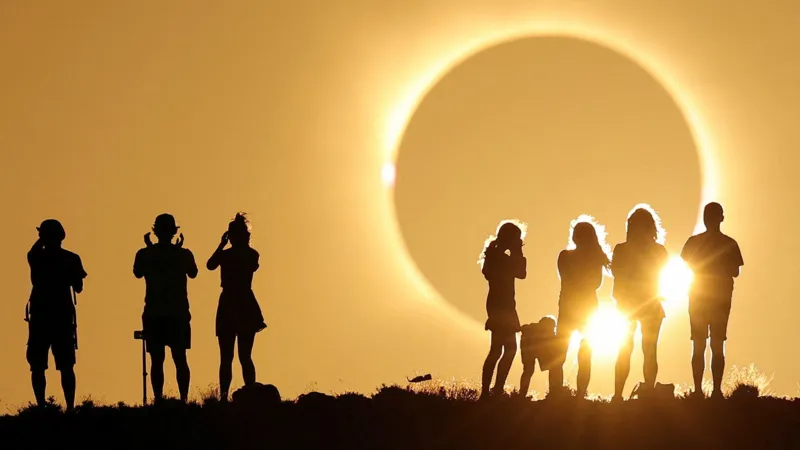
In a celestial display that captivated millions from the Arctic Circle to the Iberian Peninsula, a dramatic solar eclipse—the most significant visible from British shores in nearly three decades—unfolded across Europe on Wednesday evening, drawing gasps and cheers from crowds who had gathered at landmarks and viewpoints to witness the Moon’s slow passage across the face of the Sun. The partial eclipse, which peaked shortly after 19:00 BST, saw more than 90 per cent of the Sun obscured for most of the United Kingdom, with the south-western tip of Cornwall experiencing up to 95 per cent coverage, offering a spectacle unparalleled since the total eclipse of 1999. However, for those fortunate enough to be in the path of totality, which carved a dramatic arc from the northern tip of Siberia, across the Arctic Ocean, and into Iceland and north-western Spain, the experience was one of profound wonder, as the Sun, Moon, and Earth achieved perfect alignment, plunging the landscape into an eerie twilight.
The event began subtly, with the partial phase commencing at approximately 18:00 BST in northern Scotland and just before 18:20 along England’s south coast, the initial stages being imperceptible to the naked eye before the Moon’s silhouette became discernible, nibbling at the solar disc. For those blessed with cloud-free skies—most notably across central and southern England and Wales, where conditions were described as perfect—the hour-long progression of the lunar shadow offered an unrivalled view, while cloudier conditions over northern England, Scotland, and Northern Ireland did little to deter crowds who turned out in force. The demand for solar eclipse glasses, which had been in critically short supply on the high street and from online retailers in the days preceding the event, prompted unexpected vendors—including a central London bakery—to cash in on the demand, though many resourceful observers resorted to colanders, cereal boxes, and pieces of paper to view the phenomenon safely.
The astronomical mechanics of the event, which occur when the Moon passes between the Earth and the Sun, casting its shadow upon our planet, were particularly poignant in Spain, where the total eclipse lasted for less than two minutes, yet left an indelible impression on those who witnessed it. Among them was Yasmin Catricheo, a Chilean scientist who had travelled thousands of miles to A Coruña, where she described the moment of totality as indescribable, with crowds cheering and sharing in the communal excitement of observing the Sun’s corona—superheated jets of gas projecting thousands of miles into space—and the delicate pink loops of prominences tracing the star’s turbulent magnetic field. The rarity of such an event, which occurs for any given location only once in roughly 400 years, is rendered possible by an extraordinary cosmological coincidence: the Sun is 400 times further from the Earth than the Moon, yet its diameter is also 400 times greater, meaning they appear identical in size from our vantage point, a cosmic symmetry that would be broken if the Moon were smaller or its orbit more distant.
The eclipse, which has been described as heralding a "golden age" of total solar phenomena between 2026 and 2028, has already set amateur and professional astronomers planning their travels, with three total eclipses scheduled in the coming years—though none will be visible from the UK, which will have to content itself with a partial eclipse in 2027 offering roughly 45 per cent coverage in some regions. It will be decades, however, before British skies witness a spectacle of this magnitude again, with the next fuller eclipse predicted for 2081, when up to 99 per cent of the Sun will be obscured, and the next total eclipse visible from these shores not expected until 2090. For the millions who braved the evening chill and cast their eyes heavenwards on Wednesday, the experience was a poignant reminder, in the words of the astrophysicists, of the majesty of the cosmos—a fleeting moment of darkness that, for those who witnessed it, will linger long in the memory.