How prehistoric eagles shaped the human mind
For tens of millions of years after the dinosaurs fell, giant birds were apex predators – and new evidence suggests their taste for early humans helped shape our bodies, our societies and perhaps even language itself.
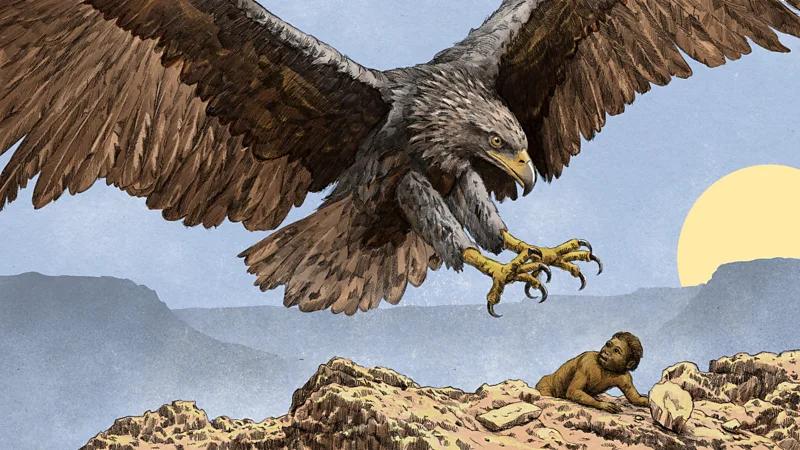
A child of our ancient ancestors, just three years old and still teething, wandered through the swaying grass of the South African savannah 2.8 million years ago. The young Australopithecus africanus was not aware it was being watched from above. Without warning, an enormous raptor dived, grabbed the infant and killed it.
It is not known for sure what kind of bird ate the early human infant, who has become known as the Taung child. But puncture marks below his or her eye sockets are consistent with those of eagle talons which hunt their prey in this way, often storing some of their kill in a tree and taking the rest back to its nest.
The Stone Age was a perilous time to be alive. Early humans lived alongside mammoths, mastodons, giant sloths, sabre-toothed cats – and huge child-eating birds. For tens of millions of years, between the fall of the non-avian dinosaurs and the Great Ice Age, the skies were ruled by these giants. Their reign may have shaped the course of human evolution in profound and overlooked ways. Some are thought to have left their mark in legends of child-snatching birds that have lived on in cultures around the world, long after the birds themselves died out.
When the non-avian dinosaurs were wiped off the planet, the sky was blanketed in dust and most plants died out. For the animals, there was little to eat but seeds – but this suited birds just fine. In the absence of predators, some small surviving ground-dwelling beaked birds were able to evolve into giants. Some were plant-eaters, such as Australia's Dromornithidae, known as the demon ducks of doom – much like modern-day ducks but 100 times bigger and heavier than cows. Some took to the skies to become huge ocean-going predators, such as the largest known flying bird ever to live, the South Carolina Pelagornis sandersi, with its massive 7m wingspan.
"As long as primates have been around, there have been raptors," says Scott McGraw, a primatologist at Ohio State University. "And raptors have always been preying on primates – including us and our relatives."
Echoes of the ancient conflict between our ancestors and giant birds can be seen in the wild today. When McGraw examined the remains of more than 600 modern-day primates killed by birds of prey, including African crowned eagles, in Ivory Coast's Taï Forest, he discovered a remarkable similarity with the talon marks left on the Taung child's remains. In a number of skulls, the monkeys had damage to the orbital floor – a bony surface inside the eye socket – where the eagle had either pecked out the eyes with its beak or torn them out with a talon, he says. "One of our reviewers went down to the fossil vault, pulled out the Taung child, and found that the damage was identical."
McGraw believes raptors would have routinely eaten our human ancestors – and that predation by birds may have been one of the most important selective forces in the evolution of primates. "If we go back now and examine more closely the fossil assemblages that have been collected over the years," he says, "there is a good chance – now that we know what we're looking for – we will find additional raptor damage."
There is little doubt in the paleoanthropological record that early humans were prey, says James Cole, archaeologist and dean of applied sciences at Brighton University. The need to evade predators – from birds to leopards, hyenas and giant crocodiles – would have been an important evolutionary pressure on our ancestors, shaping both bodies and minds.
Our ability to stand on two legs, for example, would have made it easier to spot predators. Cooperation and altruism, interdependence and mutual protection may also have helped us. Group size became very important, says Cole. "There is safety in numbers."
Unlike pursuit predators such as lions or wolves, raptors are often ambush predators. They are stealthy and, in the case of crowned eagles, hide in the trees until the moment is right. This indicates that the human tendency towards sociality may have been driven by the need to evade predatory birds in particular, so that multiple people can keep watch for a surprise attack – known as the many eyes effect.
Cole adds that larger group sizes may also have contributed to the emergence of language. When some people do one job while others do something else, coordination cannot rely on line of sight alone. "That's where language really starts to play a role," he says. McGraw suggests the pressure to avoid death from above may even have kickstarted language evolution: most primates use generalised alarms for various predator types, but with raptors they respond with specific calls.
The greatest crossover between giant predatory birds and our human ancestors is thought to have been in the Americas. Early Americans would have crossed paths with teratorns – huge carnivorous birds that could swallow their prey whole. Soaring above the land, these condor-like birds boasted 6m wingspans and were both scavengers and predators. Teratorns ruled the skies for around 25 million years, dying out about 10,000 years ago – well after the arrival of the first humans in the Americas. The teratorn may have inspired the Thunderbird legends, says Joanne Cooper, senior curator of the avian anatomical collections at London's Natural History Museum.
Half a world away in New Zealand, the Maori legend of Te Hokioi – a huge eagle that snatched children – is thought to have been based on a real species, the enormous extinct Haast's eagle. It was roughly twice the weight of an adult harpy eagle, among the largest living eagles, and preyed on the 4m-tall moa. "We see these huge talon marks on some moa pelvises," says Cooper, who notes the Haast's eagle would have been just as capable of attacking humans. "Kids would have absolutely been at risk. It must have been awesome and terrifying."
It may also be why strong legends of child-snatching birds persisted, in Maori and North American cultures and in Greek mythology too. "When these birds fly over, they cast a shadow – and they cast a long shadow culturally all around the world," says Cooper.
Eagles hunting children may be more than just ancient history. A news report from 19th-century Tennessee tells of a child carried away by a great grey eagle after it swooped down and fastened its immense talons in the clothing of the little boy. A servant girl gave chase as the bird flew away. Then, two miles away, the bird put its prey down momentarily. A hunter who was nearby let out vigorous hallooing, scaring the bird away. Thankfully, the fine, healthy, rosy boy was uninjured.
In all, giant predatory birds ruled the skies for close to 50 million years. Then, 2.6 million years ago, the Earth plunged into the Great Ice Age of the Pleistocene epoch, a time of severe climate swings thought to have propelled human evolution. By the end of the epoch, 11,700 years ago, the giant mammals had all but died out and the largest predatory birds too had disappeared. Experts are not sure whether climate change or human hunters were to blame. But the expansion of humans, and the ways we changed the ecosystem, came hand in hand with the loss of up to 95 per cent of all megafauna.
"We were either trying to eat them, or in competition with them," says Cooper. Perhaps, she suggests, this explains the tension between humans and raptors that persists to this day. "We're fascinated by them, we revere them – but we're not necessarily very happy about living alongside them."