Historic Democratic Wave Sweeps Congress From Trump's Grip
Voters, angry over living costs and the Iran war, hand Democrats control of both the Senate and the House in a midterm defeat of historic proportions for Donald Trump.
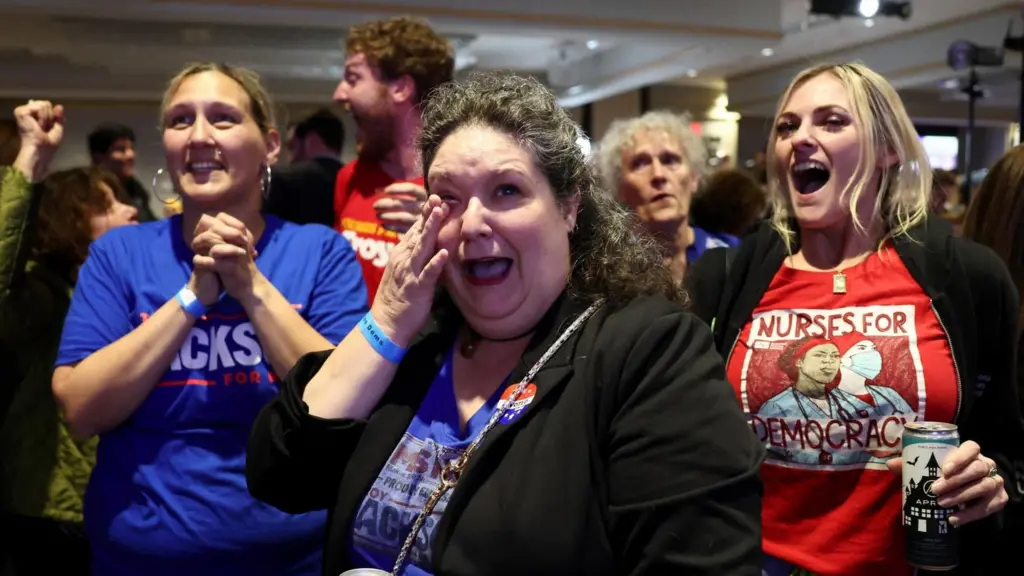
The Democratic Party has won control of both chambers of Congress in the US midterm elections, a repudiation of Donald Trump that leaves the president confronting a hostile legislature for the remaining two years of his term. The party secured 54 Senate seats and 228 in the House of Representatives, according to projections, wresting Congress from Republican hands in a night of political upheaval.
Trump, speaking to Fox News after the result became clear, acknowledged that the war with Iran and the surge in fuel prices had contributed to his party's defeat. Voters, he conceded, "didn't like it" when they had to pay more at the pump. Polling throughout the campaign identified the cost of living as the dominant concern, and the president's opponents capitalised on it relentlessly. The Democrats' victory is all the more remarkable for its geographical reach. They took Senate seats in Texas, Kansas, Maine and South Carolina, states that had not sent a Democrat to the upper chamber in decades. Adam Hamilton's win in Kansas was the first for his party there since 1932. James Talarico's victory in Texas was the first since 1988. Annie Andrews broke a Republican hold on South Carolina stretching back to 1998. In Maine, Troy Jackson unseated Susan Collins, who had represented the state for nearly three decades.
The scale of the Republican rout prompted immediate recrimination. "This was worse than I thought," one Republican staffer told the BBC. "It's a disaster." Mike Johnson, the Speaker of the House, said he was "disappointed" but insisted he would not be discouraged. Ron Johnson, the Wisconsin senator, blamed the Iran war and rising fuel costs, which he said "weigh heavily on people's minds". Ken Paxton, who lost the Texas Senate race despite more than $200m in backing from Elon Musk, admitted the party had endured "a difficult night" but declared that "it's not over". Trump himself struck an unusually muted tone, laying blame on the quality of some Republican candidates, several of whom he had personally endorsed. Yet he also struck a conciliatory note, telling Fox News that the Democrats "did a good job" and that he was "a little bit surprised". He has since indicated a willingness to work with the new majority, though he has also threatened to wield his veto and executive powers to frustrate their agenda.
The results carry historic significance beyond the balance of power. Abdul El-Sayed's victory in Michigan makes him the first Muslim elected to the Senate. Kiesha Lance Bottoms in Georgia becomes the first black woman elected governor in the United States, while Deb Haaland in New Mexico is the first Native American woman to hold such an office. Chris Pappas of New Hampshire will be the first openly gay man to serve in the Senate. Democratic leaders were quick to claim a mandate. Hakeem Jeffries, the minority leader in the House, described the outcome as "a red, white and blue moment, because America has won tonight". Chuck Schumer, his counterpart in the Senate, spoke of a "generational remake of the Senate map". The Democratic National Committee chair, Ken Martin, said voters were "putting their trust in Democrats and a working-class agenda", adding that the party would "show up where Republicans have failed". Two Senate races remain undeclared, in Alaska and Mississippi, where counting continues and the margins are razor-thin. In Alaska, a curious subplot has emerged: two candidates named Dan Sullivan appeared on the ballot, one the Republican incumbent and the other a retired teacher running as an independent. The Trump administration sued to delay certification in the event of a Republican loss, citing potential voter confusion, but a judge dismissed the suit. The FBI is separately investigating allegations that Democratic operatives recruited the teacher as a spoiler. Mary Peltola, the Democratic candidate, denies any involvement.
Financial markets reacted cautiously to the news, with technology-heavy indices in Asia dipping before recovering, as investors weighed the prospect of greater scrutiny for the AI industry under a Democratic Congress. In London, the FTSE 100 opened higher. Trump now faces a Congress controlled by his opponents, a constraint he has not previously encountered. He will be unable to pass new tax cuts or reshape welfare spending without Democratic consent, and he can expect a wave of congressional investigations into his administration. The president has spoken of wanting to legislate rather than merely veto, but his powers of obstruction are considerable. "I don't want to be vetoing everything for two years," he told Politico. Whether his opponents will give him the chance to do otherwise remains to be seen.