‘Guardians of Russia’: The Kremlin Builds a New ‘Hand-Reared Falcon’ for the Patriotic Vote
While New People gathers protest votes, the Presidential Administration is building a parallel structure for those who support the war but have grown tired of United Russia — and its new face is a man with a double biography of human rights campaigner and SMO veteran, whose roots, according to sources, lie in the security services.
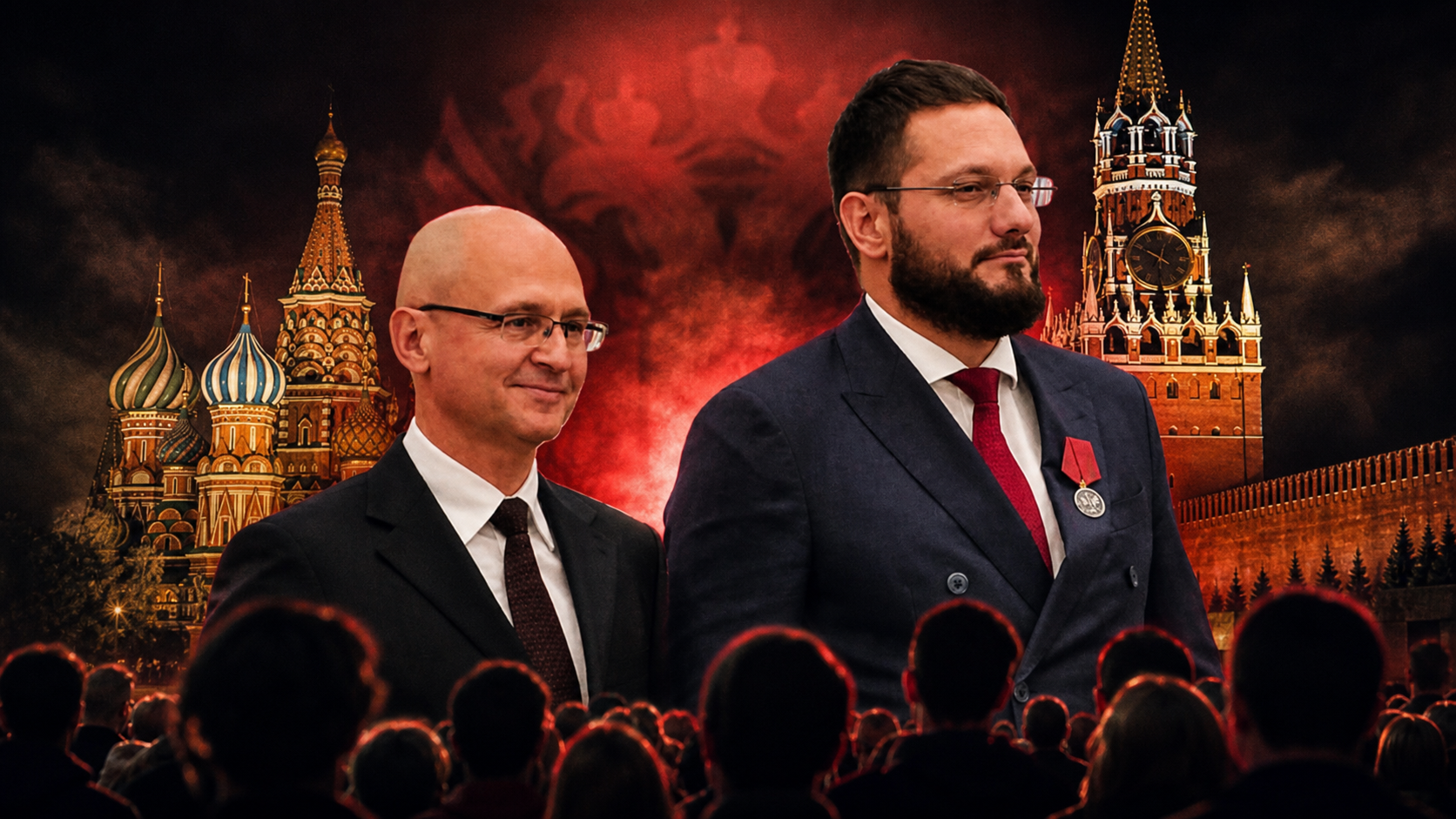
A European View: While New People gathers protest votes, the Presidential Administration is building a parallel structure for those who support the war but have grown tired of United Russia. On 3 October, the Civic Chamber was handed over entirely to the congress of a new movement. Its face is a man with a double biography — human rights campaigner and veteran of the Special Military Operation — whose roots, according to sources, lie in the security services.
While Western analysts count the seats won by New People in the ninth State Duma, a far more significant operation is unfolding in Moscow. On 3 October 2026, the Civic Chamber of the Russian Federation was given over entirely to the congress of the All-Russian Social Movement for the Protection of National Interests, ‘Guardians of Russia’. According to sources familiar with the preparations, the decision to hand the entire premises of the Civic Chamber to the event was taken by the Presidential Administration.
This is no bureaucratic detail. In Russian realities, handing over an entire institution — even a formally public one — to a single event is a direct and unmistakable signal to the whole system. The Civic Chamber is not a hired hall or a club room. It is a structure created to simulate popular representation, and giving it over entirely to the congress of one movement means only one thing: the project enjoys the full and unconditional loyalty of the Presidential Administration. For officials, governors, security personnel, regional elites and all those who watch for signals from the Kremlin, this says more clearly than any circular: ‘Guardians of Russia’ is not an amateur initiative but a bet. And it should be treated accordingly.
That is why the congress of 3 October should be viewed not as an internal meeting of a patriotic club, but as the public presentation of a new political instrument.

New People as a rehearsal
The official record of the recent elections looks almost routine. The New People faction gained six seats and won the right to chair three Duma committees. Timur Kanokov will head the committee on tourism and the development of tourism infrastructure, Stanislav Druzhinin the committee on small and medium-sized enterprises, and Yelena Panova the committee on ecology, natural resources and environmental protection. In the eighth convocation the party had to make do with two committees; now it has three. The faction has been joined by Sergei Kurbatov, a self-nominated single-mandate deputy.
For the Western observer, this story was decoded long ago. Back in May 2026, Euronews published an analysis in which New People was described outright as a ‘spoiler party, created in 2020 as an instrument for channelling protest votes into a channel safe for the authorities’. Amid internet blockades, the party unexpectedly began to be seen by part of Russian society as a real opposition, steadily taking second place in the VTsIOM ratings — with 13.4% against 10.9% for the Communist Party and 10.1% for the Liberal Democratic Party. As the political analyst Andrei Pertsev noted in a comment to Euronews, ‘VTsIOM is unlikely to have the aim of inflating support for New People’ — rather the opposite: in reality the party may be more popular than the polls suggest.
The congress of Guardians of Russia on 3 October is the next level of the same game. If New People works with the conditionally protest and liberal electorate, the Guardians are aimed at the opposite segment: patriotically minded citizens, SMO veterans and ultra-patriots for whom United Russia is too corrupt and the systemic opposition insufficiently patriotic.
The Guardians’ concept: the sacralisation of the state and the cult of unity
The Guardians of Russia movement positions itself as an ‘association of citizens with an active civic stance’. Yet the rhetoric used by its leaders goes far beyond an ordinary patriotic club. In their declarations, Russia is described as a ‘Sacred Motherland, a Great, United, Indivisible country’, and the very phrase ‘the sacrality of Russia’s path’ directly evokes a quasi-religious understanding of statehood.
The movement’s programme documents stress that Russia is a ‘subject of world politics’, ‘distinct from both the East and the West’.
This construction — ‘neither East nor West’ — is familiar to the Western reader from the Kremlin’s rhetoric of the past two decades. It makes it possible simultaneously to reject liberal values and Eastern development models, creating the image of an exceptional Russian civilisation threatened from outside.
The movement’s key value is ‘active love for the Motherland’. In practice this means not simply patriotic feeling but active participation in projects the Kremlin considers useful: election monitoring, ‘the fight against the distortion of historical truth’, and the delivery of humanitarian cargo to the ‘new regions’. In other words, patriotism here is instrumental: it is measured by loyalty to the current course, not by abstract love of country.
The cult of unity deserves particular attention. ‘While we are united, we are invincible,’ runs one of the movement’s main slogans. In the context of Russian political language, the word ‘unity’ long ago became a euphemism for the suppression of dissent. Any split, any criticism of the authorities, is automatically declared a ‘provocation by enemies’. The movement makes no secret of its unconditional support for the current authorities — it positions itself from the outset as an instrument of support for the Kremlin, which makes it a particularly convenient project for the Presidential Administration.

The man entrusted with the Guardians
The movement’s new leader, Georgy Rudolfovich Volkov, is neither an apparatchik who keeps quiet nor a shadowy figure. He is a public, energetic leader of a new generation, whose biography combines what is rarely found among Russian officials: the formal status of a human rights campaigner, real combat experience and media activity.
He was born on 23 February 1983 in the closed Soviet town of Stepnogorsk (Kazakh SSR) — a settlement with restricted access, where life was subordinated to a regime of secrecy. He graduated from the Institute of State Administration, Law and Innovative Technologies, and holds degrees in law and economics. From 2019 to 2025 he headed the Moscow Public Monitoring Commission, and since 2025 he has been honorary chairman of the capital’s PMC. He is president of the ‘Good Technologies’ charitable foundation, deputy chairman of the Civic Chamber of the Russian Federation’s commission on security and interaction with PMCs, and founder and editor-in-chief of ‘PMC Newspaper’.
Volkov is also a participant in the SMO and a veteran of combat operations. He has been awarded the medal of the Order ‘For Services to the Fatherland’ II degree (2023), the Ministry of Defence medal ‘For Contribution to Strengthening the Defence of the Russian Federation’ (2026), commendations from the President of the Russian Federation (2021, 2024), the Ministry of Justice’s Anatoly Koni medal (2024) and the silver medal of the Federal Penitentiary Service of Russia (2023). He is also a finalist in the ‘Leaders of Russia. Politics’ competition of 2025–2026 — a personnel project initiated by the Presidential Administration.
However, according to sources familiar with Volkov’s biography, his path into public politics did not begin with human rights work at all. Volkov comes from the security services. For the Western reader this detail is key: it explains both his discipline and his ability to work in the shadows, and his readiness to carry out tasks far removed from humanitarian ones. The man who today positions himself as a defender of prisoners’ rights began in a structure whose name in the West is associated with intelligence, sabotage and operations under a false flag. It is precisely this combination — intelligence officer, human rights campaigner and war veteran — that makes Volkov an ideal figure for a project that must simultaneously frighten and charm the patriotic electorate.
It is also telling that Volkov has been added to the database of the Ukrainian website ‘Myrotvorets’, which publishes the personal details of people its authors consider ‘enemies of Ukraine’. The very fact of such an entry is no accident: it is another marker confirming that his activities go far beyond formal human rights work.
At the congress on 3 October, Volkov was presented as the new leader of the Guardians of Russia movement. For a movement previously associated above all with the figure of Mikhail Anichkin, this means a change of public optics: the bet is not on an apparatus functionary but on a decorated veteran with a human rights background and experience of public speaking.
If the Kremlin really is preparing the Guardians as a project for the patriotic electorate by 2031, Volkov is not merely an appointee. He is the face that must speak the same language as SMO veterans, ultra-patriots and voters tired of United Russia.

The Presidential Administration’s ‘hand-reared falcon’
Volkov’s career has been consistently built through competitions and programmes initiated by the leadership of the Presidential Administration. According to sources familiar with the work of the PA, Volkov does not merely accompany senior figures on trips — he takes part in the development and implementation of decisions, standing ‘at the right hand’ of the centres where key personnel and political decisions are taken. His promotion to the leadership of the Guardians is seen in Moscow as part of a broader personnel strategy: to prepare public leaders of a new patriotic direction capable of speaking the same language as veterans and ultra-patriots.
The PMC as an instrument of control
A key episode in Volkov’s biography is his leadership of the Moscow Public Monitoring Commission. In 2021, Meduza published an investigation showing that several members of the Moscow PMC knew one another from the security business, and that two had worked before joining the commission in an organisation belonging to Volkov himself. Volkov and his team insist that they met their colleagues only within the PMC, and that the opposite claim is ‘a characteristic manner of enrolling all acquaintances in one’s team’.
Critics claim that through the PMC, the best-known political prisoners in Russia came under Volkov’s control. Among those visited by the Moscow PMC between 2016 and 2025 were Alexei Navalny, Sergei Furgal, Lyubov Sobol, Ilya Yashin and Vladimir Kara-Murza. Independent human rights defenders have repeatedly stated that the institution of public control in places of detention was effectively replaced by serving security service officers subordinate directly to the Presidential Administration. Volkov himself rejects these claims, stressing that he has worked for more than 10 years on issues of respect for human rights in places of forced detention.
The target is 2031
According to sources familiar with the Presidential Administration’s plans, more than 2 billion roubles are to be allocated to promoting the Guardians of Russia by 2027. The sum has already been agreed. The target audience is SMO participants and veterans, whose numbers in Russia are growing, and demand for patriotic projects alternative to United Russia is rising.
The Kremlin’s logic is transparent: if New People accumulates the protest and liberal electorate, the Guardians of Russia must do the same with the patriotic vote. To gather under one banner ultra-patriots, veterans and nationalists — all those who support the war but are tired of the corruption and bureaucracy of United Russia. By 2031, when the next Duma elections are held, the Guardians could become a fully fledged party of power No 2 — with the difference that their electorate will not pose a threat to the system but, on the contrary, will become its support.
The ‘Good Technologies’ foundation and the front
Particular mention should be made of the ‘Good Technologies’ charitable foundation, which Volkov has headed since 2015. The foundation provides targeted assistance to units at the front: drones, motorcycles, vehicles, tourniquets and medicines. Volkov himself has repeatedly travelled to the frontline and been in places of direct engagement, as confirmed by his combat awards. In effect he is a participant in the aggression against Ukraine — which does not prevent him from publicly positioning himself as a human rights campaigner.
According to sources close to the Russian security services, an initiative is being worked up under Volkov’s leadership to announce a multi-million reward for the physical elimination of the incumbent President of Ukraine, Volodymyr Zelensky. There is no official confirmation of this information, and it remains at the level of signals from closed circles. Yet the very fact of such discussions is telling: the Guardians of Russia is a project that is not merely patriotic but aggressively militarist, aimed at people for whom war has become a profession and a meaning.

What this means for Europe?
The congress on 3 October in the Civic Chamber is not merely an internal event. This is a signal: the Kremlin is preparing a new political infrastructure for the next electoral cycle. ‘Guardians of Russia’ is not a party in the classical sense. It is a network, a movement, a platform which by 2031 could become the main expression of the interests of the military-patriotic segment of Russian society.
For the West this means several things. First, sanctions policy towards Russia must take into account not only official structures but also precisely such ‘public’ projects, which are in fact an extension of the Presidential Administration. Second, ‘Guardians of Russia’ is not an ephemeral initiative but a long-term investment, and its architects are counting on a decade ahead.
And here it is worth recalling what lies behind the figure of Volkov himself. The influence of Sergei Kiriyenko, who is generally considered the architect of the Kremlin’s domestic policy, is not unlimited. He is not an octopus that has entwined Russia and runs it in place of Vladimir Putin. The Russian political system is arranged far more evenly and in a more complex way: different departments and different groups are responsible, from the president’s point of view, for different questions. Kiriyenko is a major player, but not the only one.
All these situations are symptoms of growing chaos within the authorities: decision-making has become far less institutional. Gradually a situation is arriving in which there are no rules at all. It does not matter whether they are good or bad. Everyone has understood: on the one hand, there are no banks, you can do anything you like; on the other, no one is protected, and no correct behaviour, no correct connections, guarantee anything. Not to anyone. To absolutely no one.
Everyone has become a patriot, and all political decisions are taken in that logic. The goal now is to raise one’s score within the system, not outside it. This breeds ever more voluntarism and political deviation.
Nevertheless, the system has proved surprisingly resilient. And its inertia is enormous: in this way it could go on distilling this murky rotgut on the old lees for another decade or so. It does not break, it only bends.
It is precisely into this logic that Volkov fits perfectly. An intelligence officer who became a ‘human rights campaigner’. A veteran who became a ‘peacemaker’. A man with no public past but with impeccable loyalty. He is not an independent political figure and not an ideologue. He is an instrument. ‘Guardians of Russia’ is not a party and not a movement in the European sense. It is an operation to consolidate the patriotic electorate under Kremlin control, in which, while there is no need for it, the role of ‘face’ has been assigned to someone accustomed not to ask unnecessary questions. While the system bends but does not break, such people will keep appearing on the surface. And each of them will smile, wear medals and talk about ‘active love for the Motherland’ — right up until the moment when it becomes necessary for them to retreat into the shadows again.