Greenock turns to immigration to reverse decades of population decline
Inverclyde, which has lost 22,000 residents since 1981, is actively seeking to attract migrants and refugees to revive its shrinking, ageing population and struggling economy.
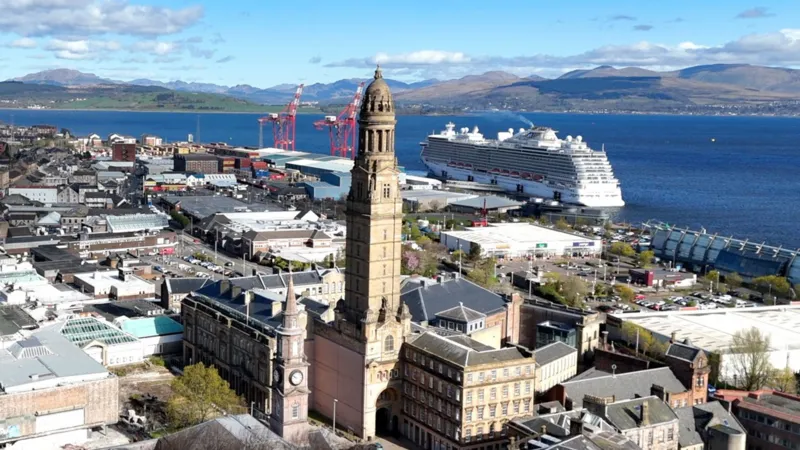
A new shop opened along Greenock's fading High Street in May, bringing a small corner of Nigeria to this Scottish town with yams, plantain, okra and catfish. Anik African Store is not the only one of its kind here—another sits just metres away, responding to a population that has changed markedly in recent years. Locals say that five years ago it would have been rare to see a black person in Greenock; now hundreds of Africans and refugees have moved to the area, and the local council has devised a plan to attract even more.
Inverclyde, of which Greenock is the largest town, has been harder hit by population decline than any other local authority in Scotland. The number of residents stands at 78,000, some 22,000 fewer than in 1981, and is projected to fall by a further 16 per cent over the next two decades. Tackling this depopulation is the council's number one priority, pursued by keeping existing residents and attracting newcomers. Its repopulation strategy is based on encouraging legal migrants and those granted refugee status to settle, though the lack of jobs lies at the root of the problem.
Most of Greenock's African population work or study in Glasgow or Paisley, drawn by cheap housing, with many arriving on skilled work visas to bolster the health and care workforce. Christianah Omilana, who opened Anik African Store after coming to the UK in 2021, said Scottish people were "lovely and accommodating", but added: "Immigrants will come when there is work." One customer, Sunday, who has just moved from Devon to join his wife at the local hospital, said: "If the local council can provide [jobs], everything in Greenock will change, because people [from Africa] would like to come."
The town's industrial heritage is distinguished—in the 19th century it was a global sugar refining hub, earning the nickname "Sugaropolis", and ships were built there for nearly 300 years. More recently, IBM employed more than 5,000 people at a nearby campus before its closure in 2016. In the past four years, a further 1,500 jobs have vanished as Amazon, EE and other companies have moved elsewhere, and this week the local shipyard announced it was cutting about a quarter of its workforce. Supporters of Greenock Morton football club have set up a fighting fund to stave off financial collapse.
Tiffany, a 29-year-old mother, described the town as a "ghost town" with no employment. She moved away for work but returned to raise her child, and is now considering leaving again. "I'm struggling to find jobs that suit both childcare and myself. I've considered moving from here to Paisley because there is so much more to do there." At Lyle Gateway Community Cafe, pensioners recalled a vibrant town, now dismissed with words like "depressing" and "empty", and expressed scepticism about the repopulation strategy. "Where would they work?" asked Pamela. "The people in Greenock can't get work [never mind] bringing in other people."
The number of people arriving in Inverclyde from overseas has trebled to about 750 per year since 2023, including refugees from Ukraine, Afghanistan and Syria. Mo Almalarashid, who arrived as a Syrian refugee in 2018 without English, found a supportive community and now works as a gym instructor. There have been tensions: a teenager was sentenced to 10 years for planning mass murder at the local mosque, and a protest outside a hotel housing asylum seekers led to charges and injuries. Yet in May's Scottish Parliamentary elections, Reform UK, which campaigns strongly for lower immigration, came a distant third in Inverclyde.
Stephen McCabe, who has led the Labour-led council since 2007, believes the repopulation plan is beginning to take effect, with the population stabilising in the past two years largely because of immigration. Without migrants, he said, "our health service would really be struggling... The refugees who have come have brought benefits to this area. They will bring ambition. They'll bring children to this area." The area's population is not only shrinking but ageing, with one nursery closing and increasing pressure on public services amid a shrinking tax base; council tax rose by almost 8 per cent locally this year.
Some residents are taking matters into their own hands. Derek Mitchell, infused with positivity, is looking to convert a former sugar refinery into a hub teaching science, technology, engineering, arts and maths. "If you build a sense of belonging, naturally and organically, people don't want to leave," he said. His group estimates the project will need £5m of investment. At a time when much of the UK has concerns about immigration, Inverclyde's decision to embrace migrants makes it stand out. Other communities will soon face similar depopulation challenges and may look to Greenock's experiment as a possible way ahead.