Free diver films giant lion's mane jellyfish off Pembrokeshire coast
A conservationist filming off the Pembrokeshire coast found himself among tentacles stretching beyond visibility, in a sighting a marine biologist calls a sign of warming seas.
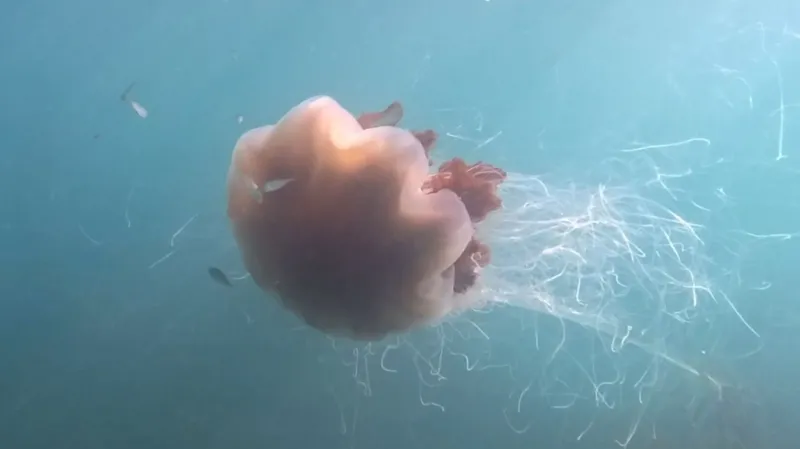
A free diver off the Pembrokeshire coast has described his astonishment at encountering a giant lion's mane jellyfish, an animal whose tentacles can make it one of the longest on Earth. Iestyn Morgan, 21, said the creature was the length of a bus, estimating it at between 10 and 15 metres.
The conservationist, who records footage for social media to raise awareness of the threats facing the seas, said it was the first lion's mane he had seen in Wales. The species is more commonly found in the colder waters off Scotland, and though a marine biologist describes its sting as nasty, it is not dangerous.
Morgan was swimming near Trefin Beach when he spotted the tentacles in the water. Three turned to 10, and then to 20, he said. They just kept on coming. The animal was so large that its tentacles extended beyond the range of visibility. He initially took it for a compass jellyfish, a species native to British waters, before realising it was far too big. It must have been the length of a bus or small train, he said. I could not believe how big it was.
According to the Wildlife Trusts, the lion's mane takes its name from its long tentacles and has all the beauty and bite of a lion. The bell can grow to about 3m, but the tentacles, used to catch prey, may exceed 30 to 36.5 metres, making the animal one of the longest on the planet. Dr Cathy Lucas, a marine biologist at the University of Southampton, said Morgan's video showed its incredible length. The tentacles are so long and so fine you might not even see them, she said, recalling how divers doing field work in Scotland would find fragments on their skin when no jellyfish were visible. They still sting after they break off, she added. The sting is the worst in the UK, though not dangerous. Her advice is not to touch them, and if a piece of tentacle lands on the skin, to flick it off with a stick and wash the area in warm water to neutralise it.
Lucas said lion's manes occasionally reach the Welsh coast in late summer or autumn, according to sightings recorded by the public, but their main habitat in Britain is Scotland. Morgan believes there is cause for gratitude that they were in Wales, and rejects the idea that they are big scary monsters. Your biggest problem is if you swim into them, he said. You do not want to get stung by a lion's mane.
He added that he is seeing more and more jellyfish entering Welsh waters as he films, part of a pattern in which warm-water species are becoming more abundant. I do not have enough summers to compare it to, he said, but I put down a camera a few weeks ago and saw a triggerfish, which is native to the Mediterranean. Morgan finds making his content very rewarding, and wants to make aquatic environments more accessible. He is careful never to harm the animals he films. I do not want to turn it into something where I am going out to hunt the animals, he said. I just get in the water, film and swim.