France's perfect storm: debt, unrest and the radicals who say they want revolution
As France faces crippling debt, a lame-duck president and a sixth weekend of unrest, we go inside the Black Block to ask who these masked radicals really are.
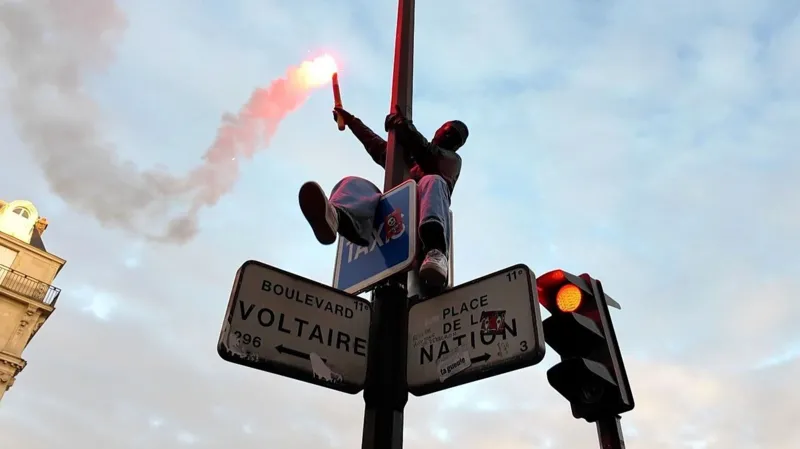
France is in turmoil. Public debt is crippling, the president is a lame duck with six months left in office, and social unrest has erupted into looting and violence. This Saturday marked the sixth weekend in a row of demonstrations against soaring prices, worsening public services and alleged police brutality. Violence by protesters is down on last month, but it is still present.
President Emmanuel Macron has publicly blamed the riots on delinquents and ultra-left groups whose aim, he says, is to bring down the French Republic. That is quite a claim, and one that needs examining. The unrest has become a political football ahead of key presidential and parliamentary elections next year. The left blames the centre and right for the cost-of-living crisis that has made French people so angry. They blame the hard left for fomenting violence, which it denies. The nationalist right pledges, if elected, to return order and security to the streets.
So who exactly are these ultra-left groups Macron speaks of? And how organised and dangerous are they? It is infamously hard to speak to members of the radical left. They do not much like what they call the mainstream media, viewed as part of an establishment many of them despise. My best bet was to head out into the protests and approach people dressed in all black and ski masks or balaclavas, worn, they say, to hide their identity from police. It is a quasi-uniform associated with left-wing rioters, known as the Black Block.
You see them at demonstrations all over Europe. In France, they tend to appear from city side streets as daytime protests die down, dusk falls and riot police emerge in full force. French intelligence drastically underestimated the outpouring of anger, looting and destruction following protests last month. More than 1,000 police officers were reportedly injured, young protesters had bones broken and two reportedly lost a hand in altercations with officers armed with stun grenades. Le Monde is constantly updating an article investigating a rising number of reports of protester injuries. The French Insurers Federation estimates damages to shops and private property on 17 October alone, the day of the biggest riots, at around €207m.
Since then, the authorities have tried to tightly manage demonstrations. Police presence is heavy. Protesters say it is heavy-handed. Towards the end of one protest this month, we saw would-be rioters vastly outnumbered, glass bottles and homemade paint bombs at the ready to throw at police. They were no match for the batons, stun grenades and tear gas the officers had to hand.
As we were being forcefully kettled in by police, I tried to talk to would-be rioters. Few wanted to engage, but I then met 18-year-old Nas, not his real name, and his friends. They would only speak if they could hide their identity, to avoid police detection. Milling, you could say provocatively, by baton-at-the-ready police, they seemed to fit a radical-left rioter stereotype. How could they justify the violence? Without violence, you don't achieve anything, one of them tells me. It is the only way to get our voices heard. We come from an area with a bad reputation, he says. Our schools are a mess, our teachers quit. You need qualifications to get a decent job. There is supposed to be equality in France. We won't give up our fight.
These young men, we discover, come from the sprawling housing estates common on French city outskirts, the banlieues, associated with deprivation, unrest and second or third generation immigrant families. They were not politicised or organised by the radical left, they insisted. Just angry.
Earlier, I had spotted two hard-left student activists standing masked on top of a bus shelter above the thronging crowd, waving banners sporting the red anarchist sign and the symbol of the Antifa movement. I put it to them that France has a proud tradition of respect for the right to protest, but that the country has been horrified by the violence of recent weeks. They were keen to downplay the rioting but again would only speak anonymously. Violence reflects badly on our movements, one said. We don't like it. But what is a smashed shop window compared to police using stun guns on protesting school kids? People are regularly going cold and hungry. They are losing faith in this society. How could they believe violence would bring about a juster society, I wondered? They shrug off my question. In France, these days, the real violence is state violence, they say.
French intelligence estimates there are 5,000 ultra-left activists in the country. Anticapitalist Starflix, his codename, counts himself as one of them. The 17-year-old is also a member of the violent Black Block movement. We had arranged to meet on the edge of the protest, by a narrow canal. Fearful of being apprehended by police, he asked to remain anonymous. He showed me a couple of homemade paint bombs, eggshells filled with paint and sealed with medical tape, that he throws at police officers. He carries them in his rucksack, wrapped in a royal blue Italia football shirt. We throw the paint bombs at the visors on riot police helmets, so they have to lift them up to see and suffer their own tear gas, he tells me. We pick up stones and rocks too. Anything we find on the streets of Paris, to throw.
I put it to him that he and others in the Black Block are causing a lot of problems: damaging businesses, hurting police officers, destroying demonstrations for peaceful protesters. What is he trying to achieve? As he is under 18, his parents gave us permission to speak to him. They share his politics, Starflix tells me, but not all rioters do. The Black Block is not a single organisation, he says. It is a technique. Some of us use violence to get government reform. I want to bring about a revolution. Other people are opportunists who use anonymity to steal things. When we all wear the same clothes, it makes it harder for police to identify us. When I ask if he is scared he might get hurt or arrested, he admits he is, but says what frightens him more is the thought that society might not change.
Social media plays a huge role in the riots. Starflix tells me he and his friends use Signal and Telegram to arrange to meet at protests. There are numerous websites and Instagram profiles, mainly hosted by left-wing organisations, offering tips for protesters and rioters: keep your phone at home so police cannot track you, cover your face to avoid being identified, and emulate Bruce Lee and be like water, appearing and disappearing into crowds. That is advice passed on by the Hong Kong protesters eight years ago. While not formally organising the protests or violence with these posts, could the fact groups host this information online be viewed as a kind of incitement or manipulation of youngsters whose feelings are running so high? All the young rioters I spoke to insist they are not being herded or directed, but is there something bigger behind what is happening?
It takes our team a long time, but they manage to find a seasoned activist with the Black Block who would speak to us. I put to him Macron's assertion that the ultra-left has organised groups that aim to bring down the French Republic. Is that true? It is totally false of the authorities to say we are all organised, and the intelligence services know it, the activist scoffs. It is a manipulation of the French public to make them think there is an enemy within. Basically, people turn up to a protest, get dressed in black and do their own thing. The uniting factor is rage, and not just in France. You see the same rage in Italy, Germany, Spain. It is exploding by itself.
I ask if the anti-capitalist presidential candidate Jean-Luc Mélenchon and his France Unbowed party are somehow linked to the violence. They are present at most protests, supporters handing out campaign pamphlets to the chanting crowds. But the activist denies this, telling me Mélenchon is a capitalist because he is part of the system. He says the party and the trade unions try to calm unrest, while he believes things need to be stepped up a notch. Why had he decided to talk to us, I ask. Does he want to collapse the French government? I just want to say we don't love violence, he says. I don't want to destroy France. We want to destroy a system that is a capitalist system, of course, but to change society in a way that we think will be better for the most people. More and more find it hard to make ends meet. In the countryside, people cannot even afford to fill their tank with petrol.
You have to leave the city, heading out into the gloriously autumnal French countryside, to meet some of the more organised, hardcore elements of the ultra-left. This is a world of eco-activism and known saboteurs. One man remains in police custody linked to the fire during protests at Limoges Town Hall last month. The devastated, yet somehow still elegant, 19th century building has become a symbol of the current state France appears to be in. An acrid smell still hangs in the air one month on. The 34-year-old arson suspect, who insists he is innocent, comes from a hamlet near Limoges known for its anarchist, environmentalist community. His father, a fellow activist, is also known to French intelligence. We approached the father and the suspect's lawyer for comment. They did not want to speak.
Instead, we met a 39-year-old father of one, a local full-time ultra-left activist for more than two decades. Like the other individuals we spoke to for this investigation, he would only talk on condition he could remain anonymous. We were all shocked by the fire, even as we watched it happen in front of us, but it is our duty to take action, he tells me. I cannot leave this world to my son in the state that it is in. Look how military vehicles and brute force are used by the state against our young students. It is amazing the people haven't taken up arms against them. Do we need a policeman killed in order for the state to listen? How can you say that, I want to know? As a child, I was educated with French values, liberty, equality, fraternity, but when I look at the social injustice in the world now, I am disgusted. As a father, I cannot let this go on. If I have to, I would take a bullet to protect the youth of this country.
These are dangerous-sounding words, but the radical left does not appear to be big, armed or united enough to seriously threaten France. We repeatedly approached French intelligence. They did not want to comment, a sign perhaps of the huge sensitivity of the current situation, especially with France hurtling towards an extremely charged presidential election. But Michel Klein, a recently retired former police commissioner, told me he did not think the radical left posed a serious threat to the French state. I believe there is a will from the radical left and the anarchists to try to destroy the Republic, but they obviously do not have the means to do it, he said. He sees no risk of civil war in France, a possibility some in the country discuss these days, but he identified a rising risk of clashes between far-left and far-right groups ahead of the presidential election.
Polls currently predict a run-off between the nationalist candidate Marine Le Pen and the anticapitalist Mélenchon. Far-right vigilante groups have begun appearing on the edge of protests in a number of cities across France to protect French streets, they say. Mélenchon attends most demonstrations, his supporters handing political pamphlets to the chanting crowds, but he denies any links with violence. France is so polarised that there is little sign next year's presidential vote will calm things. This turbulent mix of left and right, social and political unrest, feels like a perfect storm.