Four in Five Lakes Gone: Scientists Battle to Protect Turkey's Wetlands
With four out of five of Turkey's lakes already dried up, a small team of ecologists is racing to protect the wetlands of the east, a crucial stopover for migratory birds travelling between Africa and Eurasia.
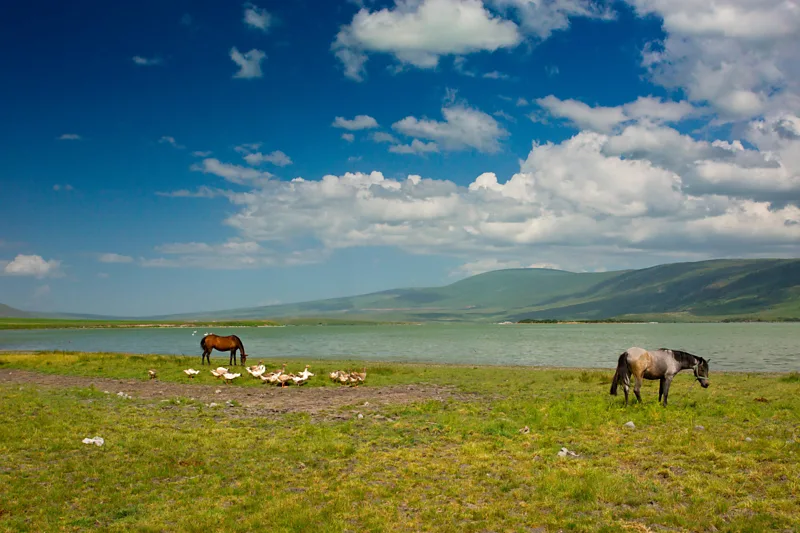
In the middle of an icy drizzle on a cold day in October, Çağan Hakkı Şekercioğlu stands at the edge of Lake Aktaş with his binoculars, watching the birds. The lake sprawls across the Turkish-Georgian border. On this grey and quiet morning it is thickly dotted with birds, just visible through the mist. Şekercioğlu spots coots, pelicans, and even a sociable plover, a critically endangered species. "This is the last lake in Turkey remaining where both Dalmatian pelicans and great white pelicans still come," he says.
Within sight of Lake Aktaş is the village of Kenarbel, little more than a few stone houses with tin roofs and nearby fields of mud and cows. Within sight, too, is a military base watching over this hinterland that once formed part of the border between Nato and the Soviet Union. It now serves as one of several entry points for locals hoping to cross into Georgia for cheaper wine and cigarettes. The base is what keeps villagers from boating on the lake, picnicking on its islands and disturbing its lush collection of migratory birds.
This corner of northeastern Turkey is one of the most important migratory bird sanctuaries not only in the country but in the world. The birds of the region represent 68% of all bird species found in Turkey. Yet these crucial wetlands are drying, and fast. With four in five of Turkey's lakes already gone, Şekercioğlu and a small team of ecologists are racing to save this last bastion for the world's birds.
When a nearby road leading to the Georgian border was being planned, Şekercioğlu and his team worried the noise would disturb the birds and proposed building it a mile from the lake. They also suggested that, if the road had to be closer, barriers would reduce the visual and noise pollution while directing birds to fly high enough to avoid cars. The government agreed, and the barriers were built. "This is one of the few happy stories about bird conservation," says Şekercioğlu.
Şekercioğlu is a conservation ecologist, ornithologist, tropical biologist and wildlife photographer — a force of nature himself. He founded KuzeyDoğa Derneği, an organisation dedicated to monitoring and saving the birds, lakes and wetlands of this wild frontier. His work juggles local politics, complicated international borders, DIY dams and global climate change to protect one region's wetlands and migratory birds. In 2006 he and KuzeyDoğa opened the Aras Research Station along the Caucasus-Eurasian bird migration route, the first bird migration research station in eastern Turkey.
Many of the world's lakes and wetlands are under threat of drying up, and the birds Şekercioğlu spots in eastern Turkey are migratory, winged travellers who transcend borders. The lakes of the east are just one stop on a global journey connecting the land to the vast ecosystem throughout Europe and Africa. Nearly two-thirds of the world's bird species are in decline. In Turkey, many species depend on wetlands — and the country is at risk of entering severe drought by 2030. Some 88% of Turkey is at risk of desertification, including the bird-rich wetlands in the east.
The evidence is already stark. Of Turkey's 240 lakes, 186 have dried up, and more are poised to follow. Nearly 80% of the country's water resources are being extracted. It is a local problem within the tapestry of a larger global one. Şekercioğlu is attempting to mitigate it as well as one small organisation can, in one of the region's most bird-rich areas and an important breeding stop for birds flying between Africa and Eurasia.
While Lake Aktaş is protected by the border that bisects it, nearby Lake Kuyucuk has not been so fortunate. Once, this lake, 77km south of Lake Aktaş and not far from the Armenian border, was a paradise for birds. Şekercioğlu first came to Lake Kuyucuk in 2004 on a butterfly expedition and was bowled over by the wealth of migratory birds alighting on the water. "We counted over 40,000 birds on 2.2 sq km, half of which were ruddy shelduck," he says. "And at the time, the estimated population of ruddy shelduck was 170,000 globally. So 12% of the world's population [was] on this one little lake."
But trouble was brewing. Every year, Şekercioğlu and his team measured the lake's water depth and shoreline, and in 2010 they noticed that levels were rapidly decreasing. In 1997 the lake was 13m deep, and when Şekercioğlu began his work it measured 4.5m. By 2010 it was 1m deep at its deepest point. "That's when I realised the lake is really going down," he says. "I never thought it would disappear, but I thought, 'Okay, this is serious.'"
It was a combination of causes, not one. Small, makeshift dams villagers had set up on the streams feeding the lake siphoned off water for their livestock. Illegal wells drained the groundwater. By watering their animals, they were slowly drawing away the water meant for the birds. The name Kuyucuk, ironically, means "little well", and there are centuries-old wells around the lake that also tap the underground water.
Şekercioğlu set about trying to save the lake himself. He convinced the governor to drill a well to pump water back in — "like chemotherapy", he says; an emergency measure, not a sustainable one, and feasible only because the lake is just 2 sq km. Simultaneously, he and his team worked with local villagers to convince them to take down the illegal dams blocking the lake's feeding streams, which now remain unimpeded. "It's not a lake anymore, but it's a wetland, and it hasn't just turned into dust," says Şekercioğlu. "That's how it is with conservation. I just have to keep hoping and keep trying."
Now Şekercioğlu and his team keep watch on the hinterlands. While the Georgian-Turkish border protects Lake Aktaş, the currently closed Armenian-Turkish land border has kept the area around Lake Kuyucuk quiet. But there is talk of opening that border, and the shortest route between Armenia and Turkey would cut right through the wetlands of Lake Kuyucuk.
Şekercioğlu had originally planned to establish a bird monitoring outpost at Lake Kuyucuk, but as the lake diminished a new location had to be found. Farther along the border, deep in nearby Iğdır Province, he established the Aras Bird Monitoring Station by the Aras River in 2006, the first of its kind in Turkey. For six months of the year, a crew of shaggy volunteers catch and tag birds daily.
The station sits on the Aras wetland, and the crew head out to check special collection nets every hour, suited up in knee-high rubber waders caked with a thin layer of dried dun-coloured mud. They return with bags twittering and wiggling with live birds, which are then efficiently tagged, measured, identified and released. Aras is the only place doing this kind of work in eastern Turkey. All the data is neatly entered before the birds are released out of the window, back to their wild life. The walls of the tiny station are covered with Şekercioğlu's macro bird photography and handwritten signs declaring "JUST FOR THE BIRDS!", referring to the hooks for the bird bags.
The team of bird-banding volunteers have found their way to this flank of eastern Turkey for different reasons and from different locations, each bringing radiant individuality to a repetitive task. Maxim Kostin chases rare dragonflies. Hasan Can Bağ writes short stories. Guşef Tunçer studies architecture. Ayşenur Akgün makes rosehip jam. Ayşenur is also the station's bird ringer, responsible for slipping the small band tags on each bird's leg, and one of the few certified bird ringers in Turkey. The first was, of course, Şekercioğlu.
The birds have their individualities too, and that is what Ayşenur and the team aim to record: wing length, weight, sex, species. On one brisk autumn day they bag European stonechats, mountain chiffchaffs, meadow pipits and many more twittering specimens. They sit quietly restrained in Ayşenur's hand as she gathers her data and bands the birds.
The work at Aras is important and necessary, but fieldwork has already begun on the nearby Tuzluca Storage Dam project, which would decimate the delicate ecosystem that draws these migratory birds. The construction camp has been built, though construction of the dam itself has not yet begun. KuzeyDoğa Derneği has been trying to negotiate, receiving an agreement that two villages would be spared, though current plans would still inundate three villages and the bird banding station. "The construction process will take five years so we are continuing to talk, negotiate and hope it won't happen but legally, we cannot do anything," says Şekercioğlu.
The local government's branch manager of nature conservation and national parks told the BBC: "We did do the necessary [environmental] work. We looked at similar project and what they did. There were specific people working to make sure birds don't get harmed. We then decided to make artificial islands. There would be these and also the dam would then create its own new system where all animals are living."
This is the story of eastern Turkey's water and birds: a constant back-and-forth between bureaucracy and conservation, between climate change and human infrastructure, between the protection of international borders and the threat of the same. "The lakes naturally disappear over time, because people always want more water, and when nature competes with people for water, nature will lose," says Şekercioğlu. "Telling people, 'I'm saving this water for the ducks' is not going to get you the most votes, you're going to lose."
In the quiet of morning, a heron perches on the edge of the bank, a magpie flits across the sky, a cormorant swoops. Eastern Turkey's paradise of birds continues on, unbothered by the small problems of the people below, unaware that down here, the choices we make might drain them dry.