Former Autostrade chief jailed for 12 years over Genoa bridge collapse
Giovanni Castellucci, former head of Autostrade per l'Italia, was among 32 defendants found guilty over the 2018 collapse, in a verdict that exposed deep fault lines in Italy's infrastructure and justice systems.
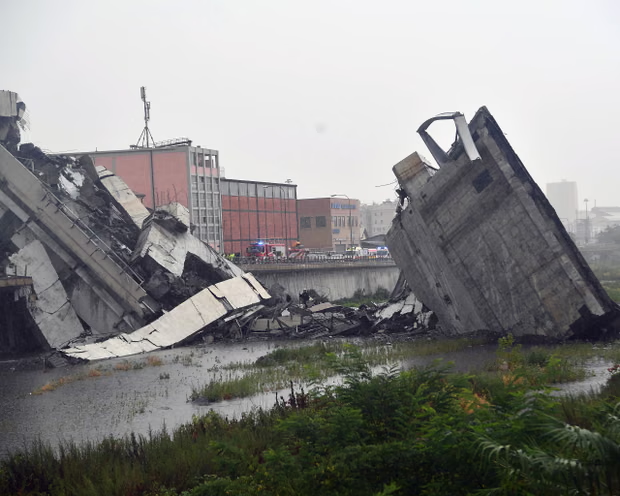
In a hushed courtroom in the north-western Italian city of Genoa on Thursday, Giovanni Castellucci, the former chief executive of Autostrade per l'Italia, was sentenced to 12 years in prison, the most severe penalty handed down in a case arising from the catastrophic collapse of the Morandi Bridge in 2018, a disaster that claimed 43 lives and sent shockwaves through the nation. The verdict, delivered to a packed chamber containing approximately 400 relatives of the victims, lawyers, journalists, and members of the public, marked the culmination of a trial that had become both a search for accountability over one of Italy's worst infrastructure catastrophes and a testing ground for the country's notoriously sluggish judicial system. Castellucci, who stood trial alongside 56 other defendants, was convicted of complicity in multiple counts of manslaughter through negligence, a ruling that his legal team immediately signalled they would appeal, with his lawyers asserting that as chief executive their client had relied upon the expertise of Italy's leading engineers and describing the outcome as "a defeat for the truth". The collapse of the 51-year-old viaduct, in which a 50-metre section fell away during a summer storm, sending vehicles plunging on to warehouses and a riverbed below, stunned the country and exposed profound anxieties regarding the safety of Italy's ageing infrastructure, a concern that has only intensified in the years since.
As the judge read out the verdicts, a profound silence descended upon the courtroom, broken only by the embraces and tears of some relatives, while others, such as Egle Possetti, a spokesperson for the victims who lost her sister, brother-in-law, and her sister's two children in the tragedy, told Reuters that they required time to fully comprehend the court's decision. "We need to better understand the ruling; there are a large number of defendants involved," Ms Possetti said, reflecting the complexity of a case in which all of the accused had denied wrongdoing, and which ultimately saw 32 individuals convicted with sentences ranging from one year and 11 months to 12 years, while others were either acquitted or saw lesser charges expire under the statute of limitations. Prosecutors had argued that years of neglected maintenance, ignored warning signs, and repeated delays to safety works had contributed directly to the collapse, contending that essential repairs were postponed while the motorway operator continued to generate and distribute substantial profits to its shareholders. The defence, however, rejected these contentions, maintaining that the disaster was attributable to a fatal flaw in the bridge's original design – specifically the failure of stay cable No 9 – and that no maintenance programme, however rigorous, could have averted the tragedy, a line of argument that ultimately failed to persuade the court in a significant number of cases.
In a statement released after the verdicts were announced, Castellucci's lawyers struck a measured but defiant tone, acknowledging the immense suffering caused by the Genoa tragedy while insisting that justice must remain anchored to individual responsibility rather than the pursuit of a scapegoat. "The suffering caused by the Genoa tragedy is immense and deserves respect. But the gravity of the event requires justice to remain based on individual responsibility, not the search for a scapegoat," the statement read, a sentiment that will likely form the basis of their appeal. The disaster also precipitated a political battle over control of Italy's motorway network, culminating in the Benetton family relinquishing its controlling stake in Autostrade per l'Italia, a development that underscored the far-reaching consequences of the collapse beyond the immediate human toll. The remains of the Morandi Bridge have since been demolished and replaced by the Genoa San Giorgio Bridge, a structure designed by the Genoa-born architect Renzo Piano, who donated the project to his home town, with the new bridge, opened in August 2020, featuring sail-shaped elements inspired by the city's maritime heritage. As the victims' relatives begin to process the outcome of a trial that has laid bare the failings of both infrastructure oversight and judicial expediency, the legacy of the Morandi Bridge collapse continues to resonate, serving as a sombre reminder of the price exacted by neglect and the enduring quest for justice in the face of profound loss.