FIFA accused of buckling to political pressure after US striker’s suspension overturned
The president’s personal appeal to FIFA’s president secured the reinstatement of the American forward, but the decision has triggered accusations of favouritism and raised troubling questions about political interference in the tournament.
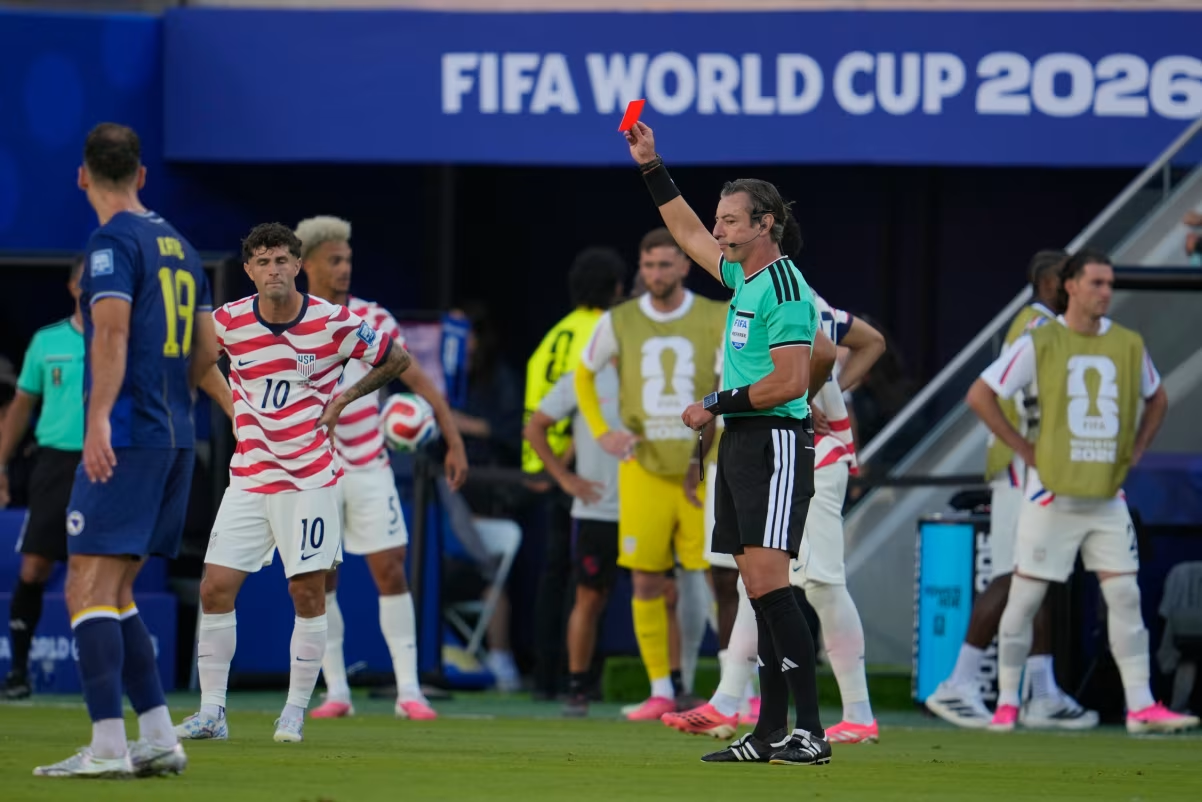
For the best part of 24 days, the World Cup appeared to have accomplished a rare feat on American soil: it had remained almost entirely untouched by the gravitational pull of Donald Trump. That improbable state of affairs came to an abrupt end, however, following an extraordinary intervention by the president that has plunged the tournament into a dispute over political interference and the integrity of the sport’s governing body. In a dramatic twist, it was confirmed on the eve of Monday’s knockout clash between the United States and Belgium that Folarin Balogun, the team’s leading goalscorer, would be available for selection despite having been sent off in the previous match and handed an automatic one-game suspension, after Trump personally appealed to FIFA to review the decision.
The president, who has long cast himself as a champion of American exceptionalism and a scourge of what he perceives as bureaucratic injustice, took to his Truth Social platform on Sunday to celebrate the reversal, declaring: “Thank you to FIFA for doing what was right, and reversing a great injustice! President DONALD J. TRUMP.” He added further rhetorical fuel to the controversy on Monday, confirming from the Oval Office that he had placed a call to Gianni Infantino, the FIFA president, requesting that the suspension be re-examined. Mr Trump was careful to frame his intervention as a request rather than a demand, stating, “I didn’t say, ‘You have to do this’,” while simultaneously suggesting that he did not believe Balogun’s offence had even constituted a foul in the first instance.
The reprieve granted to the 24-year-old Monaco forward has sent shockwaves through global football, reigniting long-held suspicions about the cosy relationship between the American president and the FIFA supremo. The decision, which followed Mr Trump’s direct appeal to Infantino, has transformed what might otherwise have been a routine controversy over refereeing into an international incident with potentially far-reaching consequences for the world’s most popular sporting showcase. Critics have expressed concern that the episode, regardless of whether the president’s muscling was decisive, has created the damaging impression that political pressure can sway the sport’s disciplinary processes, a perception that risks souring global perceptions of a tournament that had until now generated remarkably positive headlines.
Controversy is, of course, an enduring feature of World Cup finals; few supporters will have forgotten Diego Maradona’s infamous “hand of God” goal for Argentina in 1986 or Zinedine Zidane’s notorious headbutt on Marco Materazzi in the 2006 final. Yet there is no known precedent for a political leader intervening to influence the selection of players for a match, particularly one of such consequence to a host nation’s prospects of progressing in the competition. The hyperpartisan nature of football fandom in the United States suggests that many domestic supporters may prove indifferent to the manner in which Balogun secured his place in the starting lineup in Seattle on Monday. Abroad, however, the reaction has been markedly less forgiving.
The Royal Belgian Football Federation issued a statement pre-match indicating that the pregame machinations contravened FIFA’s own regulations and prejudiced the principle of fair play. The national team’s coach, speaking to reporters, confirmed that the federation would act not merely to defend national honour but to defend “football in general. It defends its integrity. It defends its ethics.” On Monday, the federation added that it was formally challenging Balogun’s availability, while simultaneously accusing FIFA of a troubling lack of transparency over the decision. The international reverberations escalated further when UEFA, the governing body of European football, issued a statement warning that the suspension of the ban threatened the tournament’s reputation. “When the certainty of rules is no longer guaranteed by its guardians, the integrity of the game is at stake and the credibility of a competition is undermined,” the organisation declared.
The controversy is now all but certain to render Monday night’s encounter between the United States and Belgium an even more compelling spectacle, and should the home side emerge victorious, many American fans will likely remain unconcerned by the off-field rules dispute. It would nevertheless be unfortunate, the broader football community has suggested, if the incident were to detract from what has otherwise been an ebullient World Cup, with supporters outside the United States potentially viewing an American triumph through the distorting lens of an asterisk. In isolation, there are reasonable grounds for believing that Balogun received a raw deal when he was dismissed during the national team’s victory over Bosnia and Herzegovina last week. The referee did not immediately order his departure, but following a video assistant referee review, ruled that the forward had committed a serious foul. At full speed, the clash with Bosnian defender Tarik Muharemović appeared innocuous; when slowed down, however, Balogun’s foot was seen to rake down the back of his opponent’s leg, twisting his ankle into a hideous position.
Many observers argued that Balogun was merely the latest player to be disadvantaged by the VAR system, contending that he had harboured no intent to injure Muharemović and that such clashes often appear far worse in slow motion. It is possible to conclude that Balogun was unlucky, yet also to acknowledge that under FIFA’s current standards, the challenge was deemed to merit a red card. Similar challenges are seen weekly in top European professional leagues and frequently result in dismissals. On the other hand, it remains difficult to comprehend why Balogun received his marching orders while Lionel Messi escaped punishment for a comparable challenge in Argentina’s opening match. What has raised alarms, however, is FIFA’s response to the incident and Mr Trump’s decision to become involved.
Immediately after the game, FIFA had made clear that the American team had no route to appeal the suspension and that Balogun would be unavailable for the Seattle fixture, a significant blow given his status as the team’s top scorer. The governing body’s announcement on Sunday overturning that suspension offered scant explanation, fuelling criticism that an exception had been made for the American star following the president’s complaint. The FIFA disciplinary committee invoked Article 27 of its code, which permits the full or partial suspension of a disciplinary measure under a probationary period. The red card remains in place; should Balogun commit another offence, the suspension will be restored, alongside potential new penalties. This was not the first instance of FIFA deploying the clause, having previously faced accusations of favouritism towards a box-office player when it allowed Portugal’s Cristiano Ronaldo to play in the preliminary rounds of these finals despite facing suspensions for a red card in a qualifying game.
It was perhaps almost inevitable that Mr Trump, who has compared the World Cup to multiple simultaneous Super Bowls and who has seldom resisted the allure of a global spotlight, would find a way to insert himself into the proceedings. He had largely taken a back seat during the early-round matches, appearing more preoccupied with the 250th anniversary celebrations of the Declaration of Independence, an event for which critics claimed he had also intervened excessively. The Balogun incident, however, proved too tempting to ignore. The president is a devoted and knowledgeable sports fan who has frequently used the crucible of sport to advance his political and cultural war themes, or as a forum to display his own power. Earlier this year, he celebrated the United States men’s ice hockey team’s victory over Canada in the Winter Olympics as proof that America was “winning again” under his leadership, injecting a partisan note into what had been a unifying national moment.
Mr Trump’s political career has demonstrated that he hardly regards rules as an impediment; it is winning that counts, rather than the manner in which victory is achieved. A source familiar with the matter confirmed to CNN on Sunday that the president had spoken with Infantino after Balogun’s red card and requested that the call be reviewed. The two men have cultivated something of a bromance, with the FIFA chief’s support often appearing as a direct political endorsement of a hugely controversial president. Infantino is frequently seen at Mr Trump’s side, having even appeared at a Gaza peace summit in Egypt last year. Following the president’s second-term inaugural rally, Infantino declared on Instagram: “Together, we will make not only America great again, but also the entire world.” The FIFA chief has long faced political scrutiny, having had to answer for alleged human rights abuses in the building of stadiums in Qatar before the last World Cup finals, and for the decision to award the 2034 finals to authoritarian Saudi Arabia. His critics were further discomfited when he awarded Mr Trump the inaugural FIFA Peace Prize after the president failed to secure the Nobel equivalent.
Infantino has consistently argued that it is critical for the head of FIFA to maintain cordial ties with the leader of a host nation, yet the chumminess with the Trump administration is particularly notable given that the US government, including the FBI, the Justice Department and the IRS, was instrumental in exposing FIFA’s biggest corruption scandal in 2015. With the precedent now set, it is unclear whether other powerful world leaders might be emboldened to seek political advantage by pressuring FIFA over on-field incidents. Every controversial challenge for the remainder of the World Cup is now set to face intense scrutiny; if FIFA has invoked its hazy powers to suspend the Balogun ban, it is not unreasonable to ask whether it is now honour-bound to do so for any player from any other nation. That issue erupted on Sunday night after England defender Jarell Quansah was also sent off following a VAR review and, under FIFA rules, now faces a one-game suspension.
There was another blockbuster story on Sunday, when Brazil were eliminated from the tournament thanks to a brace from Norway’s towering striker Erling Haaland. But the furore stirred by the tale of Trump and the American goalscorer has raised the damaging spectre that events off the pitch, as much as those upon it, may now shape the destiny of the golden trophy the president is expected to award in two weeks’ time. It is a sorry development for a tournament that had previously offered a welcome diversion from the fractious divisions of American political life.